


Clinical Outcomes and Live Birth Rate Resulted From Microdissection Testicular Sperm Extraction With ICSI-IVF in Non-Obstructive Azoospermia: A Single-Center Cohort Study
- PMID: 35813616
- PMCID: PMC9259991
- DOI: 10.3389/fendo.2022.893679
Clinical Outcomes and Live Birth Rate Resulted From Microdissection Testicular Sperm Extraction With ICSI-IVF in Non-Obstructive Azoospermia: A Single-Center Cohort Study
Abstract
Background: Most of data available in the literature reported the sperm retrieval rate and limited intracytoplasmic sperm injection (ICSI) results of microdissection testicular sperm extraction (micro-TESE) in non-obstructive azoospermia (NOA) patients with different etiologies. Unfortunately, there is currently a lack of comprehensive data to guide clinicians in conducting comprehensive consultations with NOA patients.
Objectives: To obtain more comprehensive evidence-based data and clinical outcomes for better consultation of NOA patients who opted to undergo micro-TESE combined with ICSI-IVF.
Methods: It was a retrospective study involved 968 NOA patients underwent micro-TESE during January 2015 to December 2019. Embryological, clinical, and live birth outcomes were demonstrated comprehensively and three kinds of stratification analyses were performed based on ICSI-IVF cycles using frozen and fresh sperm, different etiologies of NOA and various amounts of sperm retrieved.
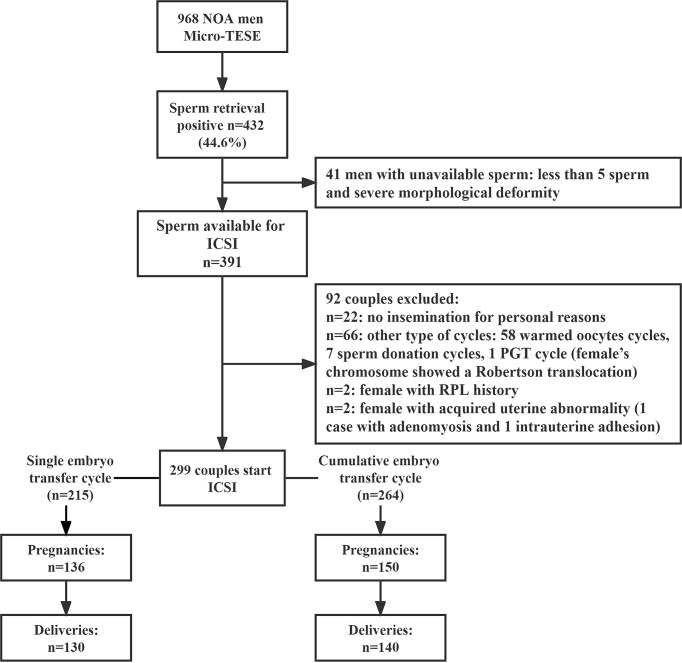
Results: The sperm retrieval rate was 44.6%, and ICSI was performed in 299 couples leading to 150 clinical pregnancies and 140 live-birth deliveries. The clinical pregnancy rate (CPR) was 50.17%, and the cumulative live birth rate (LBR) was 46.82%, and the low birth defects rate was 1.43%. No significant difference was observed about cumulative LBR in frozen sperm group and fresh sperm group (47.5% vs 42.9%, P>0.05). NOA patients with AZFc microdeletions had the lowest rate of a high-score embryo on day 3 (4.4%, P<0.05) and the lowest cumulative LBR (19.4%, P<0.05). NOA patients with lower sperm count (having fewer than 20 sperms retrieved) had significantly lower cumulative LBR than those with higher sperm count (having more than 20 sperms retrieved) (28.1% vs 51.9%, P<0.05).
Conclusions: For those NOA patients who stepped in ICSI-IVF cycles, the cumulative LBR was 46.82%. No significant difference was indicated in the LBR between ICSI-IVF cycles using frozen or fresh testicular sperm. Compared to other etiologies, NOA caused by AZFc microdeletions have the poorest embryological and clinical outcomes. Patients with less testicular sperm retrieved have poorer embryological and clinical outcomes.
Keywords: intracytoplasmic sperm injection; live birth rate; microdissection testicular sperm extraction; non-obstructive azoospermia; pregnancy rate; testicular sperm.
Copyright © 2022 Lan, Zheng, Fu, Peng, Liao, Liu, Liu and An.
Conflict of interest statement
The authors declare that the research was conducted in the absence of any commercial or financial relationships that could be construed as a potential conflict of interest.
References
-
- Shenfield F, Doyle P, Valentine A, Steele SJ, Tan SL. Effects of Age, Gravidity and Male Infertility Status on Cumulative Conception Rates Following Artificial Insemination With Cryopreserved Donor Semen: Analysis of 2998 Cycles of Treatment in One Centre Over 10 Years. Hum Reprod (1993) 8(1):60–4. doi: 10.1093/oxfordjournals.humrep.a137875 - DOI - PubMed
Publication types
MeSH terms
Supplementary concepts
LinkOut - more resources
Full Text Sources
