


Injury surveillance in community cricket: A new inning for South Africa
- PMID: 35814045
- PMCID: PMC9257739
- DOI: 10.4102/sajp.v78i1.1756
Injury surveillance in community cricket: A new inning for South Africa
Erratum in
-
Erratum: Injury surveillance in community cricket: A new innings for South Africa.S Afr J Physiother. 2022 Aug 31;78(1):1815. doi: 10.4102/sajp.v78i1.1815. eCollection 2022. S Afr J Physiother. 2022. PMID: 36092965 Free PMC article.
Abstract
Published injury rates amongst elite and club-level youth cricketers highlight the need to implement injury risk-reducing strategies amongst the youth cricketing population. Data from sports injury surveillance systems are a prerequisite for the development and evaluation of strategies to reduce injury risk. Therefore, collecting injury surveillance data is a positive move towards reducing injuries in cricket. In South Africa, a systematic, standardised, evidence-informed injury surveillance system currently does not exist for community levels of play, namely, in cricket-playing high schools and cricket clubs. Although injury surveillance systems exist at elite levels, the obvious differences in elite versus community cricket settings mean that these systems cannot be implemented in their current form at community-level cricket. An innovative model is required to implement an injury surveillance system in community cricket.
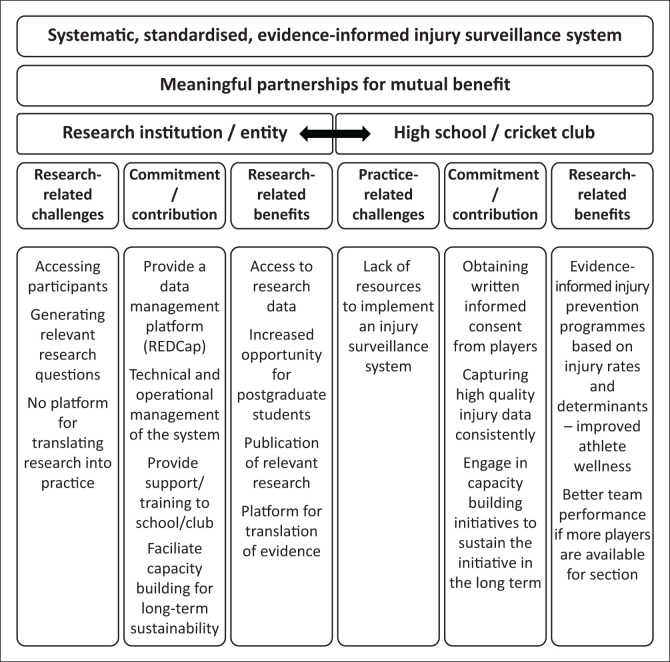
Clinical implications: This article proposes and describes a new research-practice partnership model to implement a systematic, standardised, evidence-informed injury surveillance system at cricket-playing high schools or cricket clubs within South Africa. Once this model has been employed, database systems will need to be established to allow long-term data management and sharing.
Keywords: cricket; data management; injury prevention; injury risk reduction; injury surveillance; sports.
© 2022. The Authors.
Conflict of interest statement
The authors declare that they have no financial or personal relationships that may have inappropriately influenced them in writing this article.
Figures
References
-
- Bahr, R., Clarsen, B., Derman, W., Dvorak, J., Emery, C.A., Finch, C.F., et al. , 2020, ‘International Olympic Committee consensus statement: Methods for recording and reporting of epidemiological data on injury and illness in sport 2020 (including STROBE Extension for Sport Injury and Illness Surveillance (STROBE-SIIS))’, British Journal of Sports Medicine 54(7), 372. 10.1136/bjsports-2019-101969 - DOI - PMC - PubMed
-
- Bromley, S., Drew, M., Talpey, S., Mcintosh, A. & Finch, C., 2018, ‘Collecting health and exposure data in Australian Olympic combat sports: Feasibility study utilizing an electronic system’, Journal of Medical Internet Research Human Factors 5(4), e27. 10.2196/humanfactors.9541 - DOI - PMC - PubMed
-
- Dhillon, M., Garg, B., Dhillon, S. & Prabhakar, S., 2016, ‘Problems of injury surveillance and documentation in cricket: Indian experience’, Journal of Postgraduate Medicine Education and Research 50(3), 148–150. 10.5005/jp-journals-10028-1208 - DOI
-
- Donaldson, A. & Finch, C., 2012, ‘Planning for implementation and translation: seek first to understand the end-users’ perspectives’, BMJ Publishing Group Ltd and British Association of Sport and Exercise Medicine. - PubMed
-
- Donaldson, A., Gabbe, B.J., Lloyd, D.G., Cook, J. & Finch, C.F., 2019, ‘Controlled ecological evaluation of an implemented exercise training programme to prevent lower limb injuries in sport: Differences in implementation activity’, Injury Prevention 25(6), 480–486. 10.1136/injuryprev-2017-042579 - DOI - PMC - PubMed
LinkOut - more resources
Full Text Sources