


Interpersonal Relationship Stress Brings on Social Networking Sites Addiction Among Chinese Undergraduate Students
- PMID: 35814166
- PMCID: PMC9257127
- DOI: 10.3389/fpsyg.2022.905971
Interpersonal Relationship Stress Brings on Social Networking Sites Addiction Among Chinese Undergraduate Students
Abstract
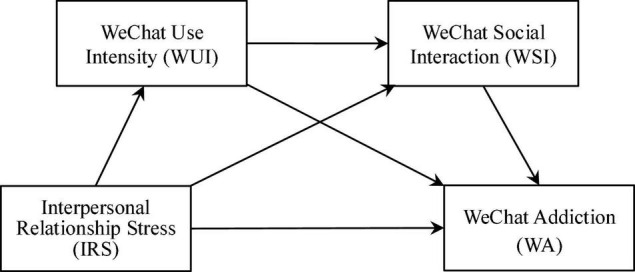
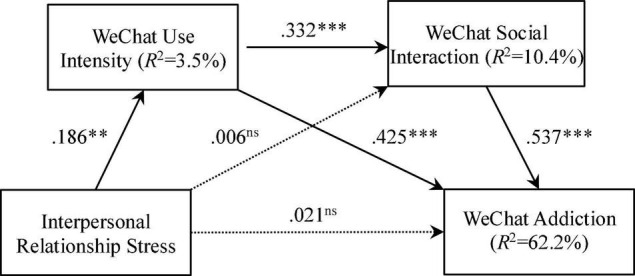
The adverse effects of life stress on social networking sites addiction are increasingly recognized, but so far there is little evidence on how and which specific types of life stress are conducive to the addictive behavior. Interpersonal relationship stress being the main source of stress for undergraduates, the purpose of the current paper is thus to delve into whether perceived stress in interpersonal relationships significantly leads to WeChat addiction and, if so, how this type of stress drives the excessive use of WeChat. The data was collected from self-report questionnaires completed by 463 Chinese undergraduate students and then analyzed with structural equation modeling. The results revealed that the positive association between WeChat users' interpersonal relationship stress and addictive behavior is fully and sequentially mediated by WeChat use intensity and social interaction. More specifically, accumulation of stress in interpersonal relationships gives rise to the intensity of WeChat use, which in turn fuels rising addiction to WeChat both directly and indirectly via social interaction on WeChat. These findings contribute to a more refined understanding of the pathological use of WeChat.
Keywords: WeChat addiction; WeChat social interaction; WeChat use intensity; interpersonal relationship stress; sequential mediation.
Copyright © 2022 Li, Zhang, Wu and Hao.
Conflict of interest statement
The authors declare that the research was conducted in the absence of any commercial or financial relationships that could be construed as a potential conflict of interest.
Figures
References
-
- Błachnio A., Przepiorka A., Pantic I. (2016). Association between facebook addiction, self-esteem and life satisfaction: a cross-sectional study. Comput. Hum. Behav. 55 701–705. 10.1016/j.chb.2015.10.026 - DOI
-
- Cao X., Gong M., Yu L., Dai B. (2020). Exploring the mechanism of social media addiction: an empirical study from WeChat users. Internet Res. 30 1305–1328. 10.1108/intr-08-2019-0347 - DOI
-
- Carbonell X., Panova T. (2017). A critical consideration of social networking sites’ addiction potential. Addict. Res. Theory 25 48–57. 10.1080/16066359.2016.1197915 - DOI
LinkOut - more resources
Full Text Sources
