


The Inflammatory Factor SNP May Serve as a Promising Biomarker for Acitretin to Alleviate Secondary Failure of Response to TNF-a Monoclonal Antibodies in Psoriasis
- PMID: 35814239
- PMCID: PMC9263382
- DOI: 10.3389/fphar.2022.937490
The Inflammatory Factor SNP May Serve as a Promising Biomarker for Acitretin to Alleviate Secondary Failure of Response to TNF-a Monoclonal Antibodies in Psoriasis
Abstract
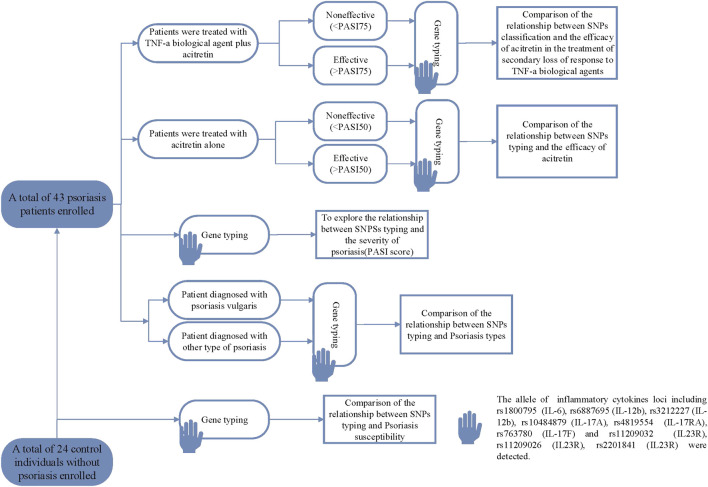
Psoriasis is a common immune-mediated inflammatory skin disease. Although biological agents have achieved good clinical efficacy in the treatment of moderate-to-severe psoriasis, the phenomenon of secondary non-response (SNR) has been gradually recognized. SNR refers to the gradual decline of efficacy after the patient achieves clinical remission with biological agents such as TNF-α biologics. Acitretin, as an immunomodulatory systemic drug for psoriasis, can improve the SNR to biological agents with good tolerance, but there are still individual differences in efficacy. Single-nucleotide polymorphisms (SNPs) of many related inflammatory cytokines have been shown to be important factors of individual differences in drug response in psoriasis, but there have been few reports on the use of pharmacogenomics to alleviate the SNR to biological agents. This study recruited 43 patients with psoriasis and 24 normal controls to investigate whether SNPs of inflammatory cytokines could be used as biomarkers for acitretin to alleviate SNR to TNF-α biologics in psoriasis, including rs1800795 (IL-6), rs6887695 (IL-12b), rs3212227 (IL-12b), rs10484879 (IL-17a), rs4819554 (IL-17ra), rs763780 (IL-17F), rs11209032 (IL23R), rs11209026 (IL23R), and rs2201841 (IL23R). The study also analyzed the correlation between the abovementioned SNPs and the efficacy of acitretin-only patients so as to understand whether the improvement is attributable to the intervention of acitretin on SNR or a simple response of acitretin. We found that in patients with homozygous AA (χ2 = 6.577, p = 0.02) at the SNP rs112009032 (IL-23R), acitretin could improve the SNR to TNFα monoclonal antibody. Patients with the genotype of TG (χ2 = 6.124, p = 0.035) at rs3212227 (IL-12B) were more sensitive to using acitretin in the treatment of psoriasis. Rs3212227 (χ2 = 7.664, p = 0.022) was also associated with the susceptibility to psoriasis. The study might provide a clinical decision reference for personalized treatment of secondary loss of response to psoriasis biologics.
Keywords: acitretin; biologics; psoriasis; secondary non-response; single-nucleotide polymorphism (SNP).
Copyright © 2022 Lin, Wang, Lu, Wang, Li, Wang, Wu, Xu and Du.
Conflict of interest statement
The authors declare that the research was conducted in the absence of any commercial or financial relationships that could be construed as a potential conflict of interest.
Figures
References
-
- Amatore F., Villani A.-P., Tauber M., Viguier M., Guillot B., and Psoriasis Research Group of the French Society of Dermatology (Groupe de Recherche sur le Psoriasis de la Société Française de Dermatologie) (2019). French Guidelines on the Use of Systemic Treatments for Moderate-To-Severe Psoriasis in Adults. J. Eur. Acad. Dermatol Venereol. 33, 464–483. 10.1111/jdv.15340 - DOI - PMC - PubMed
-
- Armstrong A. W., Bagel J., Van Voorhees A. S., Robertson A. D., Yamauchi P. S. (2015). Combining Biologic Therapies with Other Systemic Treatments in Psoriasis: Evidence-Based, Best-Practice Recommendations from the Medical Board of the National Psoriasis Foundation. JAMA Dermatol 151, 432–438. 10.1001/jamadermatol.2014.3456 - DOI - PubMed
-
- Ben-Horin S., Waterman M., Kopylov U., Yavzori M., Picard O., Fudim E., et al. (2013). Addition of an Immunomodulator to Infliximab Therapy Eliminates Antidrug Antibodies in Serum and Restores Clinical Response of Patients with Inflammatory Bowel Disease. Clin. Gastroenterol. Hepatol. 11, 444–447. 10.1016/j.cgh.2012.10.020 - DOI - PubMed
LinkOut - more resources
Full Text Sources
Miscellaneous
