


Correlation between salivary dehydroepiandrosterone sulfate (DHEA-S) levels and cervical vertebral maturation in Saudi individuals
- PMID: 35814844
- PMCID: PMC9263755
- DOI: 10.1016/j.sdentj.2022.05.001
Correlation between salivary dehydroepiandrosterone sulfate (DHEA-S) levels and cervical vertebral maturation in Saudi individuals
Abstract
Background: Growth incidents usually progress in a fairly expected sequence; however, their timing and pattern vary across individual subjects. Biochemical biomarkers have an association with bone metabolism and produce signals which stimulate the growth and development of various craniofacial structures. Steroid dehydroepiandrosterone sulfate (DHEA-S) plays a major role in the initiation of growth hormone actions which has a significant role in promoting and accelerating skeletal maturation during puberty. The aim of this study was to investigate the correlation between salivary DHEA-S levels and cervical vertebral maturation (CVM) stages throughout the circumpubertal developmental period.
Methods: One hundred forty-one participants (70 males and 71 females), between 7 and 23years of age, were categorized into six cervical stages (CS) based on lateral cephalograms. Using a passive drooling technique, unstimulated whole saliva samples were collected from all enrolled subjects. DHEA-S levels were analyzed using the enzyme-linked immunosorbent assay (ELISA) and correlated with the six CVM stages.
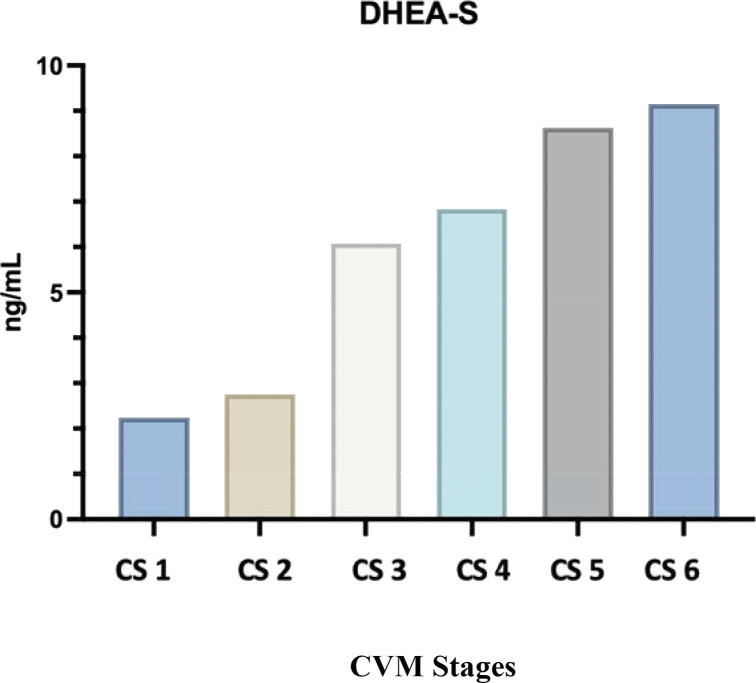
Results: One-way analysis of variance ANOVA showed that the mean salivary DHEA-S levels at CS 3 and CS 4 were significantly different from the values recorded at other stages, and the two stages were statistically significant from each other. Pearson linear correlation of mean salivary DHEA-S levels from CS 1 to CS 6 showed a significant positive correlation.
Conclusion: Salivary DHEA-S can be used as a non-invasive indicator for detecting the pubertal growth spurt.
Keywords: Biomarker; Cephalometric radiograph; Dehydroepiandrosterone sulfate DHEA-S; Growth assessment; Saliva; Skeletal maturity indicator.
© 2022 The Authors.
Figures
References
-
- Alhazmi, Nora, 2017. Salivary Parathyroid Hormone-related Protein (PTHrP) and Alkaline Phosphatase (ALP) as biomarkers for skeletal maturity.
-
- Amasya H., Cesur E., Yıldırım D., Orhan K. Validation of cervical vertebral maturation stages: Artificial intelligence vs human observer visual analysis. Am. J. Orthod. Dentofac. Orthop. Off. Publ. Am. Assoc. Orthod. its Const. Soc. Am. Board Orthod. 2020;158:e173–e179. doi: 10.1016/j.ajodo.2020.08.014. - DOI - PubMed
-
- Baccetti T., Franchi L., McNamara J. The Cervical Vertebral Maturation (CVM) Method for the Assessment of Optimal Treatment Timing in Dentofacial Orthopedics. Semin. Orthod. 2005;11 doi: 10.1053/j.sodo.2005.04.005. - DOI
Publication types
LinkOut - more resources
Full Text Sources
