


Dyhidro-β-agarofurans natural and synthetic as acetylcholinesterase and COX inhibitors: interaction with the peripheral anionic site (AChE-PAS), and anti-inflammatory potentials
- PMID: 35815566
- PMCID: PMC9278454
- DOI: 10.1080/14756366.2022.2091554
Dyhidro-β-agarofurans natural and synthetic as acetylcholinesterase and COX inhibitors: interaction with the peripheral anionic site (AChE-PAS), and anti-inflammatory potentials
Abstract
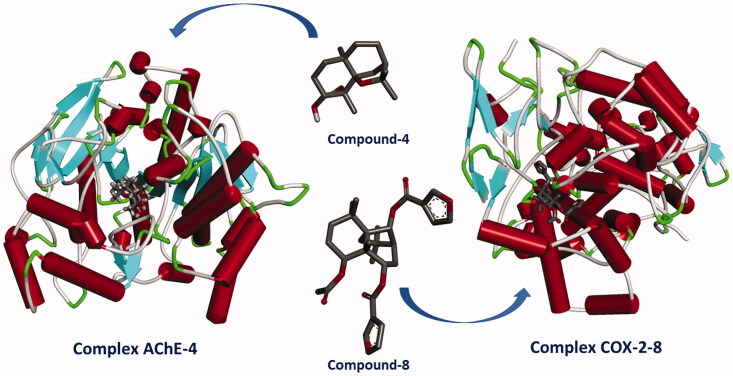
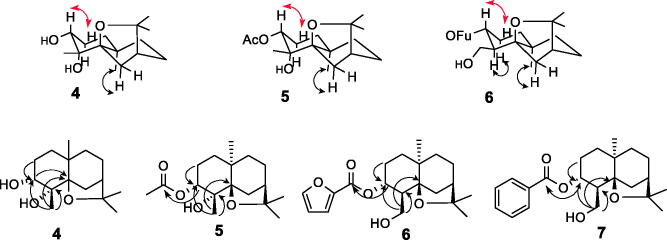
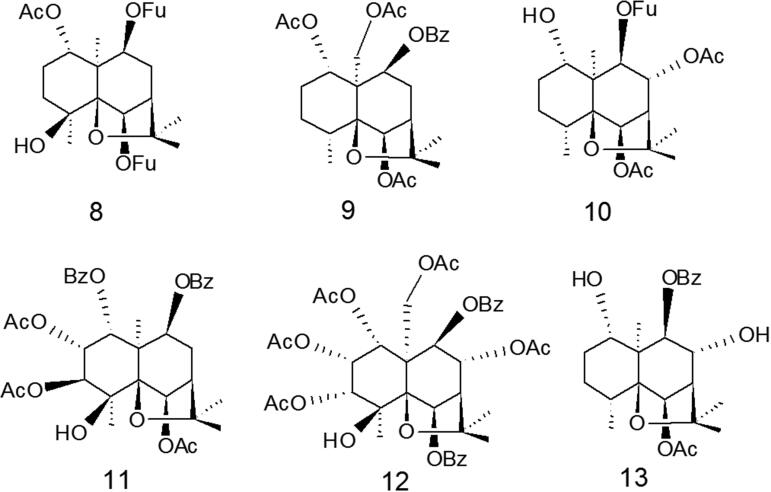
In order to find molecules of natural origin with potential biological activities, we isolate and synthesise compounds with agarofuran skeletons (epoxyeudesmanes). From the seeds of Maytenus disticha and Maytenus magellanica we obtained six dihydro-β-agarofurans, and by means of the Robinson annulation reaction we synthesised five compounds with the same skeleton. The structures were established on the basis of NMR, IR, and MS. The evaluated compounds showed inhibitory activity on the acetylcholinesterase enzyme and on the COX enzymes. Compound 4 emerged as the most potent in the acetylcholinesterase inhibition assay with IC50 17.0 ± 0.016 µM on acetylcholinesterase (AChE). The compounds evaluated were shown to be selective for AChE. The molecular docking, and the propidium displacement assay suggested that the compounds do not bind to the active site of the enzyme AChE, but rather bind to the peripheral anionic site (PAS) of the enzyme, on the other hand, the natural compound 8, showed the best inhibitory activity on the COX-2 enzyme with an IC50 value of 0.04 ± 0.007 µM. The pharmacokinetic profile calculated in silico using the SWISSADME platform shows that these molecules could be considered as potential drugs for the treatment of neurodegenerative diseases such as AD.
Keywords: Acetylcholinesterase; Alzheimer’s disease; COX-2; butyrylcholinesterase; dihydro-β-agarofurans; molecular docking.
Conflict of interest statement
No potential conflicto of interest was reported by the authors.
Figures



References
-
- Singh A, Raju R, Münch G.. Potential anti-neuroinflammatory compounds from Australian plants –a review. Neurochem Int 2021;142:104897. - PubMed
-
- Heppner FL, Ransohoff RM, Becher B.. Immune attack: the role of inflammation in alzheimer disease. Nat Rev Neurosci 2015;16:358–72. - PubMed
-
- Gandía L, Álvarez RM, Hernández-Guijo M, et al. Anticholinesterases in the treatment of Alzheimer's disease. Rev Neurol 2006;42:471–7. - PubMed
-
- Lane R, Potkin S, Enz A.. Targeting acetylcholinesterase and butyrylcholinesterase in dementia. Int J Neuropsychopharmacol 2006;9:101–24. - PubMed
-
- Kumar RS, Almansour AI, Arumugam N, et al. Highly functionalized 2-amino-4H-pyrans as potent cholinesterase inhibitors. Bioorg Chem 2018;81:134–43. - PubMed
MeSH terms
Substances
LinkOut - more resources
Full Text Sources
Medical
Research Materials
