


Undiagnosed Diabetes in U.S. Adults: Prevalence and Trends
- PMID: 35817030
- PMCID: PMC9472490
- DOI: 10.2337/dc22-0242
Undiagnosed Diabetes in U.S. Adults: Prevalence and Trends
Abstract
Objective: Confirmatory testing is recommended for diabetes diagnosis in clinical practice. However, national estimates of undiagnosed diabetes are based on single elevated test measures, potentially resulting in overestimation. Our objective was to update trends in undiagnosed diabetes using definitions consistent with clinical practice.
Research design and methods: We included 30,492 adults (aged ≥20 years) from the National Health and Nutrition Examination Survey (1988-2020). Among adults without diagnosed diabetes, confirmed undiagnosed diabetes was defined as having both elevated levels of fasting plasma glucose (FPG) (≥126 mg/dL) and elevated glycated hemoglobin (HbA1c; ≥6.5%), and persistent undiagnosed diabetes was defined as having elevated HbA1c or FPG levels, adjusted for the within-person variability in HbA1c and FPG tests.
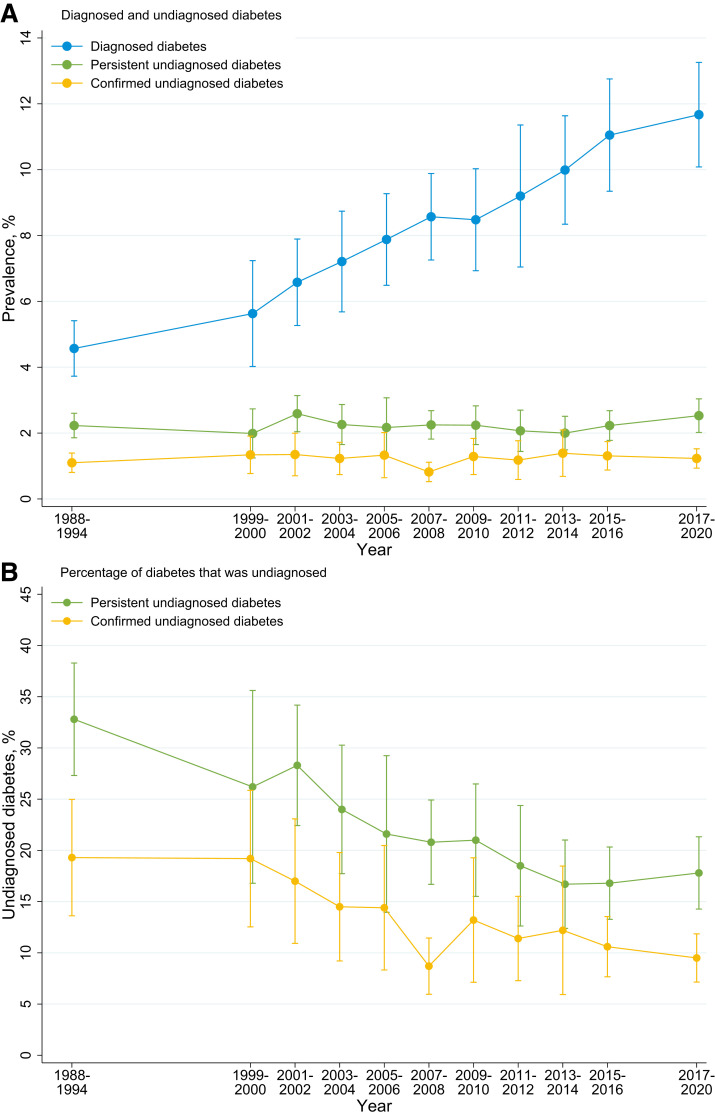
Results: From the periods 1988-1994 to 2017 to March 2020, there was an increase in the prevalence of diagnosed diabetes (from 4.6% to 11.7%), but no change in prevalence of persistent undiagnosed diabetes (from 2.23% to 2.53%) or confirmed undiagnosed diabetes (from 1.10% to 1.23%). Consequently, the proportion of all undiagnosed diabetes cases declined from 32.8% to 17.8% (persistent undiagnosed diabetes) and from 19.3% to 9.5% (confirmed undiagnosed diabetes). Undiagnosed diabetes was more prevalent in older and obese adults, racial/ethnic minorities, and those without health care access. Among persons with diabetes, Asian Americans and those without health care access had the highest proportion of undiagnosed cases, with rates ranging from 23% to 61%.
Conclusions: From 1988 to March 2020, the proportion of undiagnosed diabetes cases declined substantially, suggesting major improvements in diabetes screening and detection. Undiagnosed diabetes currently affects 1-2% of US adults; up to 90% of all cases are diagnosed.
© 2022 by the American Diabetes Association.
Figures
References
-
- Menke A, Casagrande S, Geiss L, Cowie CC. Prevalence of and trends in diabetes among adults in the United States, 1988-2012. JAMA 2015;314:1021–1029 - PubMed
-
- Centers for Disease Control and Prevention . National diabetes statistics report, 2020. 2020. Accessed July 1, 2020. Available from https://www.cdc.gov/diabetes/pdfs/data/statistics/national-diabetes-stat...
-
- American Diabetes Association . 2. Classification and Diagnosis of Diabetes: Standards of Medical Care in Diabetes-2021. Diabetes Care 2021;44(Suppl. 1):S15–S33 - PubMed
Publication types
MeSH terms
Substances
Associated data
Grants and funding
LinkOut - more resources
Full Text Sources
Medical
