Review
. 2022 Nov;8(11):930-943.
doi: 10.1016/j.trecan.2022.06.006. Epub 2022 Jul 8.

Decoding endoplasmic reticulum stress signals in cancer cells and antitumor immunity

Affiliations
Review

Decoding endoplasmic reticulum stress signals in cancer cells and antitumor immunity

Camilla Salvagno et al. Trends Cancer. 2022 Nov.

Abstract

The tumor microenvironment (TME) provokes endoplasmic reticulum (ER) stress in malignant cells and infiltrating immune populations. Sensing and responding to ER stress is coordinated by the unfolded protein response (UPR), an integrated signaling pathway governed by three ER stress sensors: activating transcription factor (ATF6), inositol-requiring enzyme 1α (IRE1α), and protein kinase R (PKR)-like ER kinase (PERK). Persistent UPR activation modulates malignant progression, tumor growth, metastasis, and protective antitumor immunity. Hence, therapies targeting ER stress signaling can be harnessed to elicit direct tumor killing and concomitant anticancer immunity. We highlight recent findings on the role of the ER stress responses in onco-immunology, with an emphasis on genetic vulnerabilities that render tumors highly sensitive to therapeutic UPR modulation.

Keywords: ER stress; cancer therapy; immune cells; tumor microenvironment; unfolded protein response.


Conflict of interest statement

Declaration of interests J.R.C-R. is a scientific consultant for NextRNA Therapeutics, Inc. and Autoimmunity Biologic Solutions, Inc. P.R. and J.R.C-R. hold patents on targeting ER stress pathways for the treatment of disease. The other authors declare no conflicts of interest.

Figures
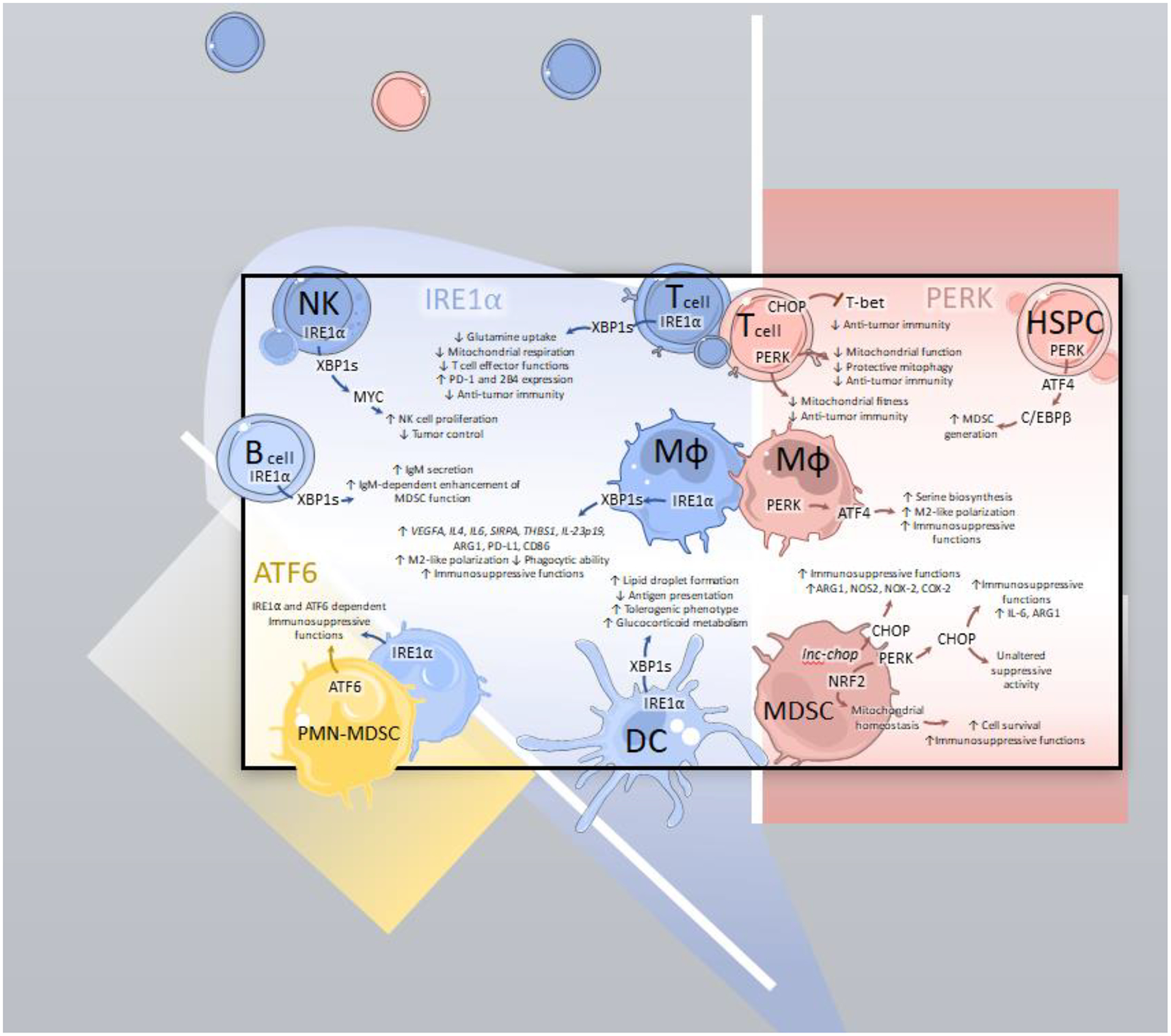
FIGURE 1:
FIGURE 1:. Immunoregulatory effects of ER stress signaling in the TME.
Intratumoral leukocytes experiencing ER stress demonstrate immunosuppressive reprogramming driven by activating transcription factor 6 (ATF6), inositol requiring enzyme 1α (IRE1α), and protein kinase R (PKR)-like endoplasmic reticulum kinase (PERK). ATF6: ATF6 and IRE1α contribute to the immunosuppressive attributes of tumor-associated polymorphonuclear (PMN) myeloid-derived suppressor cells (MDSCs; PMN-MDSCs). IRE1α: In natural killer (NK) cells, IRE1α drives XBP1s-dependent activation of MYC that is needed for NK cell proliferation and thus, NK cell-dependent tumor control. Maladaptive IRE1α-XBP1s activation provokes metabolic reprogramming of intratumoral T cells, resulting in decreased glutamine uptake, reduced mitochondrial respiration, impaired effector function, elevated expression of checkpoint markers PD-1 and 2B4 and thus, overall decreased anti-tumor immunity. In tumor-associated macrophages (TAMs; MΦ), XBP1s galvanizes M2-like polarization corresponding to an increase in expression of suppressive markers (VEGFA, IL-4, IL-6, THBS1, SIRPA, IL-23p19, ARG1 and PD-L1). It also reduces TAM phagocytic capacity and promotes their immunosuppressive functions. Furthermore, in dendritic cells (DC), IRE1α activation causes lipid droplet accumulation, impaired antigen presentation, increased glucocorticoid metabolism, and a global shift towards a tolerogenic phenotype. In B cells, XBP1s promotes soluble IgM production that enhances MDSC function via an unknown mechanism. PERK: In tumor-localized T cells, persistent PERK directs CHOP-dependent T-bet signaling resulting in impaired development of anti-tumor immunity and decreased overall mitochondrial fitness. Conversely, acute PERK activation induces protective mitophagy, mitochondrial function, and sustained anti-tumor T cell activation. In hematopoietic stem and precursor cells (HSPC), activation of PERK drives MDSC generation via downstream C/EBPβ signaling. In macrophages, PERK-directed ATF4 activation promotes serine biosynthesis that enables immunosuppressive functions. In MDSCs, PERK supports mitochondrial homeostasis via NRF2 activation, thus preserving MDSC survival and suppressive activity while directing CHOP-dependent signaling. CHOP fosters immunosuppressive functioning in MDSCs via upregulation of ARG1, NOS2, NOX-2, COX-2 and IL-6. CHOP may have limited effects on suppressive myeloid polarization depending on the context and tumor models utilized.
FIGURE 2:
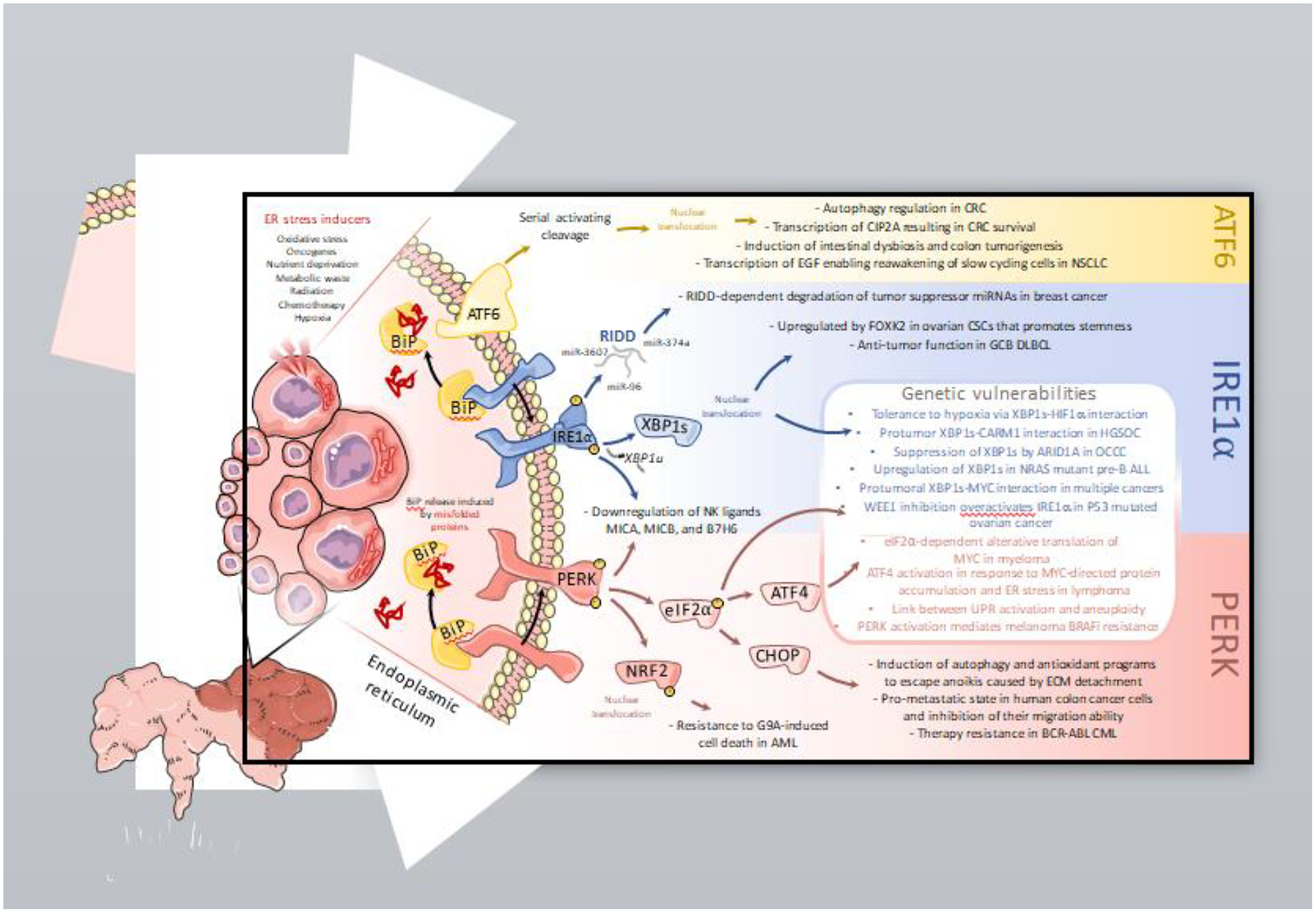
FIGURE 2:. The UPR as a targetable codependency in cancer.
Malignant cells exploit the UPR as an adaptive, prosurvival mechanism. Hence, overactivation of ER stress response pathways in the cancer cell has been demonstrated to directly promote tumor growth, metastasis, and resistance to therapy. Recent findings further underscore that distinct genetic features in the cancer cell can be harnessed to sensitize tumors to UPR therapeutic modulation. ATF6: In colorectal cancer, ATF6 induces transcription of autophagy-related genes and oncogene cancerous inhibitor of protein phosphatase 2A (CIP2A), expression of which corresponds to a poor overall prognosis. Constitutive ATF6 activation also promotes intestinal dysbiosis and colon tumorigenesis. Additionally, ATF6 enables reawakening of slow-cycling cells in non-small cell lung cancer. IRE1α: IRE1α degrades critical tumor-suppressor miRNAs such as miR-3607, miR-374a and miR-96 in breast cancer cells through its RNase activity. In germinal-center B-cell like (GCB) diffuse large B-cell lymphoma (DLBCL), IRE1α prompts XBP1s-mediated antitumor activity. Conversely, in ovarian cancer stem cells, FOXK2-mediated IRE1α-XBP1s activation directs the expression of stemness-related genes. Activation of both IRE1α and PERK decreases surface expression of stress-induced ligands such as MICA, MICB, and B7H6 on melanoma cells, allowing them to evade killing by NK cells. PERK: PERK-driven CHOP induces autophagy and antioxidant programs that enable cancer cells to escape anoikis caused by extracellular matrix (ECM) detachment. Furthermore, PERK signaling in colon cancer supports a premetastatic state and promotes therapy resistance in BCR-ABL fusion chronic myeloid leukemia (CML). Activation of NRF2, downstream of PERK, enables resistance to G9A-induced cell death in acute myeloid leukemia (AML). Genetic vulnerabilities: IRE1α-XBP1s is a crucial co-dependency in cancer cells with specific genetic contextures. XBP1s and HIF1α cooperate to increase hypoxia tolerance in breast tumors, while XBP1s and CARM1 interact to drive protumorigenic functions in high-grade serous ovarian cancer (HGSOC). The MYC-IRE1α-XBP1s axis further sculpts the aggressive phenotype of diverse cancer cell types. Loss of ARID1A unleashes protumoral IRE1α-XBP1s activity in ovarian clear cell carcinoma (OCCC). NRAS-mutant pre-B cell acute lymphocytic leukemia (pre-B ALL) exhibits increased XBP1s expression that contributes to malignant progression. Pharmacological inhibition of the G2/M cell cycle checkpoint kinase, WEE1, induces pro-apoptotic PERK and pro-survival IRE1α activation in ovarian cancer cells bearing P53 mutations, which are therefore sensitized to IRE1α inhibition. PERK signaling is another major MYC co-dependency in cancer. MYC directs protein accumulation, resulting in ER stress, and ATF4 activation in lymphoma. PERK-driven eIF2α phosphorylation enables alternative translation of MYC, supporting its protumoral role. PERK activation mediates resistance to BRAF inhibition (BRAFi) through activation of ERK and induction of protective autophagy. Finally, using the Cancer Genome Atlas (TCGA) database, a recent report linked the activation of multiple branches of the UPR as the result of aneuploidy in cancer cells.

References

    1. Chen X and Cubillos-Ruiz JR (2021) Endoplasmic reticulum stress signals in the tumour and its microenvironment. Nat Rev Cancer 21, 71–88 - PMC - PubMed
    1. Mantovani A, et al. (2017) Tumour-associated macrophages as treatment targets in oncology. Nat Rev Clin Oncol 14, 399–416 - PMC - PubMed
    1. Yan D, et al. (2016) STAT3 and STAT6 Signaling Pathways Synergize to Promote Cathepsin Secretion from Macrophages via IRE1alpha Activation. Cell Rep 16, 2914–2927 - PMC - PubMed
    1. Zhao Y, et al. (2021) XBP1 regulates the protumoral function of tumor-associated macrophages in human colorectal cancer. Signal Transduct Target Ther 6, 357. - PMC - PubMed
    1. Batista A, et al. (2020) IRE1alpha regulates macrophage polarization, PD-L1 expression, and tumor survival. PLoS Biol 18, e3000687. - PMC - PubMed

Publication types