


Smartphone-Assisted Patient-Initiated Care Versus Usual Care in Patients With Rheumatoid Arthritis and Low Disease Activity: A Randomized Controlled Trial
- PMID: 35818342
- PMCID: PMC9826407
- DOI: 10.1002/art.42292
Smartphone-Assisted Patient-Initiated Care Versus Usual Care in Patients With Rheumatoid Arthritis and Low Disease Activity: A Randomized Controlled Trial
Abstract
Objective: We developed a smartphone application for patients with rheumatoid arthritis (RA) that allows them to self-monitor their disease activity in between clinic visits by answering a weekly Routine Assessment of Patient Index Data 3. This study was undertaken to assess the safety (noninferiority in the Disease Activity Score in 28 joints using the erythrocyte sedimentation rate [DAS28-ESR]) and efficacy (reduction in number of visits) of patient-initiated care assisted using a smartphone app, compared to usual care.
Methods: A 12-month, randomized, noninferiority clinical trial was conducted in RA patients with low disease activity and without treatment changes in the past 6 months. Patients were randomized 1:1 to either app-supported patient-initiated care with a scheduled follow-up consultation after a year (app intervention group) or usual care. The coprimary outcome measures were noninferiority in terms of change in DAS28-ESR score after 12 months and the ratio of the mean number of consultations with rheumatologists between the groups. The noninferiority limit was 0.5 difference in DAS28-ESR between the groups.
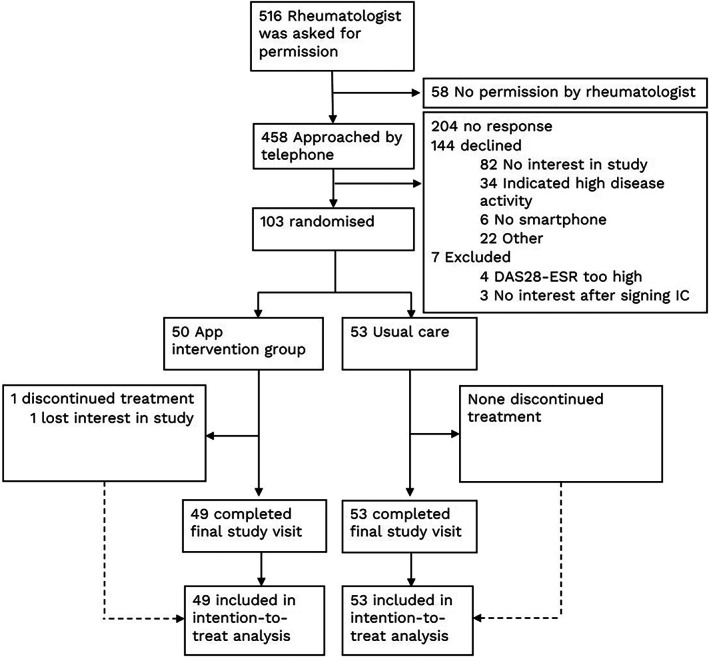
Results: Of the 103 randomized patients, 102 completed the study. After a year, noninferiority in terms of the DAS28-ESR score was established, as the 95% confidence interval (95% CI) of the mean ΔDAS28-ESR between the groups was within the noninferiority limit: -0.04 in favor of the app intervention group (95% CI -0.39, 0.30). The number of rheumatologist consultations was significantly lower in the app intervention group compared to the usual care group (mean ± SD 1.7 ± 1.8 versus 2.8 ± 1.4; visit ratio 0.62 [95% CI 0.47, 0.81]).
Conclusion: Patient-initiated care supported by smartphone self-monitoring was noninferior to usual care in terms of the ΔDAS28-ESR and led to a 38% reduction in rheumatologist consultations in RA patients with stable low disease activity.
© 2022 The Authors. Arthritis & Rheumatology published by Wiley Periodicals LLC on behalf of American College of Rheumatology.
Figures
Comment in
-
Transforming Rheumatology Practice With Technology: Products, Processes, People, and Purpose.Arthritis Rheumatol. 2022 Nov;74(11):1730-1732. doi: 10.1002/art.42259. Epub 2022 Oct 7. Arthritis Rheumatol. 2022. PMID: 35696331 No abstract available.
References
-
- Battafarano DF, Ditmyer M, Bolster MB, et al. 2015 American College of Rheumatology workforce study: supply and demand projections of Adult Rheumatology Workforce, 2015–2030. Arthritis Care Res (Hoboken) 2018;70:617–26. - PubMed
-
- Kilian A, Upton LA, Battafarano DF, et al. Workforce trends in rheumatology. Rheum Dis Clin North Am 2019;45:13–26. - PubMed
Publication types
MeSH terms
Substances
LinkOut - more resources
Full Text Sources
Medical
Miscellaneous
