


Clinical and molecular features of patients with COL1-related disorders: Implications for the wider spectrum and the risk of vascular complications
- PMID: 35822426
- PMCID: PMC9545637
- DOI: 10.1002/ajmg.a.62887
Clinical and molecular features of patients with COL1-related disorders: Implications for the wider spectrum and the risk of vascular complications
Abstract
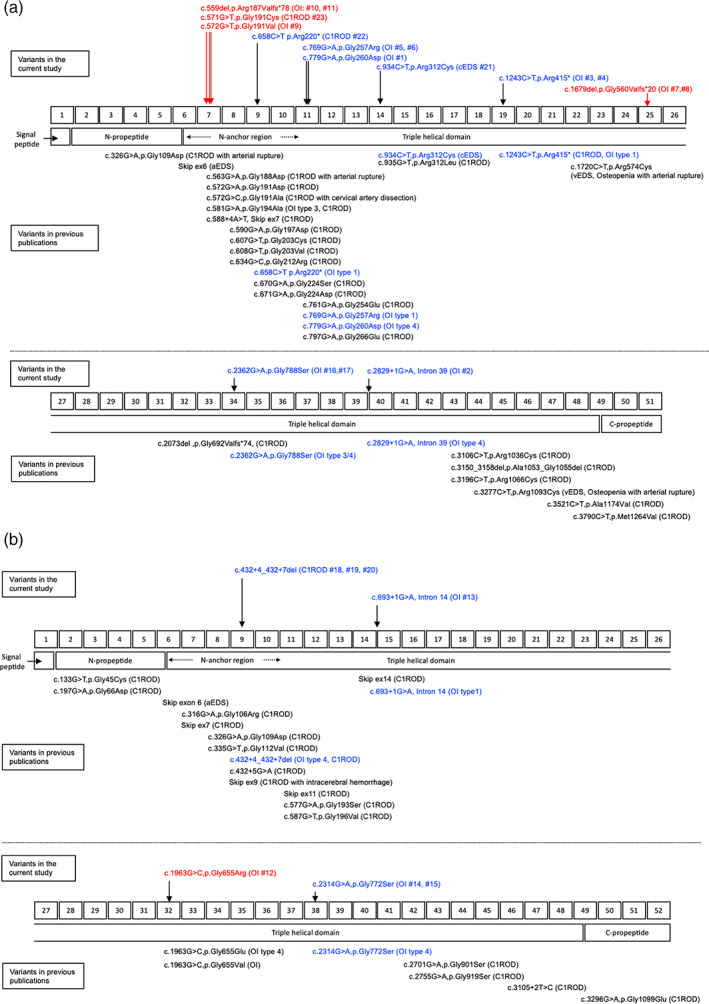
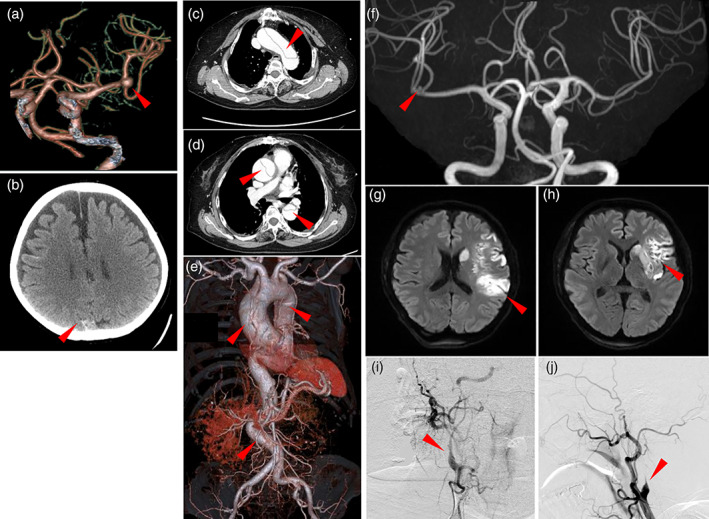
Abnormalities in type I procollagen genes (COL1A1 and COL1A2) are responsible for hereditary connective tissue disorders including osteogenesis imperfecta (OI), specific types of Ehlers-Danlos syndrome (EDS), and COL1-related overlapping disorder (C1ROD). C1ROD is a recently proposed disorder characterized by predominant EDS symptoms of joint and skin laxity and mild OI symptoms of bone fragility and blue sclera. Patients with C1ROD do not carry specific variants for COL1-related EDS, including classical, vascular, cardiac-valvular, and arthrochalasia types. We describe clinical and molecular findings of 23 Japanese patients with pathogenic or likely pathogenic variants of COL1A1 or COL1A2, who had either OI-like or EDS-like phenotypes. The final diagnoses were OI in 17 patients, classical EDS in one, and C1ROD in five. The OI group predominantly experienced recurrent bone fractures, and the EDS group primarily showed joint hypermobility and skin hyperextensibility, though various clinical and molecular overlaps between OI, COL1-related EDS, and C1ROD as well as intrafamilial phenotypic variabilities were present. Notably, life-threatening vascular complications (vascular dissections, arterial aneurysms, subarachnoidal hemorrhages) occurred in seven patients (41% of those aged >20 years) with OI or C1ROD. Careful lifelong surveillance and intervention regarding bone and vascular fragility could be required.
Keywords: COL1-related overlap disorder; COL1A1; COL1A2; Ehlers-Danlos syndrome; osteogenesis imperfecta.
© 2022 The Authors. American Journal of Medical Genetics Part A published by Wiley Periodicals LLC.
Conflict of interest statement
Tomomi Yamaguchi and Tomoki Kosho are members of an endowed chair named “Division of Clinical Sequencing, Shinshu University School of Medicine,” sponsored by BML, Inc. and Life Technologies Japan Ltd. of Thermo Fisher Scientific Inc.
Figures
References
-
- Adham, S. , Dupuis‐Girod, S. , Charpentier, E. , Mazzella, J. M. , Jeunemaitre, X. , & Legrand, A. (2020). Classical Ehlers‐Danlos syndrome with a propensity to arterial events: A report on a French family with a COL1A1 p.(Arg312Cys) variant. Clinical Genetics, 97, 357–361. 10.1111/cge.13643 - DOI - PubMed
-
- Balasubramanian, M. , Verschueren, A. , Kleevens, S. , Luyckx, I. , Perik, M. , Schirwani, S. , Mortier, G. , Morisaki, H. , Rodrigus, I. , Laer, L. V. , Verstraeten, A. , & Loeys, B. (2019). Aortic aneurysm/dissection and osteogenesis imperfecta: Four new families and review of the literature. Bone, 121, 191–195. doi:10.1016/j.bone.2019.01.022 - DOI - PubMed
-
- Brady, A. F. , Demirdas, S. , Fournel‐Gigleux, S. , Ghali, N. , Giunta, C. , Kapferer‐Seebacher, I. , Kosho, T. , Mendoza‐Londono, R. , Pope, M. F. , Rohrbach, M. , Van Damme, T. , Vandersteen, A. , van Mourik, C. , Voermans, N. , Zschocke, J. , & Malfait, F. (2017). The Ehlers‐Danlos syndromes, rare types. American Journal of Medical Genetics part C Seminars in Medical Genetics, 175, 70–115. 10.1002/ajmg.c.31550 - DOI - PubMed
Publication types
MeSH terms
Substances
LinkOut - more resources
Full Text Sources
Medical
Miscellaneous
