Trend in the incidence rates of accidents with venomous animals in children and adolescents in Brazil (2007-2019)
- PMID: 35830166
- PMCID: PMC9273123
- DOI: 10.1590/1984-0462/2023/41/2021272
Trend in the incidence rates of accidents with venomous animals in children and adolescents in Brazil (2007-2019)
Abstract
Objective: To estimate the temporal trend of the incidence rates of accidents with venomous animals in children and adolescents in Brazil.
Methods: An ecological time-series study was carried out between 2007 and 2019. Data were obtained from the Brazilian Information System on Diseases of Compulsory Declaration (Sistema de Informação de Agravos de Notificação - SINAN). The time series of incidence rates of accidents with venomous animals were stratified by age group (children aged 0 to 9 years and adolescents aged 10 to 19 years), Brazilian macro-regions (North, Northeast, Midwest, Southeast, and South), and type of accident (snake, scorpion, spider, and caterpillar). For trend analysis, the Prais-Winsten model and the Annual Percent Change (APC) were used.
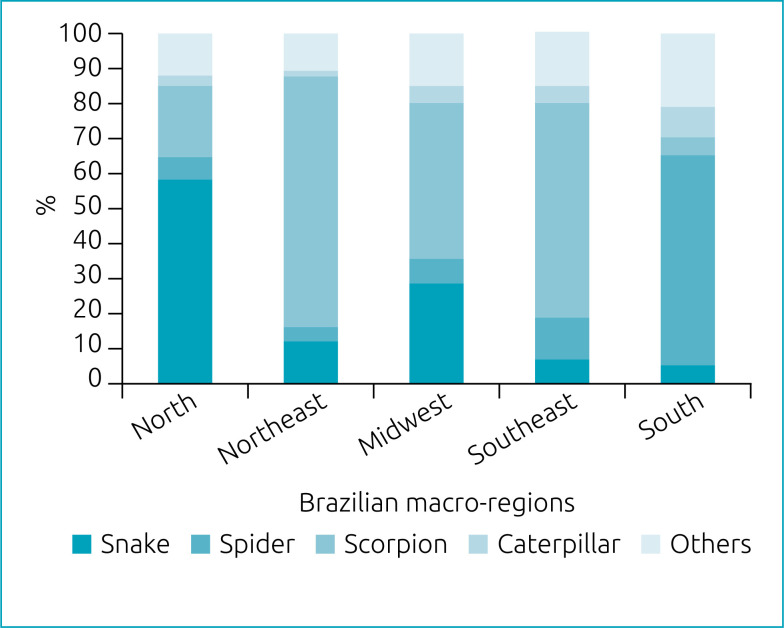
Results: The time series of the incidence rate of accidents with venomous animals in children and adolescents from the North, Northeast, Midwest, and Southeast macro-regions and in children from the South region showed an upward trend. The average annual incidence rates were higher in the age group of 10 to 19 years, except for the South macro-region. Accidents with scorpions, snakes, and spiders, in this order, were the most frequent; the trends in the time series stratified by type of animal varied according to the geographic macro-region.
Conclusions: There was an upward trend in the incidence rate of accidents with venomous animals in children and adolescents in Brazil, except for adolescents in the South macro-region of the country.
Objetivo:: Estimar a tendência temporal das taxas de incidência de acidentes com animais peçonhentos em crianças e adolescentes no Brasil.
Métodos:: Foi realizado um estudo ecológico de séries temporais, entre 2007 e 2019. Os dados foram obtidos do Sistema de Informação de Agravos de Notificação (SINAN). As séries temporais das taxas de incidência com animais peçonhentos foram estratificadas por faixa etária (crianças de 0 a 9 anos e adolescentes de 10 a 19 anos), macrorregiões brasileiras (Norte, Nordeste, Centro-Oeste, Sudeste e Sul) e tipo de acidente (serpente, escorpião, aranha e lagarta). Para análise de tendência, foi utilizado o modelo de Prais-Winsten e calculada a variação percentual anual das taxas (Annual Percentage Change — APC).
Resultados:: As séries históricas da taxa de incidência de acidentes com animais peçonhentos em crianças e adolescentes das macrorregiões Norte, Nordeste, Centro-Oeste e Sudeste e em crianças da macrorregião Sul apresentaram tendência ascendente. As taxas de incidências anuais médias foram maiores na faixa etária de 10 a 19 anos, exceto na macrorregião Sul. Os acidentes com escorpiões, serpentes e aranhas, nesta ordem, foram os mais frequentes; as tendências das séries históricas estratificadas por tipo de animal variaram conforme a macrorregião.
Conclusões:: Houve tendência ascendente na taxa de incidência de acidentes com animais peçonhentos em crianças e adolescentes no Brasil, exceto nos adolescentes da macrorregião Sul do país.
Conflict of interest statement
The authors declare there is no conflict of interests.
Figures
References
-
- Brazil – Ministério da Saúde . Define as terminologias adotadas em legislação nacional, conforme disposto no Regulamento Sanitário Internacional 2005 (RSI 2005), a relação de doenças, agravos e eventos em saúde pública de notificação compulsória em todo o território nacional e estabelecer fluxo, critérios, responsabilidades e atribuições aos profissionais e serviços de saúde. Brasília: Ministério da Saúde; 2010. Portaria N° 2.472, de 31 de agosto de 2010.
-
- Brazil – Ministério da Saúde . Secretaria de Vigilância em Saúde. Guia de Vigilância em Saúde. 3rd ed. Brasília: Ministério da Saúde; 2019.
-
- Brenes-Chacón H, María Gutiérrez J, Camacho-Badilla K, Soriano-Fallas A, Ulloa-Gutierrez R, Valverde-Muñoz K, et al. Snakebite envenoming in children: a neglected tropical disease in a Costa Rican pediatric tertiary care center. Acta Trop. 2019;200:105176–105176. doi: 10.1016/j.actatropica.2019.105176. - DOI - PubMed
MeSH terms
Substances
LinkOut - more resources
Full Text Sources