. 2022 Jul 13;12(1):11910.
doi: 10.1038/s41598-022-16027-3.

Feasibility of source-free DAS logging for next-generation borehole imaging

Affiliations

Feasibility of source-free DAS logging for next-generation borehole imaging

David Li et al. Sci Rep. .

Abstract

Characterizing and monitoring geologic formations around a borehole are crucial for energy and environmental applications. However, conventional wireline sonic logging usually cannot be used in high-temperature environments nor is the tool feasible for long-term monitoring. We introduce and evaluate the feasibility of a source-free distributed-acoustic-sensing (DAS) logging method based on borehole DAS ambient noise. Our new logging method provides a next-generation borehole imaging tool. The tool is source free because it uses ever-present ambient noises as sources and does not need a borehole sonic source that cannot be easily re-inserted into a borehole after well completion for time-lapse monitoring. The receivers of our source-free DAS logging tool are fiber optic cables cemented behind casing, enabling logging in harsh, high-temperature environments, and eliminating the receiver repeatability issue of conventional wireline sonic logging for time-lapse monitoring. We analyze a borehole DAS ambient noise dataset to obtain root-mean-squares (RMS) amplitudes and use these amplitudes to infer subsurface elastic properties. We find that the ambient noise RMS amplitudes correlate well with anomalies in conventional logging data. The source-free DAS logging tool can advance our ability to characterize and monitor subsurface geologic formations in an efficient and cost-effective manner, particularly in high-temperature environments such as geothermal reservoirs. Further validation of the source-free DAS logging method using other borehole DAS ambient noise data would enable the new logging tool for wider applications.


Conflict of interest statement

The authors declare no competing interests.

Figures
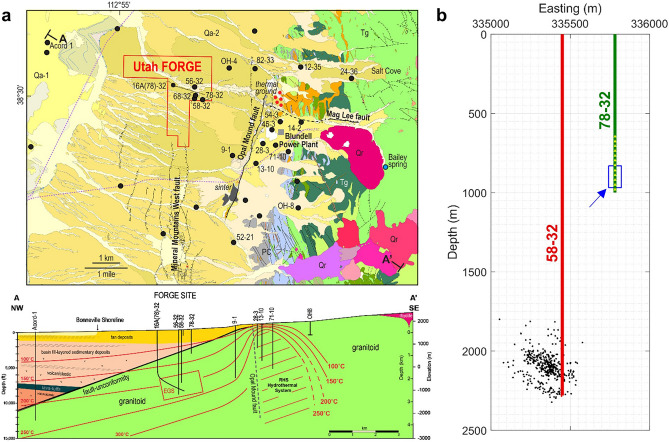
Figure 1
Figure 1
Geologic maps and cross-sections of the Utah FORGE site. (a) Geologic map and cross-section of the Utah FORGE geothermal site (modified from Kirby et al. by courtesy of The Utah Geological Survey). The treatment well (58–32) was drilled through fan and sediment deposits and reached the geothermal reservoir (EGS) in the low permeability granite rocks at a depth of 2294 m with a temperature of about 200 °C. The observation well (78–32) was drilled to a depth of 1000 m. A fiber-optic cable and 12 three-component (3C) geophones were deployed in well 78–32 to monitor activities in the treatment well. (b) A zoomed in view of the treatment well 58–32 (red line) and monitoring well 78–32 (green line). The black dots are the location of microseismic events, the yellow dots show the 12 3-C geophone locations, and the blue box shows the area of investigation for this study. Both the treatment and monitoring wells are nearly vertical.
Figure 2
Figure 2
DAS ambient noise data and noise RMS depth profiles. (a) Fifteen-second ambient noise traces of 138 DAS channels ranging from depths of 830 to 968 m. (b) Noise RMS depth profile showing noise RMS amplitudes varying with depths. (c) Ambient noise RMS amplitude depth profiles for each hour in a 48-h period. (d) 48 RMS depth profiles of ambient noise superimposed on the left showing consistent features with a few exceptions. The red curve on the right is the RMS depth profile averaged over the 48-h period. There are consistent noise peaks at certain depths, marked Na, Nb, Nc, Nd, and Ne. This average RMS profile indicates noise RMS amplitude levels vary with depth with several distinct peaks. The profile of the red curve is similar to that in (b). Note that the amplitude scale of the red curve is not the same as that of the black curves for easy identification of Nb to Nd.
Figure 3
Figure 3
Noise RMS depth profile compared with well 78–32 logging data. (a) Ambient noise RMS depth profile (thick blue curve) plotted with casing collar locator (CCL), bond index (BI), cement bond log amplitude (CBLA), and sonic waveforms (right column). Clear first and later arrivals on the sonic waveforms indicate the casing and cementing are in good condition. The major peaks of noise RMS amplitudes show no correlation with the relative high amplitudes (indicated by blue circles) of the CBLA curve nor with the casing collar locator (CCL). (b) Ambient noise RMS depth profile (thick blue curve) versus gamma ray log curve (orange curve) and lithological log (right column). A major RMS peak (Na) at a depth of 849 m, correlates with a trough of the gamma ray curve. The major RMS peak (Ne) at a depth of 945 m coincides with the interface between granite and diorite on the lithological log.
Figure 4
Figure 4
Noise RMS depth profile compared with well 58–32 logging data after depth correction. (a) Noise RMS profile (right column) compared with P-wave reflection coefficient (RC), density (ρ), Poisson’s ratio (ν), S-wave velocity (Vs), P-wave velocity (Vp), S-impedance (Zs), P-impedance (Zp), density porosity (%Dp), sonic derived porosity (%Sp), and thermal neutron porosity (%Tp), gamma ray (Gr-58), and well 78–32 gamma ray (Gr-78). We shift the depth of 58–32 logs upwards by 124.5 m to account for a 20° formation dip. The magenta brackets show depths of major noise zones (849 and 945 m) that correspond to thicker LVZs bounded by sharp interfaces. The horizontal dashed magenta lines show the major noise peaks, corresponding to ρ troughs, porosity peaks, distinct RCs, and the location of the sediment-granite boundary and granite-diorite boundaries. The green brackets show three weaker noise zones that correlate with LVLs with less sharp boundaries. The peaks (green dashed lines) of these noise zones also correspond with thin LVLs within the thick LVZs. The dashed green line at 876–889 m shows a gradient on both the RMS and Vp profiles. The slight shift between the noise RMS amplitude peaks and Vp troughs may be attributed to depth uncertainties between the wireline cable and DAS fiber. (b) Noise RMS profile compared with P-wave velocity (Vp), P-wave velocity to the power of 1.5 (Vp1.5), Poisson’s Ratio, and thermal porosity. The depths marked by the red rectangles, 834–853 m (Na) and 937–957 m (Ne), show a consistent pattern of low velocities, low Poisson ratio, high porosities, and large noise RMS values, indicating highly fracturing LVL. The red vertical dashed line at Pr = 2/7 indicates the transition from brittle to ductile regimes. For the Pr < 0.25 region, rocks are easier to fracture. At depths from 859 to 868 m (marked by green rectangular), there is an LVL with high porosity, but a high Poisson ratio of about 0.35 in a ductile regime, which corresponds to a quiet zone of the noise RMS profile.
Figure 5
Figure 5
Types of noises recorded by DAS system. (a) Ambient noise. (b) Type B noise, six events within 5 m (6E5M). (c) Type C noise, caused by interrogator end disturbance (IED) that appears on all DAS channels simultaneously. (d) Noise caused by a suspected local or regional seismic event. (e) Zoomed in view of three groups of Type B noise (6E5M). Note that 6E5M noise amplitudes vary with channel depths. They either increase or decrease with the increasing channel depth. (f) Enlarged plot of Type C noise (IED) showing a simple pulse on all DAS channels at the same time.
Figure 6
Figure 6
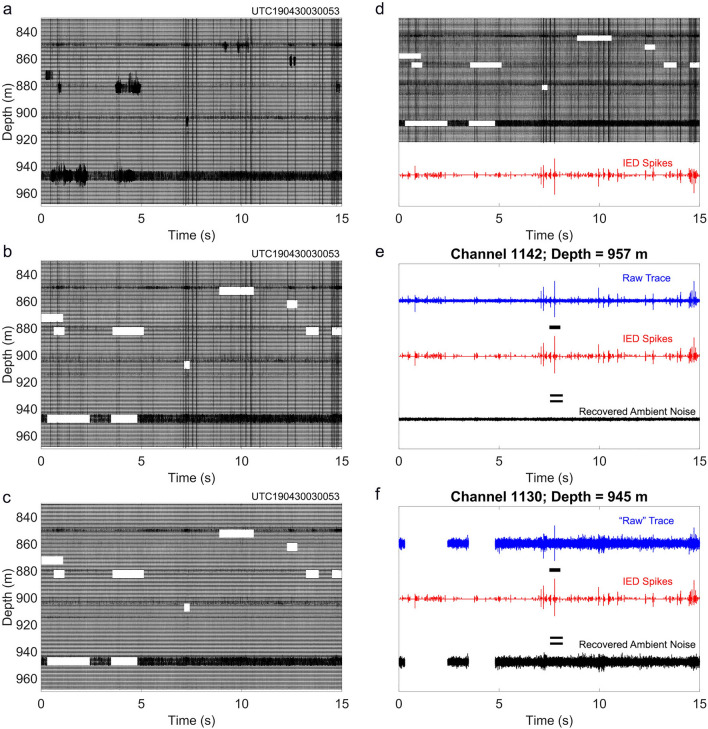
Workflow to remove Types B and C noises from the ambient noise and de-spiking procedure to remove Type C noise. (a) Raw 15-s-long noise traces with Types B and C noises. (b) Type B noise removed. (c) Type C noise removed using a de-spiking method. (d) 15-s noise traces of all channels are stacked and averaged to form a trace of IED spikes. (e) The trace of IED spikes is subtracted from the raw noise trace to recover ambient noise of a relatively quiet channel (1142) at a depth of 957 m. (f) Recovered useful ambient noise trace of a relatively noisy channel (1130) at a depth of 945 m.
Figure 7
Figure 7
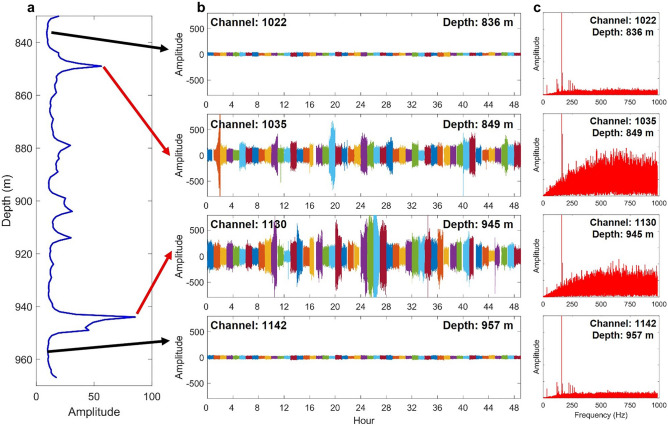
Comparing the average noise RMS profile with 48 h of data on different channels. (a) Average RMS depth profile of borehole DAS ambient noise. (b) 48 h of ambient noise traces with15-second segments for both quiet (channel 1022 and 1142) and noisy (channel 1035 and 1130) channels. Each segment starts at the 53rd second of each hour. (c) Amplitude spectrums of 15 s noisy (1035 and 1130) and quite (1022 and 1142) traces.
Figure 8
Figure 8
Noise amplitudes varied over time. (a) Average RMS depth profile of ambient noise marked with two major noise peak zones (Na and Ne) with two larger RMS peaks and six quiet zones (Qa to Qf) with smaller RMS values. (b) Ambient noise RMS amplitudes-time plots for the two channels with two larger RMS peaks (Na and Ne). (c) Noise RMS amplitude-time plots for the six quiet zones (Qa to Qf), averaged over each quiet zone. These six curves show the quiet and noise periods, which occur twice within 48 h, suggesting a possible daily variation. The thick black curve (Q) is an average over the six quiet zones, clearly demonstrating the possible daily variation pattern.

References

    1. Paillet FL, Cheng CH. Acoustic Waves in Boreholes. CRC Press; 1991.
    1. Tang X-M, Cheng CHA, Cheng A. Quantitative Borehole Acoustic Methods. Elsevier; 2004.
    1. Li D, et al. Gaussian beam imaging of fractures near the wellbore using sonic logging tools after removing dispersive borehole waves. Geophysics. 2020;85:D133–D143. doi: 10.1190/Geo2019-0104.1. - DOI
    1. Ajo-Franklin J, et al. 2015 SEG Annual Meeting. OnePetro; 2015.
    1. Ajo-Franklin J, et al. Distributed acoustic sensing using dark fiber for near-surface characterization and broadband seismic event detection. Sci. Rep. 2019 doi: 10.1038/s41598-018-36675-8. - DOI - PMC - PubMed