


Modelling in economic evaluation of mental health prevention: current status and quality of studies
- PMID: 35831821
- PMCID: PMC9281039
- DOI: 10.1186/s12913-022-08206-9
Modelling in economic evaluation of mental health prevention: current status and quality of studies
Abstract
Background: The present study aimed to identify and critically appraise the quality of model-based economic evaluation studies in mental health prevention.
Methods: A systematic search was performed on MEDLINE, EMBASE, EconLit, PsycINFO, and Web of Science. Two reviewers independently screened for eligible records using predefined criteria and extracted data using a pre-piloted data extraction form. The 61-item Philips Checklist was used to critically appraise the studies. Systematic review registration number: CRD42020184519.
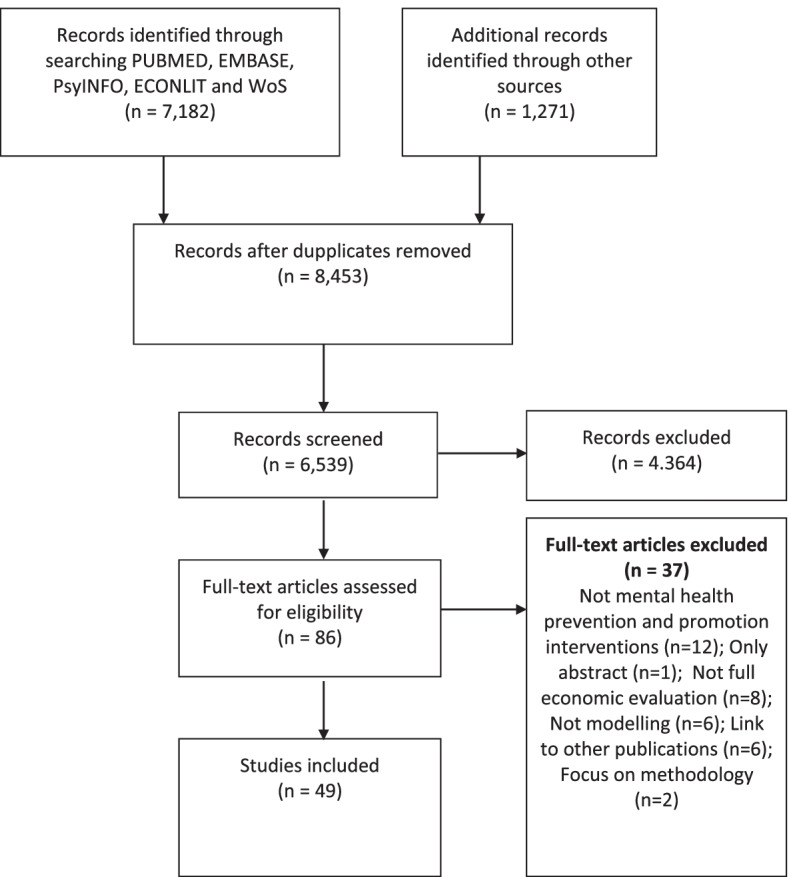
Results: Forty-nine studies were eligible to be included. Thirty studies (61.2%) were published in 2015-2021. Forty-seven studies were conducted for higher-income countries. There were mainly cost-utility analyses (n = 31) with the dominant primary outcome of quality-adjusted life year. The most common model was Markov (n = 26). Most of the studies were conducted from a societal or health care perspective (n = 37). Only ten models used a 50-year time horizon (n = 2) or lifetime horizon (n = 8). A wide range of mental health prevention strategies was evaluated with the dominance of selective/indicate strategy and focusing on common mental health problems (e.g., depression, suicide). The percentage of the Philip checkilst's criteria fulfilled by included studies was 69.3% on average and ranged from 43.3 to 90%. Among three domains of the Philip checklist, criteria on the model structure were fulfilled the most (72.1% on average, ranging from 50.0% to 91.7%), followed by the data domain (69.5% on average, ranging from 28.9% to 94.0%) and the consistency domain (54.6% on average, ranging from 20.0% to 100%). The practice of identification of 'relevant' evidence to inform model structure and inputs was inadequately performed. The model validation practice was rarely reported.
Conclusions: There is an increasing number of model-based economic evaluations of mental health prevention available to decision-makers, but evidence has been limited to the higher-income countries and the short-term horizon. Despite a high level of heterogeneity in study scope and model structure among included studies, almost all mental health prevention interventions were either cost-saving or cost-effective. Future models should make efforts to conduct in the low-resource context setting, expand the time horizon, improve the evidence identification to inform model structure and inputs, and promote the practice of model validation.
Keywords: Cost-effectiveness; Decision-analytic models; Economic evaluation; Mental disorders; Mental health; Prevention; Universal prevention; Value-for-money.
© 2022. The Author(s).
Conflict of interest statement
The authors declare that they have no competing interests.
Figures
References
-
- Global Burden of Disease Collaborative Network. Global Burden of Disease Study 2019 (GBD 2019) Results. Seattle, United States: Institute for Health Metrics and Evaluation (IHME), 2020. Available from https://vizhub.healthdata.org/gbd-results/.
-
- McDaid D, Hewlett E, Park AL. Understanding effective approaches to promoting mental health and preventing mental illness. 2017.
Publication types
MeSH terms
LinkOut - more resources
Full Text Sources
Medical
