


Predictive value of clinical characteristics on risk and prognosis of synchronous brain metastases in small-cell lung cancer patients: A population-based study
- PMID: 35831985
- PMCID: PMC9883432
- DOI: 10.1002/cam4.4978
Predictive value of clinical characteristics on risk and prognosis of synchronous brain metastases in small-cell lung cancer patients: A population-based study
Abstract
Background: Patients with small-cell lung cancer (SCLC) have a high incidence of synchronous brain metastases (SBM) and a poor prognosis, which causes a heavy burden of morbidity and mortality. A better understanding of the demographic and tumor-specific characteristics of these patients is critical to guiding clinical practice. The purpose of this study was to investigate the predictive and prognostic value of the clinical characteristics of SCLC patients with SBM at initial diagnosis.
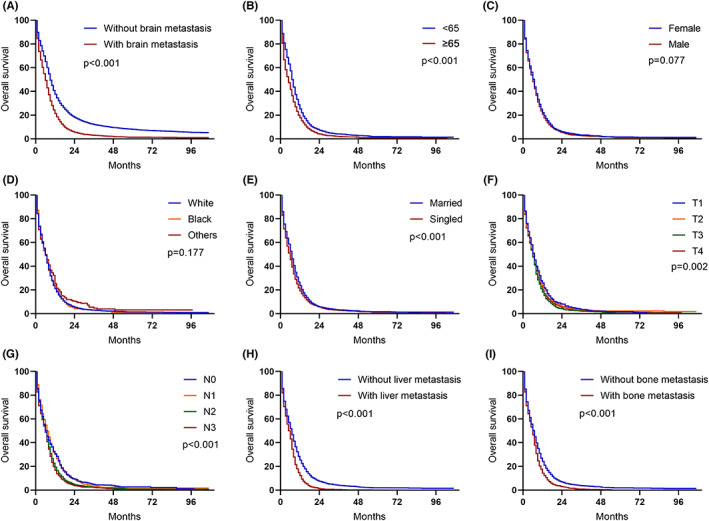
Methods: This is a retrospective study based on the data in the latest Surveillance, Epidemiology, and End Results (SEER) version which was released in 2021 for patients diagnosed with SCLC in the presence or absence of SBM from 2010 to 2018. Multivariable logistic regression was performed to identify predictors of the presence of SBM at the initial diagnosis. Kaplan-Meier curves and multivariable Cox regression models were built to compare the prognosis of patients with different clinical characteristics and treatments.
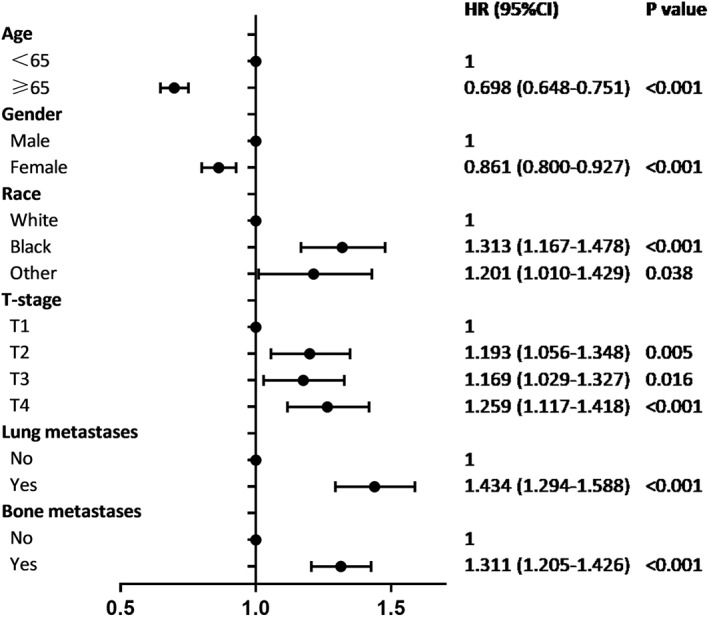
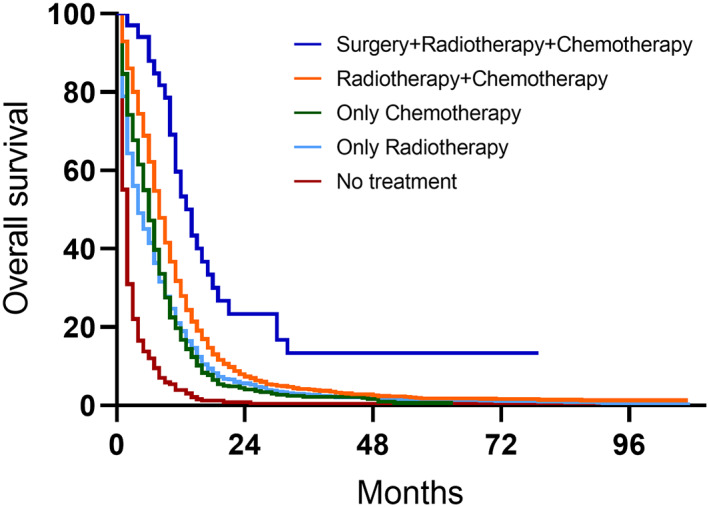
Results: A total of 33,169 SCLC patients were enrolled in this study, including 5711 (17.2%) patients with SBM and 27,458 (82.8%) patients without SBM. Patients who are black(HR = 1.313, 95% CI = 1.167-1.478, p < 0.001), higher T stage (T2, HR = 1.193, 95%CI = 1.065-1.348, p = 0.005; T3, HR = 1.169, 95%CI = 1.029-1.327, p = 0.016; T4, HR = 1.259, 95%CI = 1.117-1.418, p < 0.001), lung metastases (HR = 1.434, 95%CI = 1.294-1.588, p < 0.001) and bone metastases (HR = 1.311, 95% CI = 1.205-1.426, p < 0.001) had greater odds of SBM at initial diagnosis. The median overall survival (OS) for SCLC patients with SBM was 5.0 months. Multivariable Cox regression revealed that age ≥ 65 (HR = 1.164, 95% CI = 1.086-1.247, p < 0.025), singled (HR = 1.095, 95% CI = 1.020-1.174, p = 0.012), higher T stage (T3, HR = 1.265, 95% CI = 1.123-1.425, p < 0.001; T4, HR = 1.192, 95% CI = 1.066-1.332, p = 0.002), higher N stage (N2, HR = 1.347, 95%CI = 1.214-1.494, p < 0.001; N3, HR = 1.452, 95%CI = 1.292-1.632, p < 0.001), liver metastases (HR = 1.415, 95%CI = 1.306-1.533, p < 0.001), and bone metastases (adjusted HR = 1.126, 95%CI = 1.039-1.221, p = 0.004). Analysis of treatment regimens showed that patients who received combinational treatment exhibited longer OS than chemotherapy or radiotherapy alone, and surgery combined with chemotherapy and radiotherapy exhibited the longest OS.
Conclusions: In this study, we identified risk factors for SBM in SCLC patients and prognostic indicators among this patient population. We also found that patients who received different therapeutic strategies exhibited significant difference on OS, which will provide evidence-based support for treatment options.
Keywords: SEER; prognosis; risk factors; small cell lung cancer; synchronous brain metastases.
© 2022 The Authors. Cancer Medicine published by John Wiley & Sons Ltd.
Conflict of interest statement
The authors have no conflicts of interest to declare.
Figures
References
-
- Kromer C, Xu J, Ostrom QT, et al. Estimating the annual frequency of synchronous brain metastasis in the United States 2010‐2013: a population‐based study. J Neurooncol. 2017;134(1):55‐64. - PubMed
-
- Rittberg R, Banerji S, Kim JO, Rathod S, Dawe DE. Treatment and prevention of brain metastases in small cell lung cancer. Am J Clin Oncol. 2021;44(12):629‐638. - PubMed
-
- Reddy SP, Dowell JE, Pan E. Predictors of prognosis of synchronous brain metastases in small‐cell lung cancer patients. Clin Exp Metastasis. 2020;37(4):531‐539. - PubMed
-
- van Meerbeeck JP, Fennell DA, De Ruysscher DK. Small‐cell lung cancer. Lancet. 2011;378(9804):1741‐1755. - PubMed
Publication types
MeSH terms
LinkOut - more resources
Full Text Sources
Medical
