


Parkinsonian Syndromes in Motor Neuron Disease: A Clinical Study
- PMID: 35832068
- PMCID: PMC9271964
- DOI: 10.3389/fnagi.2022.917706
Parkinsonian Syndromes in Motor Neuron Disease: A Clinical Study
Abstract
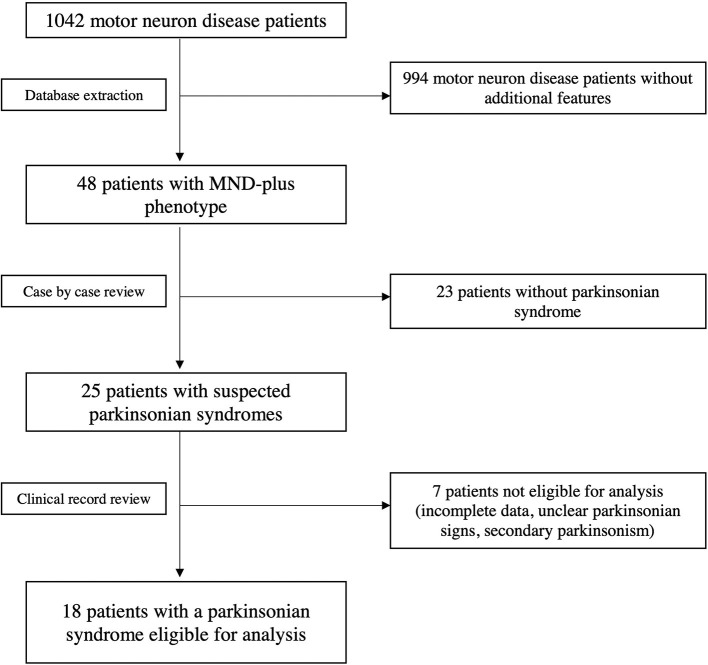
Background: Parkinsonian syndromes may rarely occur in motor neuron disease (MND). However, previous studies are heterogeneous and mostly case reports or small case series. Therefore, we aimed to identify and characterize patients with concurrent parkinsonian syndromes extracted from a cohort of 1,042 consecutive cases diagnosed with MND at a tertiary Italian Center.
Methods: Diagnosis of Parkinson's disease (PD), progressive supranuclear palsy (PSP) and corticobasal syndrome (CBS) was made according to current criteria. Clinical characterization included: upper and lower motor neuron disease features, typical and atypical parkinsonian features, oculomotor disorders, cognitive testing, MRI features, and, when available molecular neuroimaging. Genetic testing was carried out for major MND and PD-associated genes.
Results: Parkinsonian syndromes were diagnosed in 18/1042 (1.7%) of MND patients (7 PD, 6 PSP, 3 CBS, 2 other parkinsonisms). Based on phenotype, patients could be categorized into amyotrophic lateral sclerosis (ALS)-parkinsonism and primary lateral sclerosis (PLS)-parkinsonism clusters. Across the whole database, parkinsonism was significantly more common in PLS than in other MND phenotypes (12.1 vs. 1.1%, p = 5.0 × 10⁻¹⁰). MND patients with parkinsonian features had older age of onset, higher frequency of oculomotor disorders, cognitive impairment, and family history of parkinsonism or dementia. Two patients showed pathogenic mutations in TARDBP and C9orf72 genes.
Conclusion: Specific patterns in MND-parkinsonism were observed, with PLS patients often showing atypical parkinsonian syndromes and ALS patients more frequently showing typical PD. Systematic clinical, genetic, and neuropathologic characterization may provide a better understanding of these phenotypes.
Keywords: amyotrophic lateral sclerosis; motor neuron disease (MND); parkinsonism; primary lateral sclerosis (PLS); progressive supranuclear palsy.
Copyright © 2022 Pasquini, Trogu, Morelli, Poletti, Girotti, Peverelli, Brusati, Ratti, Ciammola, Silani and Ticozzi.
Conflict of interest statement
JP is the recipient of a European Academy of Neurology Research Fellowship grant. AR received research funding from AriSLA. VS received compensation for consulting services and/or speaking activities from AveXis, Cytokinetics, Italfarmaco, Liquidweb Srl, and Novartis Pharma AG. He receives or has received research support from the Italian Ministry of Health, AriSLA, and E-Rare Joint Transnational Call. He is on the Editorial Board of Amyotrophic Lateral Sclerosis and Frontotemporal Degeneration, European Neurology, American Journal of Neurodegenerative Diseases, and Frontiers in Neurology. NT received research funding from the Italian Ministry of Health and AriSLA. The remaining authors declare that the research was conducted in the absence of any commercial or financial relationships that could be construed as a potential conflict of interest.
Figures
References
-
- Brooks B. R., Miller R. G., Swash M., Munsat T. L. (2000). World Federation of Neurology Research Group on Motor Neuron Diseases. El Escorial revisited: revised criteria for the diagnosis of amyotrophic lateral sclerosis. Amyotroph Lateral Scler Other Motor Neuron. Disord. 1, 293–299. 10.1080/146608200300079536 - DOI - PubMed
LinkOut - more resources
Full Text Sources
Miscellaneous
