Review
. 2022 Jun 27:13:934877.
doi: 10.3389/fpls.2022.934877. eCollection 2022.

Molecular Mechanisms of Plant Responses to Salt Stress

Affiliations
Review

Molecular Mechanisms of Plant Responses to Salt Stress

Liang Ma et al. Front Plant Sci. .

Abstract

Saline-alkali soils pose an increasingly serious global threat to plant growth and productivity. Much progress has been made in elucidating how plants adapt to salt stress by modulating ion homeostasis. Understanding the molecular mechanisms that affect salt tolerance and devising strategies to develop/breed salt-resilient crops have been the primary goals of plant salt stress signaling research over the past few decades. In this review, we reflect on recent major advances in our understanding of the cellular and physiological mechanisms underlying plant responses to salt stress, especially those involving temporally and spatially defined changes in signal perception, decoding, and transduction in specific organelles or cells.

Keywords: SOS pathway; epigenetic regulation; hormonal regulation; salt stress; signal transduction.


Conflict of interest statement

The authors declare that the research was conducted in the absence of any commercial or financial relationships that could be construed as a potential conflict of interest.

Figures
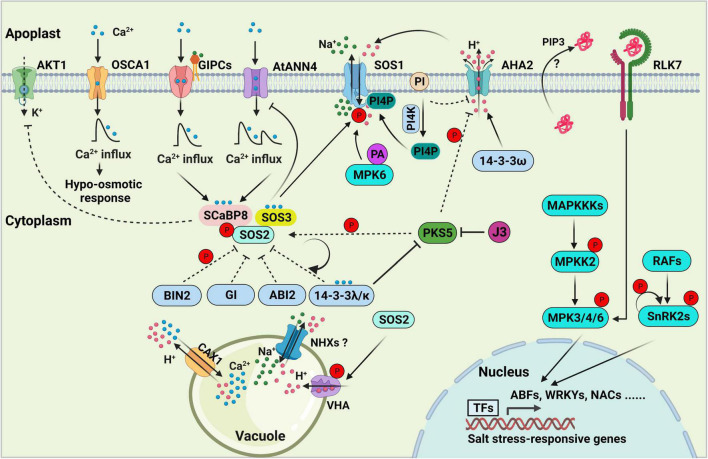
FIGURE 1
FIGURE 1
Salt stress signal transduction in plants. The SOS pathway, consisting of SOS3, SCaBP8, SOS2, and SOS1, is essential for decoding salt-induced calcium signals and maintaining ionic homeostasis in the plant cell. 14-3-3, GIGANTEA (GI), ABI2, and BIN2 proteins negatively regulate SOS pathway activity by directly interacting with SOS2 and repressing its kinase activity. PKS5-mediated phosphorylation of SOS2 enhances its interaction with 14-3-3, thereby inhibiting and maintaining basal levels of SOS2 activity under normal conditions. Arabidopsis K+ TRANSPORTER 1 (AKT1) activity is repressed by SCaBP8. GIPCs might function as monovalent-cation sensors that bind to Na+ and initiate calcium influx, which further activates the SOS pathway. AtANN4, a putative calcium-permeable transporter, might also generate calcium influx to activate the SOS pathway under salt stress. OSCA1 functions as an osmosensor to generate osmotic Ca2+ signaling in response to osmotic stress. Feedback regulation of AtANN4 by the SOS pathway is required to fine-tune the formation and duration of salt-induced calcium influx and long-term salt stress responses. Phosphatidylinositol (PI) directly binds to the C-terminus of the plasma membrane (PM) H+-ATPase AHA2 to repress its activity. PI is converted into phosphatidylinositol 4-phosphate (PI4P) to release the inhibition of AHA2 under salt stress. PI4P binds to and activates the PM Na+/H+ antiporter SOS1. PIP3 and RLK7 accumulate under salt stress, and the PIP3-RLK7 interaction contributes to the activation of RLK7, resulting in the activation of MPK3/6 to transduce stress signals. MAP kinase cascades are involved in regulating salt stress signal transduction. RAFs are required for the phosphorylation and activation of SnRK2s in response to salt-induced osmotic stress, and SnRK2 activity is amplified by auto-phosphorylation. In the nucleus, several specific transcription factors that are downstream targets of MPKs and SnRK2s bind to and activate the expression of salt stress-responsive genes. In the vacuole, NHXs, CAX1, the vacuolar Ca2+/H+ antiporter and vacuolar H+-ATPase (VHA) exclude Na+ from the cell. The dashed lines indicate regulatory roles under normal conditions.
FIGURE 2
FIGURE 2
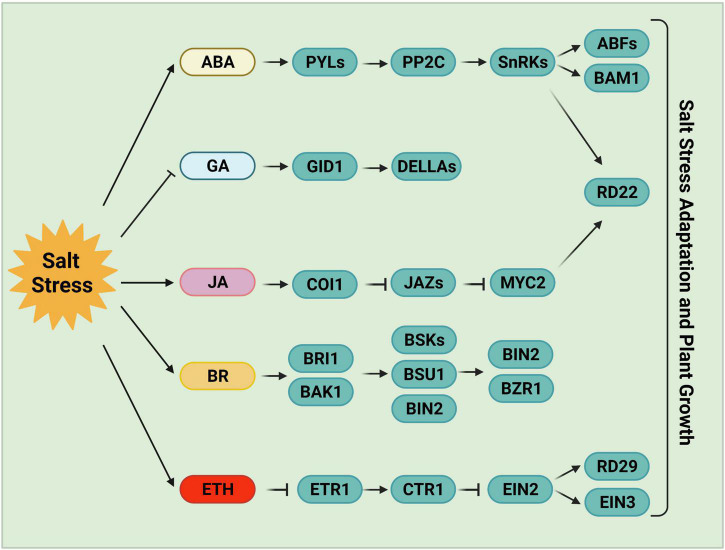
Phytohormone-mediated salt stress responses. ABA, one of the most important stress response hormones, plays a crucial role in salt stress tolerance. ABA-activated SnRK2s regulate stomatal closure, osmotic homeostasis, and gene expression. Salt stress negatively regulates the accumulation of bioactive GAs, and the reduced GAs levels or inactivated GAs promote plant salt tolerance following germination. JA levels increase and JA signaling is activated by high salinity stress. JA is required for the inhibition of primary root growth, which may be an adaptive strategy for survival under salt stress. BR, a growth-promoting phytohormone, accumulates upon salt stress to positively regulate plant salt tolerance. BR induces the formation of the BRI1-BAK1 heterodimer, which then initiates the phosphorylation relay cascades among BSKs, BSU1, and BIN2, ultimately remodeling gene expression via the regulation of BZR1 and BES1. Ethylene also accumulates under salt stress in plants. The components involved in ethylene homeostasis or the ethylene signaling pathway play either positive or negative roles in salt stress responses. ABA, abscisic acid; GA, gibberellin; JA, jasmonic acid; BR, brassinosteroid; ETH, ethylene.

References

    1. Abe H., Urao T., Ito T., Seki M., Shinozaki K., Yamaguchi-Shinozaki K. (2003). Arabidopsis AtMYC2 (bHLH) and AtMYB2 (MYB) function as transcriptional activators in abscisic acid signaling. Plant Cell 15 63–78. 10.1105/tpc.006130 - DOI - PMC - PubMed
    1. Achard P., Cheng H., De Grauwe L., Decat J., Schoutteten H., Moritz T., et al. (2006). Integration of plant responses to environmentally activated phytohormonal signals. Science 311 91–94. 10.1126/science.1118642 - DOI - PubMed
    1. Alzwiy I. A., Morris P. C. (2007). A mutation in the Arabidopsis MAP kinase kinase 9 gene results in enhanced seedling stress tolerance. Plant Sci. 173 302–308.
    1. Arioli T., Peng L., Betzner A. S., Burn J., Wittke W., Herth W., et al. (1998). Molecular analysis of cellulose biosynthesis in Arabidopsis. Science 279 717–720. - PubMed
    1. Ascenzi R., Gantt J. S. (1997). A drought-stress-inducible histone gene in Arabidopsis thaliana is a member of a distinct class of plant linker histone variants. Plant Mol. Biol. 34 629–641. 10.1023/a:1005886011722 - DOI - PubMed