Occurrence, genetic diversity and zoonotic potential of Blastocystis sp. in forest musk deer (Moschus berezovskii) in Southwest China
- PMID: 35833784
- PMCID: PMC9281496
- DOI: 10.1051/parasite/2022037
Occurrence, genetic diversity and zoonotic potential of Blastocystis sp. in forest musk deer (Moschus berezovskii) in Southwest China
Abstract
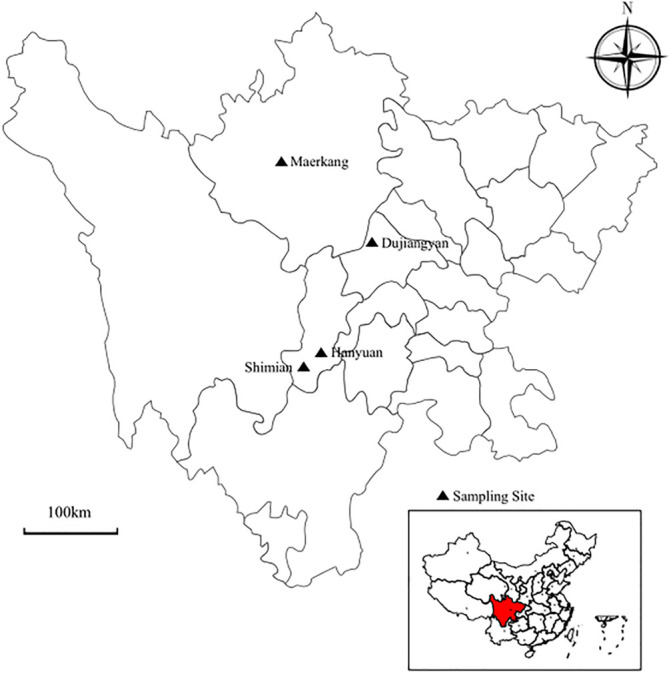
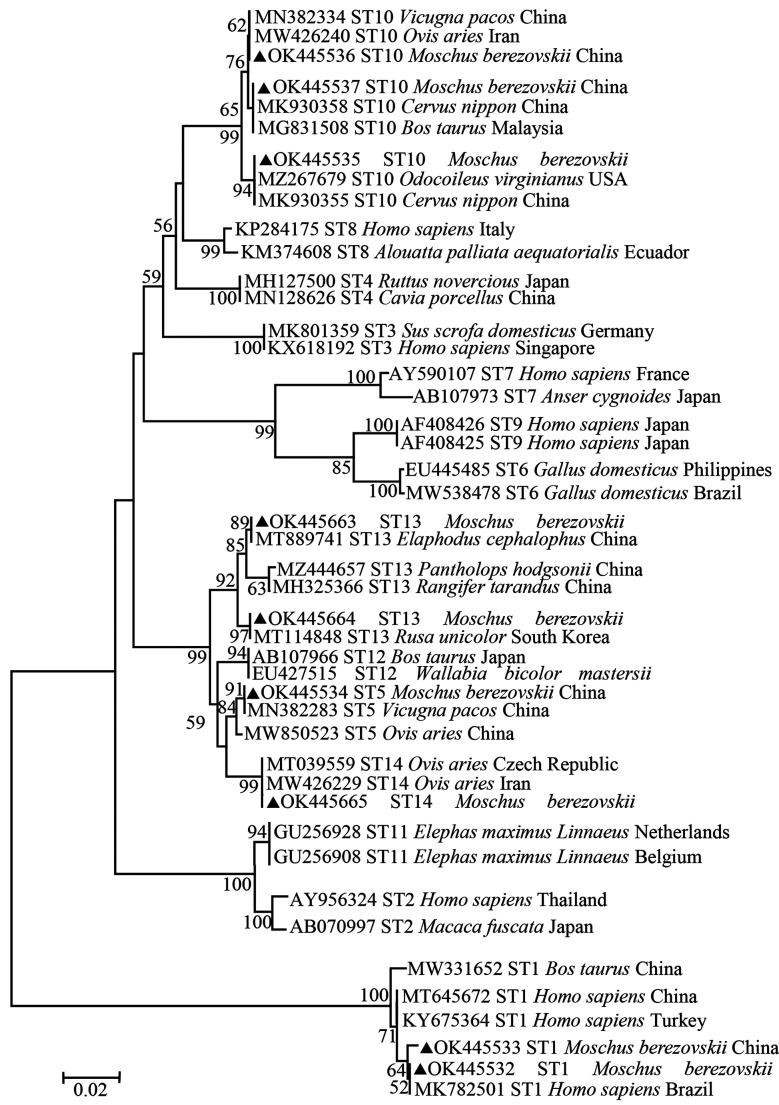
Blastocystis sp. is a common anaerobic protist with controversial pathogenicity that can infect various animals and humans. However, there are no reports of Blastocystis sp. infections in forest musk deer (Moschus berezovskii). The present study was designed to examine the occurrence, subtype distribution and genetic characterization of Blastocystis sp. in forest musk deer in southwestern China, and to assess the potential for zoonotic transmission. A total of 504 fresh stool samples were collected from captive forest musk deer in four distinct areas of southwestern China. Overall, 14.7% of the forest musk deer (74/504) were found to be infected with Blastocystis sp. The highest occurrence of Blastocystis sp. was observed in Dujiangyan (27.5%), followed by Maerkang (23.3%). The occurrence of Blastocystis sp. was 7.9% and 4.1% in Shimian and Hanyuan, respectively. Significant differences in the occurrence of Blastocystis sp. among different areas were observed (p < 0.05), while we did not observe significant differences among animals of different age and sex (p > 0.05). Two known zoonotic subtypes (ST1 and ST5) and three animal-predominant subtypes (ST10, ST13, and ST14) were identified, of which ST10 was the most common (36/74, 48.6%). Our findings highlight that forest musk deer may be potential reservoirs of zoonotic human Blastocystis sp. infections.
Title: Présence, diversité génétique et potentiel zoonotique de Blastocystis sp. chez le cerf porte-musc (Moschus berezovskii) dans le sud-ouest de la Chine.
Abstract: Blastocystis sp. est un protiste anaérobie commun, de pathogénicité controversée, et qui peut infecter divers animaux et les humains. Cependant, aucun cas d’infection par Blastocystis sp. n’a été rapporté chez le cerf porte-musc (Moschus berezovskii). La présente étude a été conçue pour examiner la présence, la distribution des sous-types et la caractérisation génétique de Blastocystis sp. chez le cerf porte-musc du sud-ouest de la Chine et pour évaluer son potentiel de transmission zoonotique. Au total, 504 échantillons de selles fraîches ont été prélevés sur des cerfs porte-musc captifs dans quatre régions distinctes du sud-ouest de la Chine. Dans l’ensemble, 14,7 % (74/504) des cerfs porte-musc se sont avérés infectés par Blastocystis sp. La plus forte occurrence de Blastocystis sp. a été observée à Dujiangyan (27,5 %), suivi de Maerkang (23,3 %). La présence de Blastocystis sp. était respectivement de 7,9 % et 4,1 % à Shimian et Hanyuan. Des différences significatives dans la présence de Blastocystis sp. entre les différentes zones ont été observées (p < 0,05), alors que nous n’avons pas observé de différences significatives entre les animaux d’âge et de sexe différents (p > 0,05). Deux sous-types zoonotiques connus (ST1 et ST5) et trois sous-types à prédominance animale (ST10, ST13 et ST14) ont été identifiés, dont ST10 était le sous-type le plus courant (36/74, 48,6 %). Nos découvertes mettent en évidence que le cerf porte-musc forestier peut être un réservoir potentiel d’infections à Blastocystis sp.
Keywords: Blastocystis sp.; China; Forest musk deer; Prevalence; Zoonotic potential.
© S. Chen et al., published by EDP Sciences, 2022.
Figures
References
-
- Ajjampur SS, Tan KS. 2016. Pathogenic mechanisms in Blastocystis spp. – Interpreting results from in vitro and in vivo studies. Parasitology International, 65(6 Pt B), 772–779. - PubMed
-
- Alfellani MA, Stensvold CR, Vidal-Lapiedra A, Onuoha ES, Fagbenro-Beyioku AF, Clark CG. 2013. Variable geographic distribution of Blastocystis subtypes and its potential implications. Acta Tropica, 126(1), 11–18. - PubMed
-
- Alfellani MA, Taner-Mulla D, Jacob AS, Imeede CA, Yoshikawa H, Stensvold CR, Clark CG. 2013. Genetic diversity of Blastocystis in livestock and zoo animals. Protist, 164(4), 497–509. - PubMed
MeSH terms
Substances
Grants and funding
LinkOut - more resources
Full Text Sources