


Antisense Oligonucleotide Rescue of Deep-Intronic Variants Activating Pseudoexons in the 6-Pyruvoyl-Tetrahydropterin Synthase Gene
- PMID: 35833796
- PMCID: PMC9595628
- DOI: 10.1089/nat.2021.0066
Antisense Oligonucleotide Rescue of Deep-Intronic Variants Activating Pseudoexons in the 6-Pyruvoyl-Tetrahydropterin Synthase Gene
Abstract
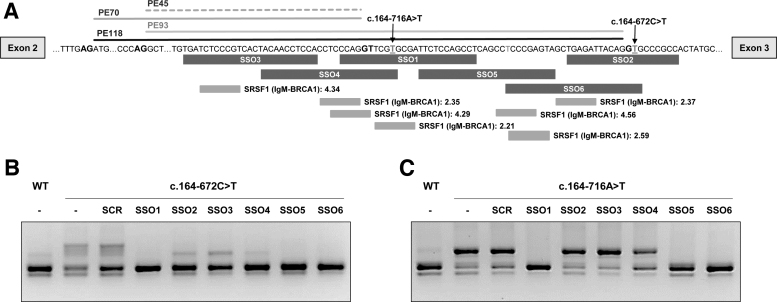
We report two new 6-pyruvoyl-tetrahydropterin synthase splicing variants identified through genomic sequencing and transcript analysis in a patient with tetrahydrobiopterin deficiency, presenting with hyperphenylalaninemia and monoamine neurotransmitter deficiency. Variant c.243 + 3A>G causes exon 4 skipping. The deep-intronic c.164-672C>T variant creates a potential 5' splice site that leads to the inclusion of four overlapping pseudoexons, corresponding to exonizations of an antisense short interspersed nuclear element AluSq repeat sequence. Two of the identified pseudoexons have been reported previously, activated by different deep-intronic variants, and were also detected at residual levels in control cells. Interestingly, the predominant pseudoexon is nearly identical to a disease causing activated pseudoexon in the F8 gene, with the same 3' and 5' splice sites. Splice switching antisense oligonucleotides (SSOs) were designed to hybridize with splice sites and/or predicted binding sites for regulatory splice factors. Different SSOs corrected the aberrant pseudoexon inclusion, both in minigenes and in fibroblasts from patients carrying the new variant c.164-672C>T or the previously described c.164-716A>T. With SSO treatment PTPS protein was recovered, illustrating the therapeutic potential of the approach, for patients with different pseudoexon activating variants in the region. In addition, the natural presence of pseudoexons in the wild type context suggests the possibility of applying the antisense strategy in patients with hypomorphic PTS variants with the purpose of upregulating their expression to increase overall protein and activity.
Keywords: antisense oligonucleotides; pseudoexons; splicing; tetrahydrobiopterin.
Conflict of interest statement
No competing financial interests exist.
Figures




References
-
- Werner ER, Blau N, and Thony B. (2011). Tetrahydrobiopterin: biochemistry and pathophysiology. Biochem J 438:397–414. - PubMed
-
- Blau N, Thony B, Cotton GH, and Hyland K. (2001). Disorders of tetrahydrobioterin and related biogenic amines. In: The Metabolic and Molecular Basis of Inherited Disease, Scriver C.R. et al. eds., 8th edn. McGraw-Hill, New York, pp. 1725–1776.
-
- Baralle D, and Buratti E. (2017). RNA splicing in human disease and in the clinic. Clin Sci (Lond) 131:355–368. - PubMed
Publication types
MeSH terms
Substances
LinkOut - more resources
Full Text Sources
Other Literature Sources
Miscellaneous
