. 2022 Jul 14;17(7):e0271125.
doi: 10.1371/journal.pone.0271125. eCollection 2022.

A taxonomically representative strain collection to explore xenobiotic and secondary metabolism in bacteria

Affiliations

A taxonomically representative strain collection to explore xenobiotic and secondary metabolism in bacteria

Evanthia Kontomina et al. PLoS One. .

Abstract

Bacteria employ secondary metabolism to combat competitors, and xenobiotic metabolism to survive their chemical environment. This project has aimed to introduce a bacterial collection enabling comprehensive comparative investigations of those functions. The collection comprises 120 strains (Proteobacteria, Actinobacteria and Firmicutes), and was compiled on the basis of the broad taxonomic range of isolates and their postulated biosynthetic and/or xenobiotic detoxification capabilities. The utility of the collection was demonstrated in two ways: first, by performing 5144 co-cultures, recording inhibition between isolates and employing bioinformatics to predict biosynthetic gene clusters in sequenced genomes of species; second, by screening for xenobiotic sensitivity of isolates against 2-benzoxazolinone and 2-aminophenol. The co-culture medium of Bacillus siamensis D9 and Lysinibacillus sphaericus DSM 28T was further analysed for possible antimicrobial compounds, using liquid chromatography-mass spectrometry (LC-MS), and guided by computational predictions and the literature. Finally, LC-MS analysis demonstrated N-acetylation of 3,4-dichloroaniline (a toxic pesticide residue of concern) by the actinobacterium Tsukamurella paurometabola DSM 20162T which is highly tolerant of the xenobiotic. Microbial collections enable "pipeline" comparative screening of strains: on the one hand, bacterial co-culture is a promising approach for antibiotic discovery; on the other hand, bioremediation is effective in combating pollution, but requires knowledge of microbial xenobiotic metabolism. The presented outcomes are anticipated to pave the way for studies that may identify bacterial strains and/or metabolites of merit in biotechnological applications.


Conflict of interest statement

The authors have declared that no competing interests exist.

Figures
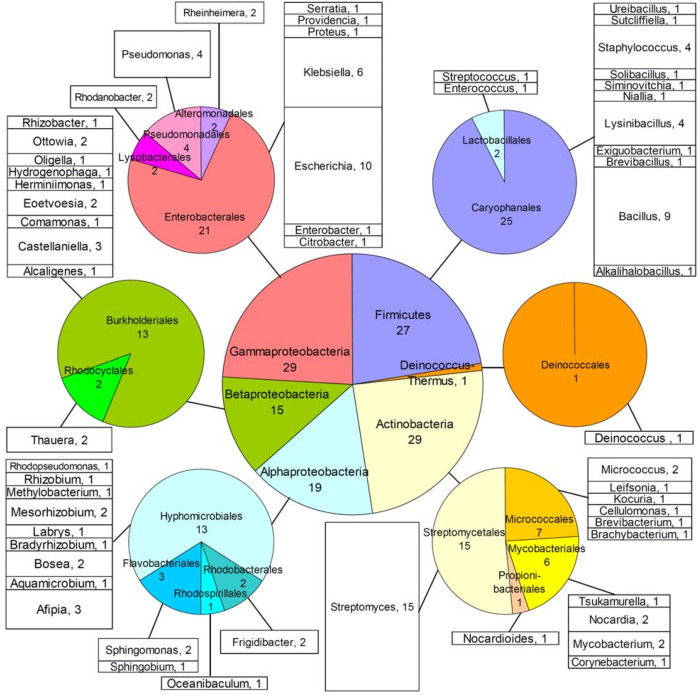
Fig 1
Fig 1. The bacterial collection.
Distribution of 120 isolates in higher taxa (central pie), classes (peripheral pies) and genera (stacked columns). Details of isolates are provided in Table A in S1 File.
Fig 2
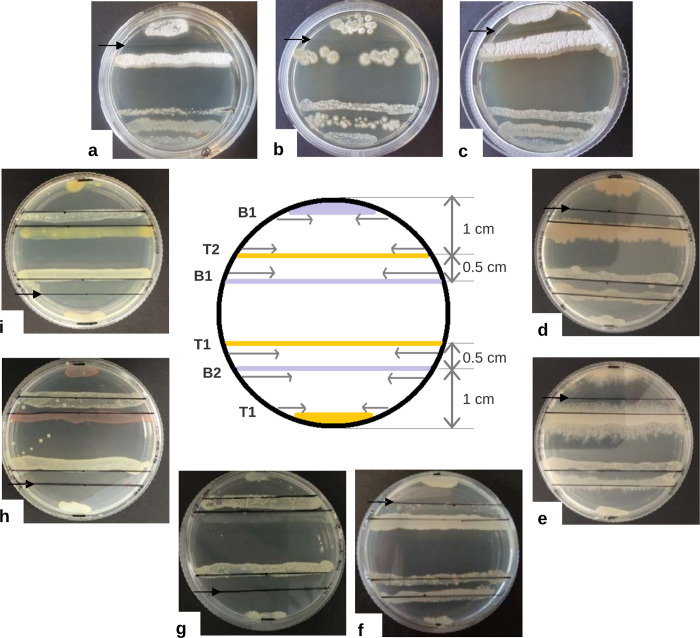
Fig 2. Examples of competition between Tsukamurella paurometabola and other bacterial isolates of the collection.
Co-culture of isolate #25-T. paurometabola DSM 20162T was performed according to the arrangement illustrated in the centre, as follows: each bacterial isolate was initially inoculated at diametrically opposite parts of a 60 x 15 mm Nutrient Agar (NA) plate. T. paurometabola was inoculated along the lines labelled T1, while the second bacterium was inoculated along the lines labelled B1. The two isolates were incubated until growth was readily visible. Subsequently, a second round of inoculation took place, with T. paurometabola inoculated along the line labelled T2 and the other bacterium inoculated along the line labelled B2. The approximate distance between those inoculated lines is indicated. Visual inspection of co-cultures took place daily, over a period of 10 d. Inoculation was performed using a sterile loop twice, and the isolates were spread along the lines in the direction indicated by the horizontal arrows. Representative results of this procedure are presented, as follows: clockwise, binary co-cultures with isolates #84-Streptomyces griseus subsp. griseus FBUA 801 (a), #87-Streptomyces sp. FBUA 1287 (b), #89-Streptomyces zaomyceticus FBUA 1571 (c), #26-Lysinibacillus sphaericus ZK38 (d), #30-Bacillus licheniformis B3 (e), #35-Bacillus siamensis D9 (f), #16- Sphingomonas sanxanigenens DSM 19645T (g), #53-Hydrogenophaga carboriunda TV-122 (h) and #74-Rhodanobacter lindaniclasticus RB3-4A (i). The photographs were taken 7 d after incubation of the co-cultures and the black arrows indicate the inoculation line of the inhibited isolate. T. paurometabola is inhibited by the Actinobacteria (a-c) and the Firmicutes (d-f), but inhibits the Proteobacteria (g-i).
Fig 3
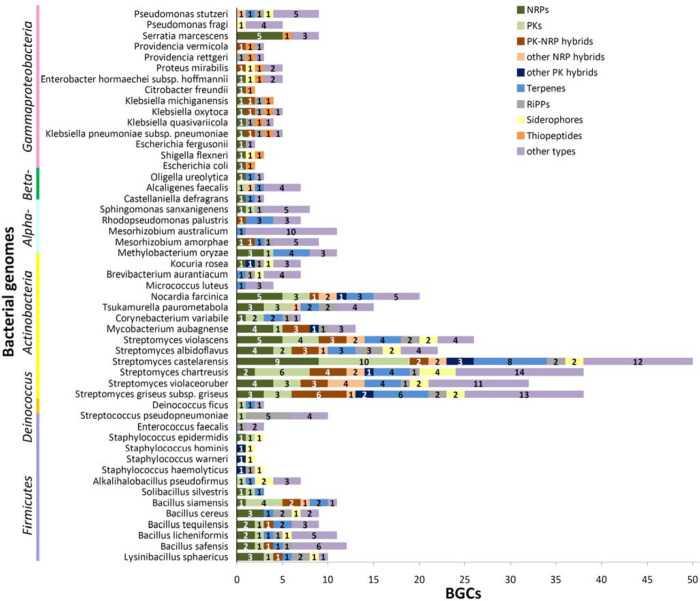
Fig 3. Distribution of biosynthetic gene clusters (BGCs) predicted in complete sequenced genomes of bacterial species represented in the collection.
The graph illustrates the distribution of clusters for non-ribosomal peptides (NRPs), polyketides (PKs), PK-NRP hybrids, other NRP or PK hybrids, terpenes, ribosomally synthesized and post-translationally modified peptides (RiPPs), siderophores, thiopeptides, or "other types".
Fig 4
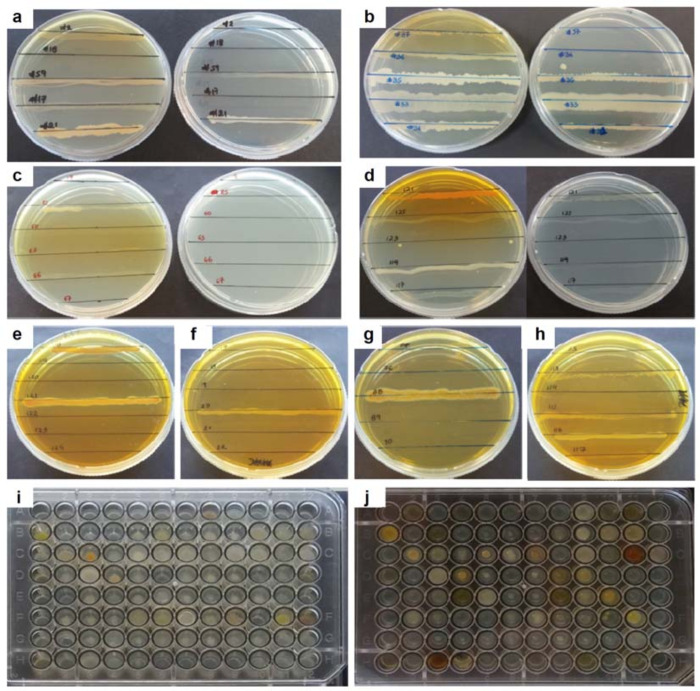
Fig 4. Sensitivity of bacterial isolates to xenobiotics.
In a-d, the examples shown are xenobiotic sensitivity screens with 2-benzoxazolinone (BOA) in concentrations of 500 or 1000 μg/mL (Petri dish on the left- or the right-hand side of each image, respectively). In e-h, the examples shown are xenobiotic sensitivity screens with 250 μg/mL of 2-aminophenol (2AP). In i and j, the xenobiotic sensitivity screens were repeated for monocultures grown in 96-well agar plates, and the example shows the results for 96 (of 107 total) bacterial isolates screened in the absence (i) or the presence (j) of BOA (500 μg/mL). Identical screens were also performed with 1000 μg/mL of BOA or 250 μg/mL of 2AP (not shown). In a-d, the displayed bacterial isolates are as follows: in a, isolates #2, #18, #59, #17 and #21; in b, isolates #37, #36, #35, #33 and #31; in c, isolates #19, #25, #60, #63, #66 and #67; in d, isolates #121, #125, #123, #119 and #117; in e, isolates #118, #119, #120, #121, #122, #123 and #124; in f, isolates #17, #18, #19, #20, #21 and #22; in g, isolates #87, #76, #88, #89 and #90; in h, isolates #105, #113, #114, #115, #116 and #117 (Table G in S1 File for details).
Fig 5
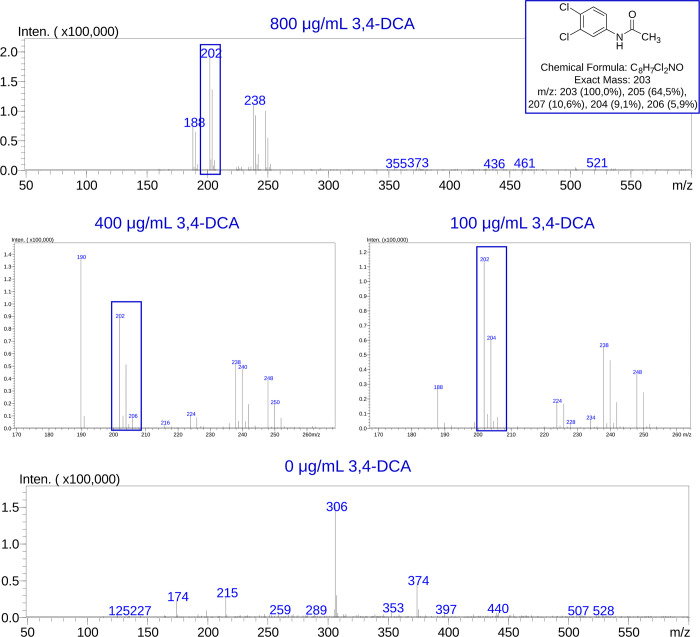
Fig 5. LC-MS analysis of xenobiotic-amended culture medium, following growth of isolate #25-T. paurometabola DSM 20162T.
The actinobacterium was allowed to grow in Nutrient Broth (NB) medium amended with 800, 400, 100 or 0 μg/mL of 3,4-dichloroaniline (3,4-DCA). The culture medium was then subjected to organic extraction and LC-MS analysis, to specifically look for possible N-acylated metabolic derivatives of the parent compound. Negative ion mode ESI spectrometry detected the characteristic isotopic pattern (peak intensity ratio 9:6:1, retention time ~8.5 min) of a bis-chlorinated compound with mass corresponding to the N-acetylated form of 3,4-DCA [M-H] (peaks and chemical structure in blue frames). This compound was absent in the extract of the culture that lacked the parent arylamine (0 μg/mL).

References

    1. Hunter-Cevera JC. The value of microbial diversity. Cur Opin Microbiol. 1998;1:278–285. doi: 10.1016/s1369-5274(98)80030-1 - DOI - PubMed
    1. Van der Meer JR, De Vos WM, Harayama S, Zehnder AJB. Molecular mechanisms of genetic adaptation to xenobiotic compounds. Microbiol Rev. 1992;56:677–694. doi: 10.1128/mr.56.4.677-694.1992 - DOI - PMC - PubMed
    1. Demain AL, Fang A. The natural functions of secondary metabolites. Adv Biochem Eng Biotechnol. 2000;69:1–39. doi: 10.1007/3-540-44964-7_1 - DOI - PubMed
    1. Hertweck C. The biosynthetic logic of polyketide diversity. Angew Chem Int Ed Engl. 2009;48:4688–4716. doi: 10.1002/anie.200806121 - DOI - PubMed
    1. Walsh CT, Fischbach MA. Natural Products Version 2.0: Connecting genes to molecules. J Am Chem Soc. 2010;132:2469–2493. doi: 10.1021/ja909118a - DOI - PMC - PubMed

Publication types