Dairy Manure Co-composting with Wood Biochar Plays a Critical Role in Meeting Global Methane Goals
- PMID: 35834734
- PMCID: PMC9352309
- DOI: 10.1021/acs.est.2c03467
Dairy Manure Co-composting with Wood Biochar Plays a Critical Role in Meeting Global Methane Goals
Erratum in
-
Correction to "Dairy Manure Co-composting with Wood Biochar Plays a Critical Role in Meeting Global Methane Goals".Environ Sci Technol. 2022 Oct 4;56(19):14216-14217. doi: 10.1021/acs.est.2c06350. Epub 2022 Sep 15. Environ Sci Technol. 2022. PMID: 36108150 Free PMC article. No abstract available.
Abstract
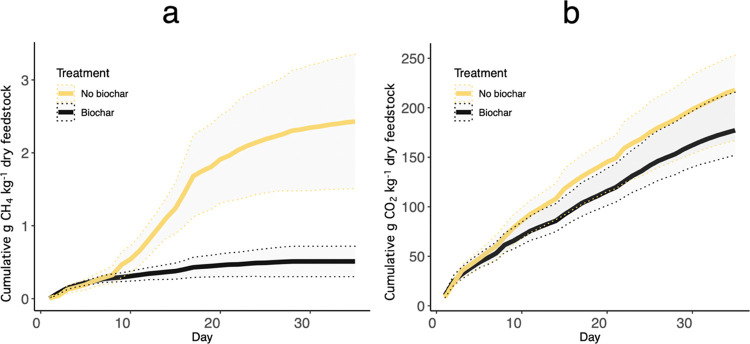
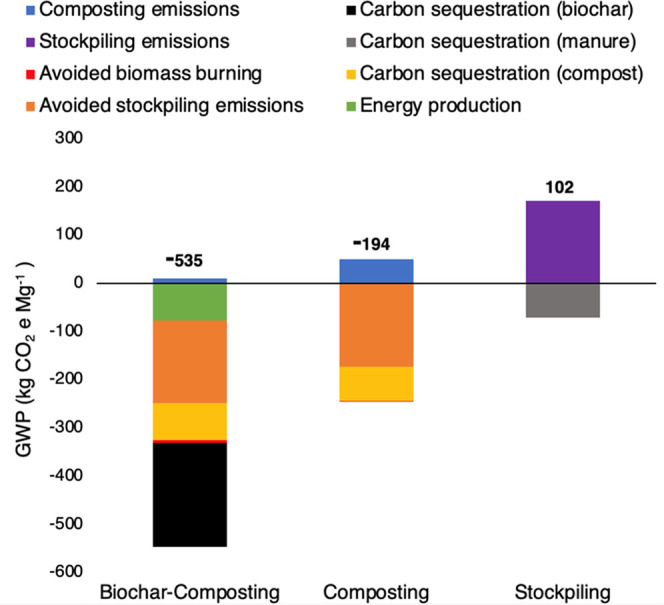
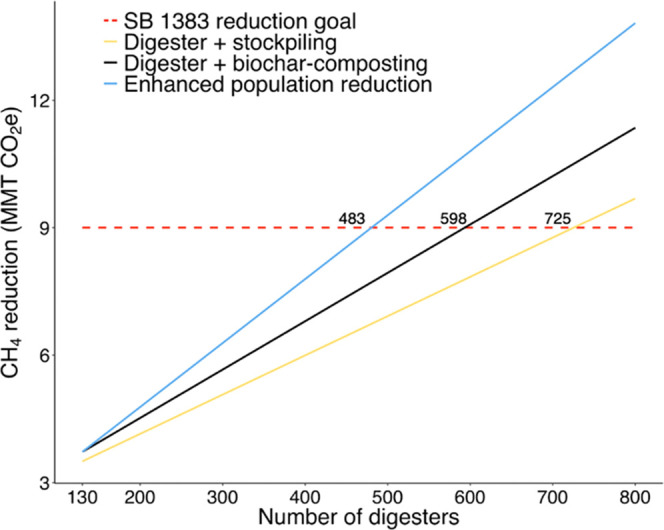
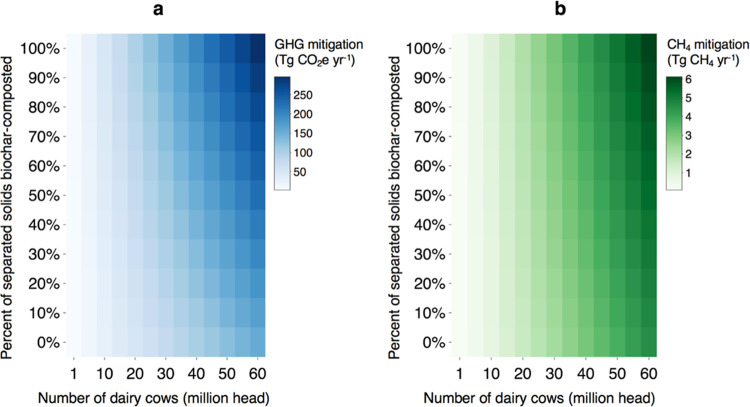
Livestock are the largest source of anthropogenic methane (CH4) emissions, and in intensive dairy systems, manure management can contribute half of livestock CH4. Recent policies such as California's short-lived climate pollutant reduction law (SB 1383) and the Global Methane Pledge call for cuts to livestock CH4 by 2030. However, investments in CH4 reduction strategies are primarily aimed at liquid dairy manure, whereas stockpiled solids remain a large source of CH4. Here, we measure the CH4 and net greenhouse gas reduction potential of dairy manure biochar-composting, a novel manure management strategy, through a composting experiment and life-cycle analysis. We found that biochar-composting reduces CH4 by 79%, compared to composting without biochar. In addition to reducing CH4 during composting, we show that the added climate benefit from biochar production and application contributes to a substantially reduced life-cycle global warming potential for biochar-composting: -535 kg CO2e Mg-1 manure compared to -194 kg CO2e Mg-1 for composting and 102 kg CO2e Mg-1 for stockpiling. If biochar-composting replaces manure stockpiling and complements anaerobic digestion, California could meet SB 1383 with 132 less digesters. When scaled up globally, biochar-composting could mitigate 1.59 Tg CH4 yr-1 while doubling the climate change mitigation potential from dairy manure management.
Keywords: biochar; climate change mitigation; composting; livestock; methane; natural climate solutions.
Conflict of interest statement
The authors declare no competing financial interest.
Figures
References
-
- Höglund-Isaksson L.; Gómez-Sanabria A.; Klimont Z.; Rafaj P.; Schöp W. Technical potentials and costs for reducing global anthropogenic methane emissions in the 2050 timeframe - results from the GAINS model. Environ. Res. Commum. 2020, 2, 025004 10.1088/2515-7620/ab7457. - DOI
-
- Herrero M.; Henderson B.; Havlík P.; Thornton P.; Conant R.; Smith P.; Wirsenius S.; Hristov A.; Gerber P.; Gill M.; Buterbach-Bahl K.; Valin H.; Garnett T.; Stehfest E. Greenhouse gas mitigation potentials in the livestock sector. Nat. Clim. Change 2016, 6, 452–461. 10.1038/nclimate2925. - DOI
Publication types
MeSH terms
Substances
LinkOut - more resources
Full Text Sources
Other Literature Sources
Miscellaneous