


Bioaccessibility of arsenic from contaminated soils and alteration of the gut microbiome in an in vitro gastrointestinal model
- PMID: 35835276
- PMCID: PMC9667710
- DOI: 10.1016/j.envpol.2022.119753
Bioaccessibility of arsenic from contaminated soils and alteration of the gut microbiome in an in vitro gastrointestinal model
Abstract
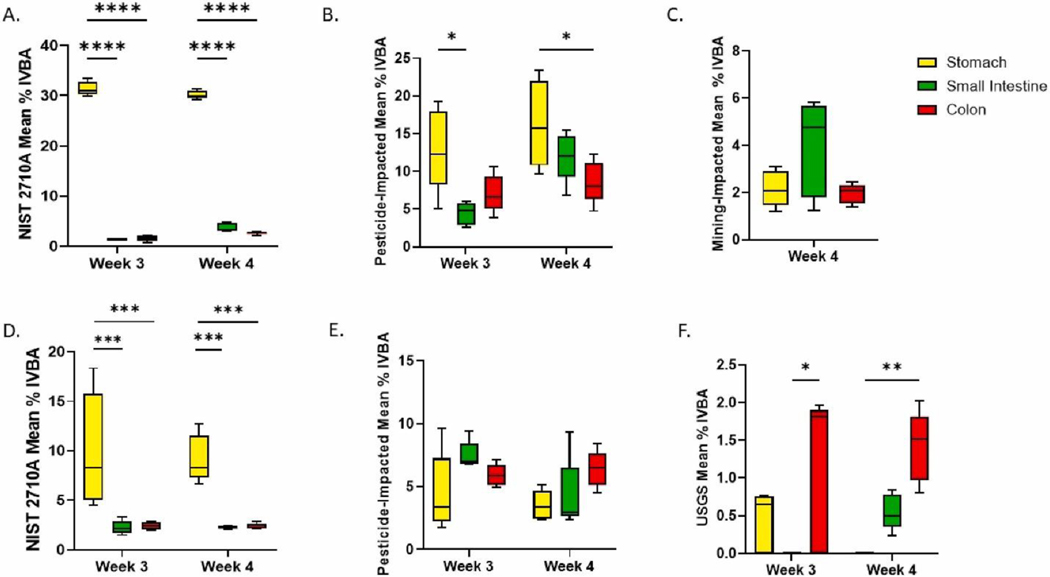
Arsenic exposure has been reported to alter the gut microbiome in mice. Activity of the gut microbiome derived from fecal microbiota has been found to affect arsenic bioaccessibility in an in vitro gastrointestinal (GI) model. Only a few studies have explored the relation between arsenic exposure and changes in the composition of the gut microbiome and in arsenic bioaccessibility. Here, we used simulated GI model system (GIMS) containing a stomach, small intestine, colon phases and microorganisms obtained from mouse feces (GIMS-F) and cecal contents (GIMS-C) to assess whether exposure to arsenic-contaminated soils affect the gut microbiome and whether composition of the gut microbiome affects arsenic bioaccessibility. Soils contaminated with arsenic did not alter gut microbiome composition in GIMS-F colon phase. In contrast, arsenic exposure resulted in the decline of bacteria in GIMS-C, including members of Clostridiaceae, Rikenellaceae, and Parabacteroides due to greater diversity and variability in microbial sensitivity to arsenic exposure. Arsenic bioaccessibility was greatest in the acidic stomach phase of GIMS (pH 1.5-1.7); except for GIMS-C colon phase exposed to mining-impacted soil in which greater levels of arsenic solubilized likely due to microbiome effects. Physicochemical properties of different test soils likely influenced variability in arsenic bioaccessibility (GIMS-F bioaccessibility range: 8-37%, GIMS-C bioaccessibility range: 2-18%) observed in this study.
Copyright © 2022 Elsevier Ltd. All rights reserved.
Conflict of interest statement
Declaration of competing interest
The authors declare that they have no known competing financial interests or personal relationships that could have appeared to influence the work reported in this paper.
Figures


References
-
- Agency for Toxic Substances and Disease Registry, 2017. ATSDR’s Substance Priority List, 2018 12/04/2018]; Available from: https://www.atsdr.cdc.gov/spl/#2017spl.
-
- Alava P, et al. , 2013. Arsenic bioaccessibility upon gastrointestinal digestion is highly determined by its speciation and lipid-bile salt interactions. J. Environ. Sci. Health - Part A Toxic/Hazard. Subst. Environ. Eng 48 (6), 656–665. - PubMed
-
- Alava P, et al. , 2015. Westernized diets lower arsenic gastrointestinal bioaccessibility but increase microbial arsenic speciation changes in the colon. Chemosphere 119, 757–762. - PubMed
MeSH terms
Substances
Grants and funding
LinkOut - more resources
Full Text Sources
Medical
