


Exercise and the Brain: Lessons From Invertebrate Studies
- PMID: 35836487
- PMCID: PMC9275788
- DOI: 10.3389/fnbeh.2022.928093
Exercise and the Brain: Lessons From Invertebrate Studies
Abstract
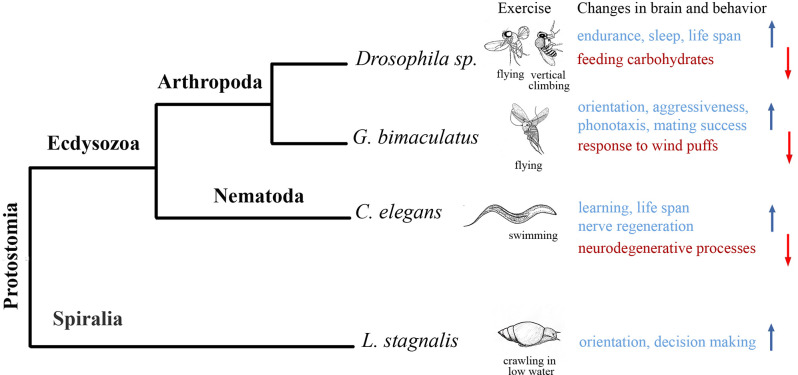
Benefits of physical exercise for brain functions are well documented in mammals, including humans. In this review, we will summarize recent research on the effects of species-specific intense locomotion on behavior and brain functions of different invertebrates. Special emphasis is made on understanding the biological significance of these effects as well as underlying cellular and molecular mechanisms. The results obtained in three distantly related clades of protostomes, Nematodes, Molluscs and Artropods, suggest that influence of intense locomotion on the brain could have deep roots in evolution and wide adaptive significance. In C. elegans, improved learning, nerve regeneration, resistance to neurodegenerative processes were detected after physical activity; in L. stagnalis-facilitation of decision making in the novel environment, in Drosophila-increased endurance, improved sleep and feeding behavior, in G. bimaculatus-improved orientation in conspecific phonotaxis, enhanced aggressiveness, higher mating success, resistance to some disturbing stimuli. Many of these effects have previously been described in mammals as beneficial results of running, suggesting certain similarity between distantly-related species. Our hypothesis posits that the above modulation of cognitive functions results from changes in the organism's predictive model. Intense movement is interpreted by the organism as predictive of change, in anticipation of which adjustments need to be made. Identifying the physiological and molecular mechanisms behind these adjustments is easier in experiments in invertebrates and may lead to the discovery of novel neurobiological mechanisms for regulation and correction of cognitive and emotional status.
Keywords: cognitive functions; desicion making; intense locomotion; invertebrate model organisms; learning and memory; motor performance; nerve regeneration; orientation.
Copyright © 2022 Dyakonova, Mezheritskiy, Boguslavsky, Dyakonova, Chistopolsky, Ito and Zakharov.
Conflict of interest statement
The authors declare that the research was conducted in the absence of any commercial or financial relationships that could be construed as a potential conflict of interest.
Figures
Similar articles
-
The Role of Serotonin in the Influence of Intense Locomotion on the Behavior Under Uncertainty in the Mollusk Lymnaea stagnalis.Front Physiol. 2020 Mar 17;11:221. doi: 10.3389/fphys.2020.00221. eCollection 2020. Front Physiol. 2020. PMID: 32256385 Free PMC article.
-
Previous motor activity affects the transition from uncertainty to decision making in snails.J Exp Biol. 2016 Nov 15;219(Pt 22):3635-3641. doi: 10.1242/jeb.146837. Epub 2016 Sep 8. J Exp Biol. 2016. PMID: 27609760
-
Unraveling the complexities of circadian and sleep interactions with memory formation through invertebrate research.Front Syst Neurosci. 2014 Aug 4;8:133. doi: 10.3389/fnsys.2014.00133. eCollection 2014. Front Syst Neurosci. 2014. PMID: 25136297 Free PMC article. Review.
-
Neurogenetics of courtship and mating in Drosophila.Adv Genet. 2008;62:67-184. doi: 10.1016/S0065-2660(08)00603-2. Adv Genet. 2008. PMID: 19010254 Review.
-
Enrichment Effects on Adult Cognitive Development: Can the Functional Capacity of Older Adults Be Preserved and Enhanced?Psychol Sci Public Interest. 2008 Oct;9(1):1-65. doi: 10.1111/j.1539-6053.2009.01034.x. Epub 2008 Oct 1. Psychol Sci Public Interest. 2008. PMID: 26162004
Cited by
-
Rest Induces a Distinct Transcriptional Program in the Nervous System of the Exercised L. stagnalis.Int J Mol Sci. 2025 Jul 20;26(14):6970. doi: 10.3390/ijms26146970. Int J Mol Sci. 2025. PMID: 40725218 Free PMC article.
-
Intense Locomotion Enhances Oviposition in the Freshwater Mollusc Lymnaea stagnalis: Cellular and Molecular Correlates.Biology (Basel). 2023 May 24;12(6):764. doi: 10.3390/biology12060764. Biology (Basel). 2023. PMID: 37372049 Free PMC article.
-
Nauphoeta cinerea as an emerging model in neurotoxicology.Adv Neurotoxicol. 2023;9:181-196. doi: 10.1016/bs.ant.2023.01.004. Epub 2023 Feb 27. Adv Neurotoxicol. 2023. PMID: 37389201 Free PMC article. No abstract available.
References
Publication types
LinkOut - more resources
Full Text Sources
Molecular Biology Databases
