Histone acetyltransferases CBP/p300 in tumorigenesis and CBP/p300 inhibitors as promising novel anticancer agents
- PMID: 35836809
- PMCID: PMC9274749
- DOI: 10.7150/thno.73223
Histone acetyltransferases CBP/p300 in tumorigenesis and CBP/p300 inhibitors as promising novel anticancer agents
Abstract
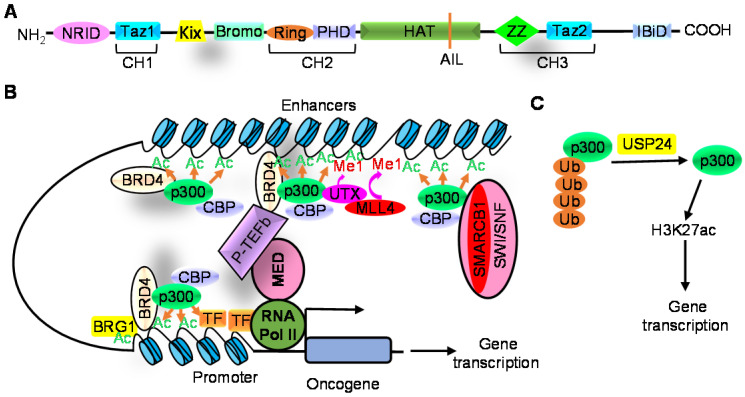
The histone acetyltransferases CBP and p300, often referred to as CBP/p300 due to their sequence homology and functional overlap and co-operation, are emerging as critical drivers of oncogenesis in the past several years. CBP/p300 induces histone H3 lysine 27 acetylation (H3K27ac) at target gene promoters, enhancers and super-enhancers, thereby activating gene transcription. While earlier studies indicate that CBP/p300 deletion/loss can promote tumorigenesis, CBP/p300 have more recently been shown to be over-expressed in cancer cells and drug-resistant cancer cells, activate oncogene transcription and induce cancer cell proliferation, survival, tumorigenesis, metastasis, immune evasion and drug-resistance. Small molecule CBP/p300 histone acetyltransferase inhibitors, bromodomain inhibitors, CBP/p300 and BET bromodomain dual inhibitors and p300 protein degraders have recently been discovered. The CBP/p300 inhibitors and degraders reduce H3K27ac, down-regulate oncogene transcription, induce cancer cell growth inhibition and cell death, activate immune response, overcome drug resistance and suppress tumor progression in vivo. In addition, CBP/p300 inhibitors enhance the anticancer efficacy of chemotherapy, radiotherapy and epigenetic anticancer agents, including BET bromodomain inhibitors; and the combination therapies exert substantial anticancer effects in mouse models of human cancers including drug-resistant cancers. Currently, two CBP/p300 inhibitors are under clinical evaluation in patients with advanced and drug-resistant solid tumors or hematological malignancies. In summary, CBP/p300 have recently been identified as critical tumorigenic drivers, and CBP/p300 inhibitors and protein degraders are emerging as promising novel anticancer agents for clinical translation.
Keywords: CBP/p300; cancer therapy; gene transcription; small molecule inhibitors; tumorigenesis.
© The author(s).
Conflict of interest statement
Competing Interests: The authors have declared that no competing interest exists.
Figures

References
-
- Vannini A, Cramer P. Conservation between the RNA polymerase I, II, and III transcription initiation machineries. Mol Cell. 2012;45:439–46. - PubMed
-
- Cramer P. Organization and regulation of gene transcription. Nature. 2019;573:45–54. - PubMed
-
- Sur I, Taipale J. The role of enhancers in cancer. Nat Rev Cancer. 2016;16:483–93. - PubMed
Publication types
MeSH terms
Substances
LinkOut - more resources
Full Text Sources
Other Literature Sources
Medical
Miscellaneous