Review
. 2022 Jun 28:13:927163.
doi: 10.3389/fphys.2022.927163. eCollection 2022.

Role of Inflammation in Cardiac Remodeling After Acute Myocardial Infarction

Affiliations
Review

Role of Inflammation in Cardiac Remodeling After Acute Myocardial Infarction

Francisco A Fonseca et al. Front Physiol. .

Abstract

Atherosclerosis is defined as an inflammatory disease. Low-grade inflammation is present in all phases of the cardiovascular continuum, since the establishment of cardiovascular risk factors and ischemic heart disease until cardiovascular events, such as myocardial infarction, heart failure and death. Not all inflammatory pathways are linked to cardiovascular outcomes, and thus, not all anti-inflammatory approaches decrease cardiovascular events. The most common cause of ventricular remodeling and heart failure is ischemic heart disease. Biomarkers such as high-sensitivity C-reactive protein can identify individuals at risk of major cardiovascular complications, but this biomarker has no causal effect on cardiovascular disease. On the other hand, interleukin 6 appears to be causally associated with cardiovascular disease. CANTOS was the first proof of concept study showing that anti-inflammatory therapy reduces major cardiovascular outcomes. Based on many anti-inflammatory trials, only therapies acting on the NLRP3 inflammasome, or interleukin 1beta, showed benefits on cardiovascular disease. Ventricular remodeling, particularly after myocardial infarction seems also influenced by the intensity of inflammatory responses, suggesting that anti-inflammatory therapies may reduce the residual cardiovascular risk. Inflammasome (NLRP3) activation, subtypes of lymphocytes, interleukin 6, and some inflammatory biomarkers, are associated with larger infarct size and impaired ventricular function after myocardial infarction. Cardiovascular risk factors commonly present in patients with myocardial infarction, and advanced age are associated with higher inflammatory activity.

Keywords: C-reactive protein; acute myocardial infarction; cardiac magnetic resonance imaging; interleukin-6; lymphocytes.


Conflict of interest statement

FF has served as a steering committee member in JUPITER and CANTOS trials, declares an investigator-initiated study with Astra Zeneca, and has served as a speaker for Astra Zeneca, Novo Nordisk, Boehringer, Lilly, Biolab, Libbs, Ache, and Novartis; MI has served as a speaker for PTC, Novartis, Ache, Amgen, Sanofi-Aventis, Abbott, and Amrit, and declares an investigator-initiated study with PTC.

Figures
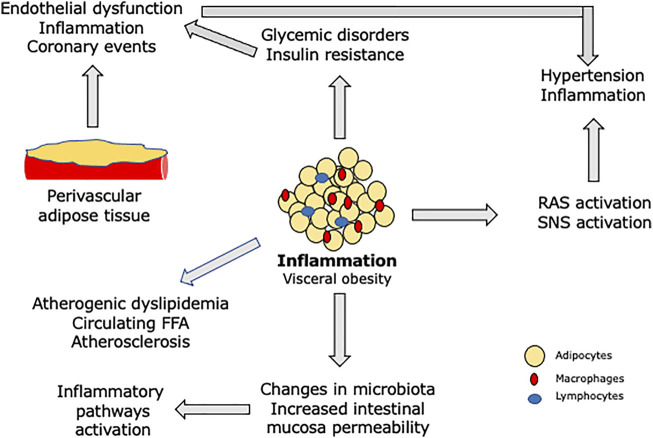
FIGURE 1
FIGURE 1
Pivotal role of inflammation in patients with metabolic syndrome. RAS—renin angiotensin system; SNS—sympathetic nervous system; FFA—free fatty acids. Perivascular adipose tissue causes endothelial dysfunction and local inflammation, contributing for atherosclerotic plaque complications. Changes in microbiota composition and higher permeability of the intestinal mucosa to bacterial products such as lipopolysaccharides activate inflammatory pathways. Macrophages and lymphocytes infiltrate visceral adipose tissue and release proinflammatory cytokines, which are related to insulin resistance. These cytokines and FFA change cell signaling related to insulin causing endothelial dysfunction, insulin resistance, and cardiovascular remodeling. The systemic inflammatory status is also related to increased thrombotic risk, leading to ischemic events.
FIGURE 2
FIGURE 2
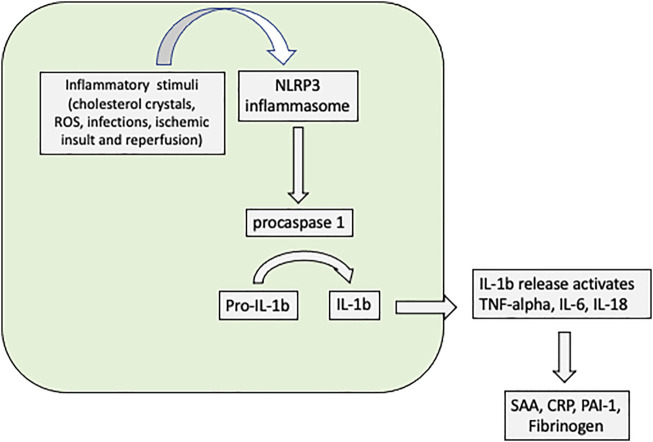
NLRP3 activation triggers the inflammatory pathway of atherosclerosis in monocytes and macrophages resident cells. The ischemic insult due to ischemia and reperfusion after acute myocadial infarction activates the inflammatory pathway mediated by NLRP3. ROS—reactive oxygen species; NLRP3 - nucleotide-binding and oligomerization-like receptor pyrin domain-containing protein 3; IL—interleukin; SAA—serum amyloid A; CRP—C-reactive protein; TNF-alpha—tumour necrosis factor—alpha; PAI-1—plasminogen activator inhibitor type 1. NLRP3 inflammasome is a common inflammatory platform where many stimuli (e.g., cholesterol crystals, ischemic conditions) can activate IL-1beta triggering the inflammatory pathway, including IL-6. The activation of IL-1beta reduces contractility in response to beta adrenergic stimuli and is associated with ventricular remodeling. Further, increase in CRP levels can be used for monitoring of the low-grade inflammation.

References

    1. Ahmadi A., Argulian E., Leipsic J., Newby D. E., Narula J. (2019). From Subclinical Atherosclerosis to Plaque Progression and Acute Coronary Events: JACC State-Of-The-Art Review. J. Am. Coll. Cardiol. 74, 1608–1617. 10.1016/j.jacc.2019.08.012 - DOI - PubMed
    1. Alkouri A., Cybularz M., Mierke J., Nowack T., Biedermann J., Ulbrich S., et al. (2022). The Predictive Role of Early CRP Values for One-Year Mortality in the First 2 D after Acute Myocardial Infarction. Biomarkers 27, 293–298. 10.1080/1354750X.2022.2040591 - DOI - PubMed
    1. Ambrose J. A., Tannenbaum M. A., Alexopoulos D., Hjemdahl-Monsen C. E., Leavy J., Weiss M., et al. (1988). Angiographic Progression of Coronary Artery Disease and the Development of Myocardial Infarction. J. Am. Coll. Cardiol. 12, 56–62. 10.1016/0735-1097(88)90356-7 - DOI - PubMed
    1. Andrié R. P., Becher U. M., Frommold R., Tiyerili V., Schrickel J. W., Nickenig G., et al. (2012). Interleukin-6 Is the Strongest Predictor of 30-day Mortality in Patients with Cardiogenic Shock Due to Myocardial Infarction. Crit. Care 16, R152. 10.1186/cc11467 - DOI - PMC - PubMed
    1. Arbab-Zadeh A., Fuster V. (2015). The Myth of the "vulnerable Plaque": Transitioning from a Focus on Individual Lesions to Atherosclerotic Disease Burden for Coronary Artery Disease Risk Assessment. J. Am. Coll. Cardiol. 65, 846–855. 10.1016/j.jacc.2014.11.041 - DOI - PMC - PubMed