


Modeling Transmission Dynamics and Risk Assessment for COVID-19 in Namibia Using Geospatial Technologies
- PMID: 35837572
- PMCID: PMC7886649
- DOI: 10.1007/s41403-021-00209-y
Modeling Transmission Dynamics and Risk Assessment for COVID-19 in Namibia Using Geospatial Technologies
Abstract
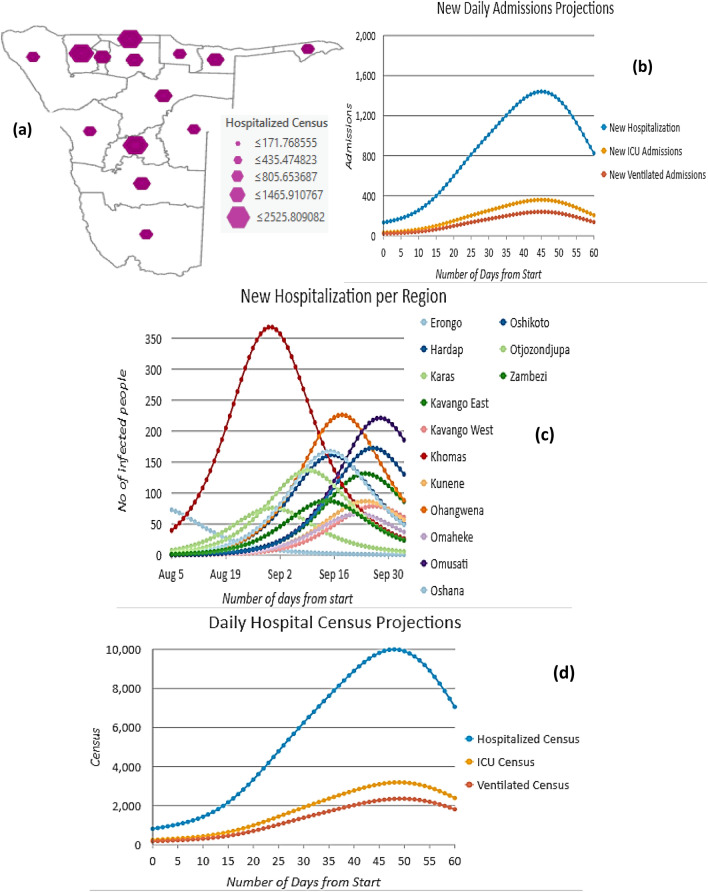
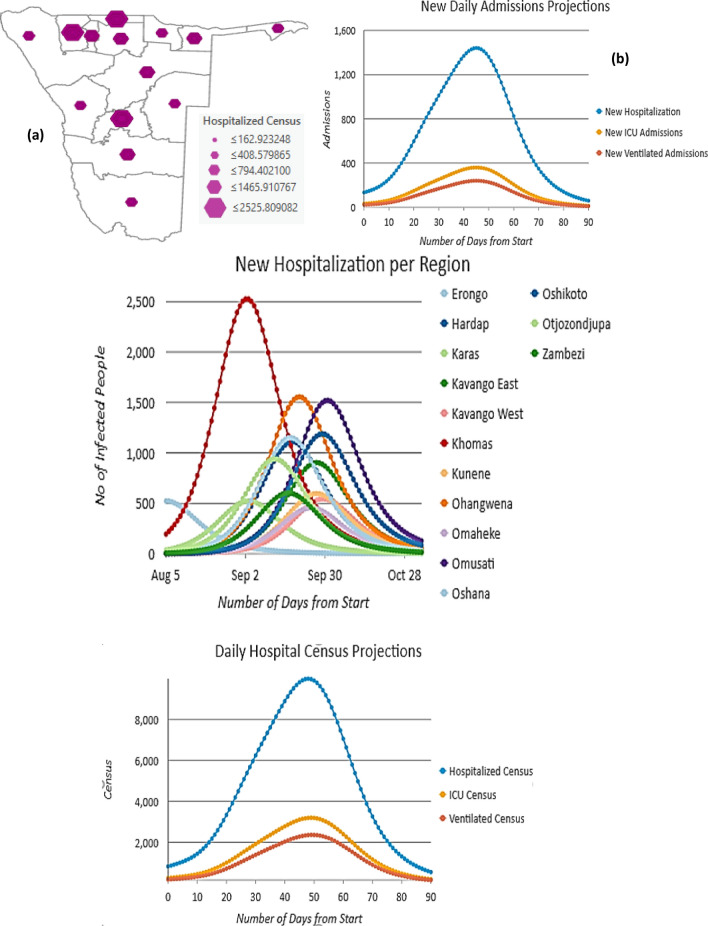
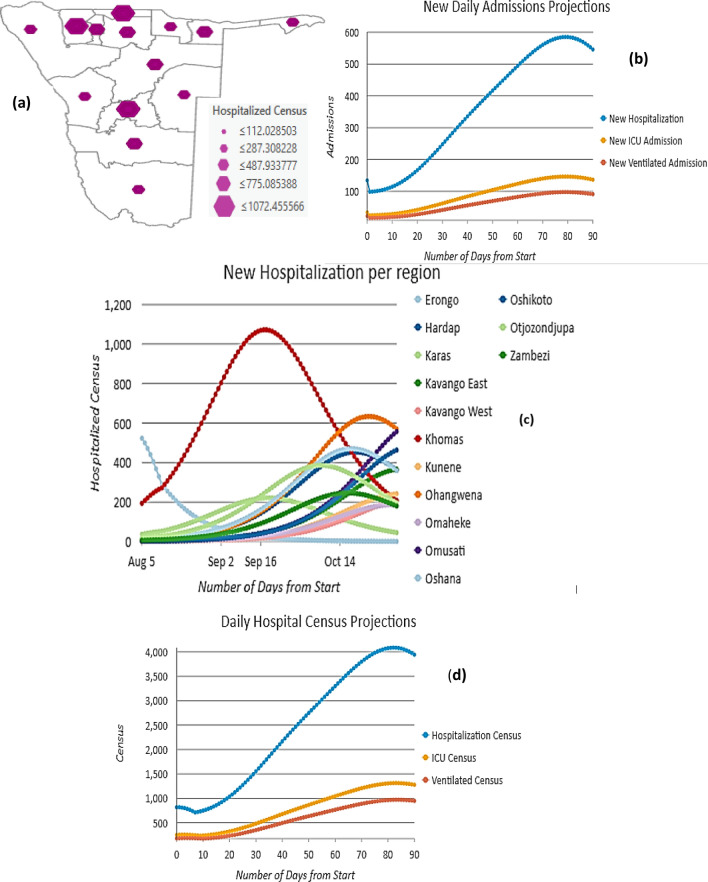
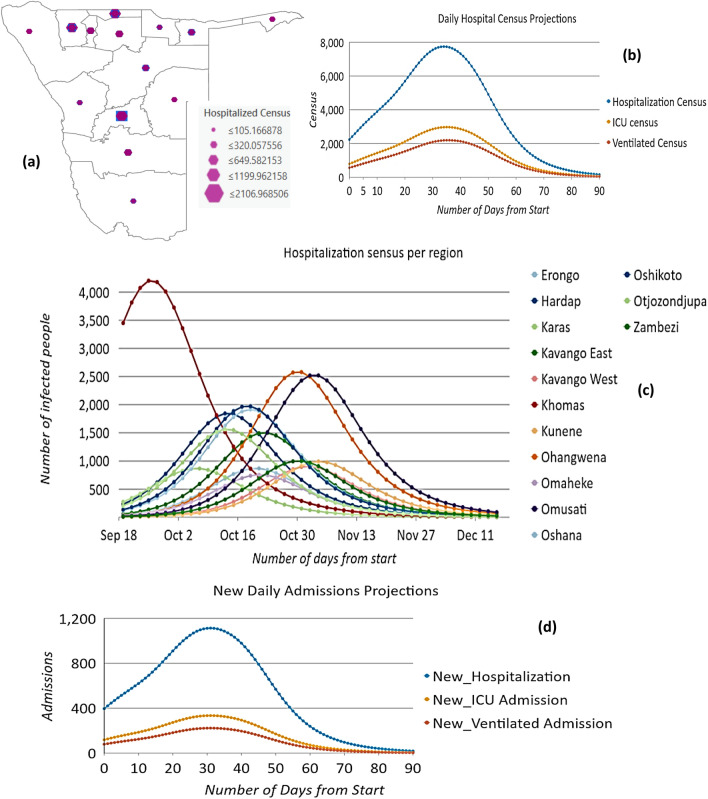
The SARS-CoV-2 infections continue to increase in Namibia and globally. Assessing and mapping the COVID-19 risk zones and modeling the response of COVID-19 using different scenarios are very vital to help decision-makers to estimate the immediate number of resources needed and plan for future interventions of COVID-19 in the area of interest. This study is aimed to identify and map COVID-19 risk zones and to model future COVID-19 response of Namibia using geospatial technologies. Population density, current COVID-19 infections, and spatial interaction index were used as proxy data to identify the different COVID-19 risk zones of Namibia. COVID-19 Hospital Impact Model for Epidemics (CHIME) V1.1.5 tool was used to model future COVID-19 responses with mobility restrictions. Weights were assigned for each thematic layer and thematic layer classes using the Analytical Hierarchy Process (AHP) tool. Suitably ArcGIS overlay analysis was conducted to produce risk zones. Current COVID-19 infection and spatial mobility index were found to be the dominant and sensitive factors for risk zoning in Namibia. Six different COVID-19 risk zones were identified in the study area, namely highest, higher, high, low, lower, and lowest. Modeling result revealed that mobility reduction by 30% within the country had a notable effect on controlling COVID-19 spread: a flattening of the peak number of cases and delay to the peak number. The research output could help policy-makers to estimate the immediate number of resources needed and plan for future interventions of COVID-19 in Namibia, especially to assess the potential positive effects of mobility restriction.
Keywords: CHIME modeling; COVID-19; Geospatial technology; Namibia; Spatial interaction index.
© Indian National Academy of Engineering 2021.
Conflict of interest statement
Conflict of InterestThe authors declare that they have no conflict of interests.
Figures



References
-
- An G, Jia F (2020) Analysis of the economic impact of the NCP and countermeasure study. Financ Theor Pract 3:45–51
-
- Centers for Disease Control and Prevention. Coronavirus disease 2019 (COVID-19) in the U.S. [cited 21 Feb 2020]. www.cdc.gov/coronavirus/2019-ncov/cases-in-us.html
-
- Champion T, Fotheringham S, Rees P, Boyle P, Stillwell J (1998) The determinants of migration flows in England: a review of existing data and evidence. Report prepared for the Department of the Environment, Transport and the Regions. The Department of Geography, University of Newcastle upon Tyne, Newcastle upon Tyne, UK, pp 31–128, ISBN 0-902155-39-3
-
- Flaxman S, Mishra S, Gandy A, Unwin HJT, Coupland H, Mellan TA, et al (2020) Imperial College COVID-19 Response Team. Report 13: estimating the number of infections and the impact of non-pharmaceutical interventions on COVID-19 in 11 European countries [Cited 20 Mar 2020]. https://www.imperial.ac.uk/media/imperial-college/medicine/sph/ide/gida-...
LinkOut - more resources
Full Text Sources
Miscellaneous