


Social Creativity and Entrepreneurial Intentions of College Students: Mediated by Career Adaptability and Moderated by Parental Entrepreneurial Background
- PMID: 35837633
- PMCID: PMC9275665
- DOI: 10.3389/fpsyg.2022.893351
Social Creativity and Entrepreneurial Intentions of College Students: Mediated by Career Adaptability and Moderated by Parental Entrepreneurial Background
Abstract
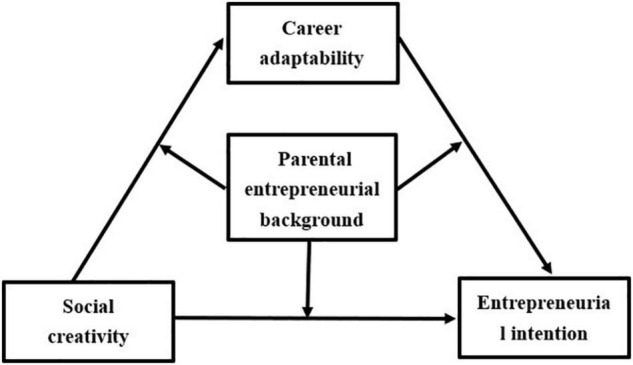
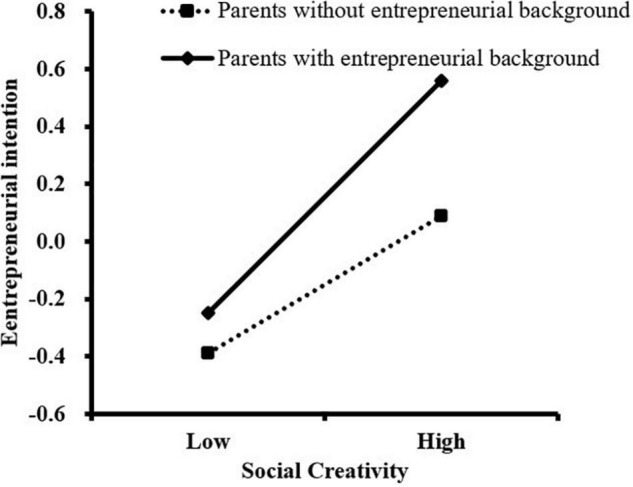
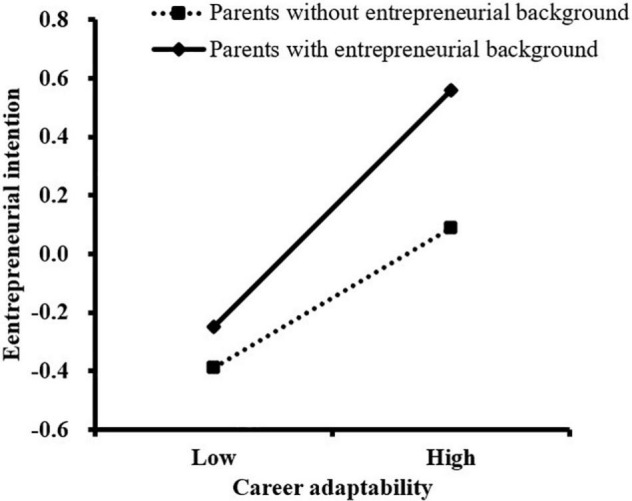
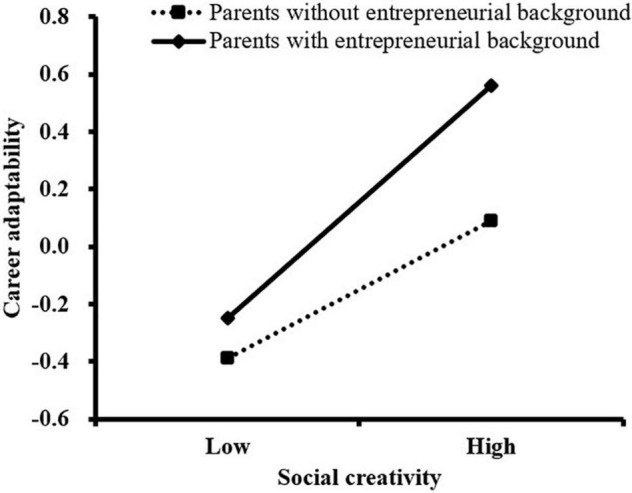
Drawing on social cognitive career theory, this study aims to ascertain how social creativity influences college students' entrepreneurial intentions, based on the mediating role of career adaptability and the moderating role of parental entrepreneurial background. A total of 715 college students completed an online survey designed to collect information on these variables. SPSS (version 25.0) was used to test the model. The results indicate that after controlling for gender and individual entrepreneurial experience, college students with a high level of social creativity were likely to have a high level of entrepreneurial intention. Career adaptability partially mediates the association between social creativity and entrepreneurial intention. Moreover, both direct and indirect associations between social creativity and entrepreneurial intention were moderated by parental entrepreneurial background. Specifically, compared with college students whose parents had no entrepreneurial background, the relationships between social creativity and entrepreneurial intention, social creativity and career adaptability, and career adaptability and entrepreneurial intention were stronger among college students whose parents had an entrepreneurial background. The findings help to develop promotion programs that are more suitable for college students' entrepreneurship intentions.
Keywords: career adaptability; college students; entrepreneurial intention; parental entrepreneurial background; social creativity.
Copyright © 2022 Zhang, Li, Zhou, Li, Gu and Zhao.
Conflict of interest statement
The authors declare that the research was conducted in the absence of any commercial or financial relationships that could be construed as a potential conflict of interest.
Figures
References
-
- Abraham A. (2018). The Neuroscience of Creativity. Cambridge: Cambridge University Press.
-
- Ajzen I. (1991). The theory of planned behavior. Organ. Behav. Hum. Decis. Process. 2 179–211. 10.1016/0749-5978(91)90020-T - DOI
-
- Amabile T. M., Barsade S. G., Mueller J. S., Staw B. M. (2005). Affect and creativity at work. Admin. Sci. Q. 50 367–403. 10.2189/asqu.2005.50.3.367 - DOI
-
- Bae T. J., Qian S., Miao C., Fiet J. O. (2014). The relationship between entrepreneurship education and entrepreneurial intentions: a meta-analytic review. Entrep. Theory Pract. 2 217–254. 10.1111/etap.12095 - DOI
-
- Baer J., Kaufman J. C. (2005). Bridging generality and specificity: the amusement park theoretical (APT) model of creativity. Roeper Rev. 27 158–163. 10.1080/02783190509554310 - DOI
LinkOut - more resources
Full Text Sources
