


Supporting parenting among Syrian refugees in Lebanon: a randomized controlled trial of the caregiver support intervention
- PMID: 35837815
- PMCID: PMC10083936
- DOI: 10.1111/jcpp.13668
Supporting parenting among Syrian refugees in Lebanon: a randomized controlled trial of the caregiver support intervention
Abstract
Background: Parenting interventions in humanitarian settings have prioritized the acquisition of parenting knowledge and skills, while overlooking the adverse effects of stress and distress on parenting-a key mediator of refugee children's mental health. We evaluated the effectiveness of the Caregiver Support Intervention (CSI), which emphasizes caregiver wellbeing together with training in positive parenting.
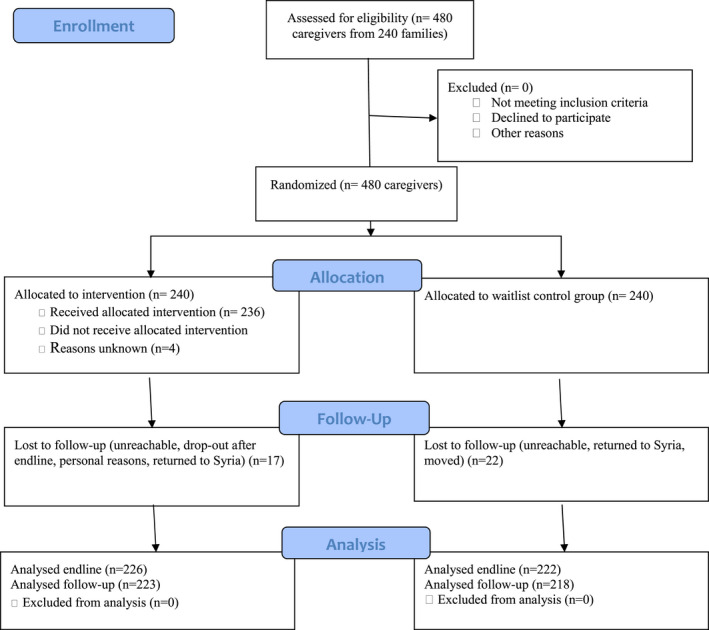
Methods: We conducted a two-arm randomized controlled trial of the CSI with Syrian refugees in Lebanon, with an intent-to-treat design, from September 2019-December 2020. A total of 480 caregivers from 240 families were randomized to the CSI or a waitlist control group (1:1). Retention from baseline to endline was 93%. Data on parenting and caregiver psychological wellbeing were collected at baseline, endline, and three-month follow-up. Prospective trial registration: ISRCTN22321773.
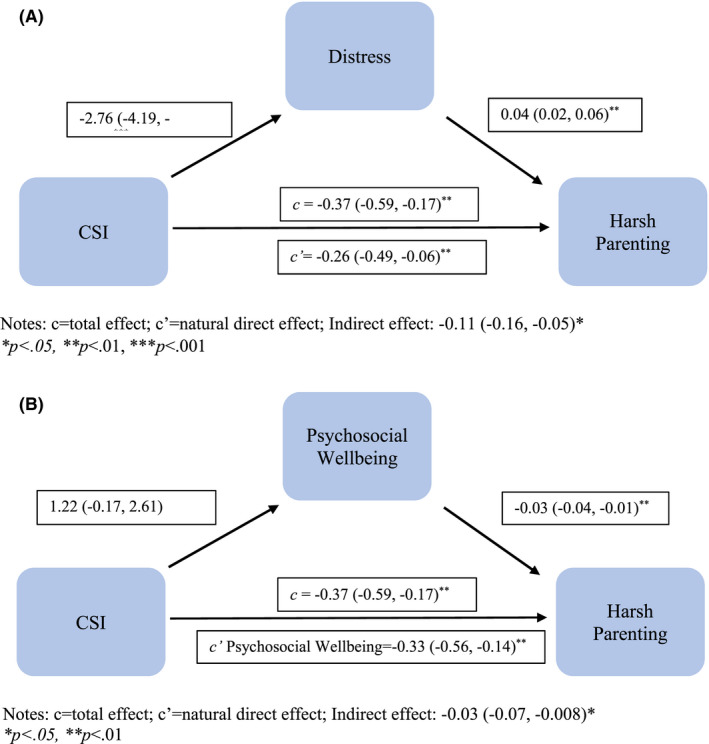
Results: We did not find a significant change on overall parenting skills at endline (primary outcome endpoint) (d = .11, p = .126) or at follow-up (Cohen's d = .15, p = .054). We did find a significant effect on overall parenting skills among participants receiving the full intervention-the sub-sample not interrupted by (COVID-19) (d = 0.25, p < .05). The CSI showed beneficial effects in the full sample at endline and follow-up on harsh parenting (d = -.17, p < .05; d = .19, p < .05), parenting knowledge (d = .63, p < .001; d = .50, p < .001), and caregiver distress (d = -.33, p < .001; d = .23, p < .01). We found no effects on parental warmth and responsiveness, psychosocial wellbeing, stress, or stress management. Changes in caregiver wellbeing partially mediated the impact of the CSI on harsh parenting, accounting for 37% of the reduction in harsh parenting.
Conclusions: The CSI reduced harsh parenting and caregiver distress, and demonstrated the value of addressing caregiver wellbeing as a pathway to strengthening parenting in adversity. These effects were achieved despite a pandemic-related lockdown that impacted implementation, a severe economic crisis, and widespread social unrest. Replication under less extreme conditions may more accurately demonstrate the intervention's full potential.
Keywords: Parenting; distress; refugees; stress; war.
© 2022 The Authors. Journal of Child Psychology and Psychiatry published by John Wiley & Sons Ltd on behalf of Association for Child and Adolescent Mental Health.
Figures
References
-
- Bryant, R. , Edwards, B. , Creamer, M. , O'Donnell, M. , Forbes, D. , Felmingham, K. , … Hadzi‐Pavlovic, D. (2018). The effect of post‐traumatic stress disorder on refugees' parenting and their children's mental health: A cohort study. The Lancet Public Health, 3, e249–e258. - PubMed
-
- Chen, A. , Koppenol‐Gonzalez, G.V. , Bakolis, I. , Arnous, M. , Tossyeh, F. , Al‐Ogaily, D. , Jordans, M.J.D. , & Miller, K.E. (2022). Dimensions of Parenting Scale: a culturally grounded measure of parenting in adversity (Manuscript in preparation).
-
- Fung, K. (2015). Acceptance and commitment therapy: Western adoption of Buddhist tenets? Transcultural Psychiatry, 52, 561–576. - PubMed
Publication types
MeSH terms
Supplementary concepts
LinkOut - more resources
Full Text Sources
Medical
