


Whole-exome sequencing identified five novel de novo variants in patients with unexplained intellectual disability
- PMID: 35837997
- PMCID: PMC9459325
- DOI: 10.1002/jcla.24587
Whole-exome sequencing identified five novel de novo variants in patients with unexplained intellectual disability
Abstract
Background: Intellectual disability (ID) represents a neurodevelopmental disorder, which is characterized by marked defects in the intellectual function and adaptive behavior, with an onset during the developmental period. ID is mainly caused by genetic factors, and it is extremely genetically heterogeneous. This study aims to identify the genetic cause of ID using trio-WES analysis.
Methods: We recruited four pediatric patients with unexplained ID from non-consanguineous families, who presented at the Department of Pediatrics, Guizhou Provincial People's Hospital. Whole-exome sequencing (WES) and Sanger sequencing validation were performed in the patients and their unaffected parents. Furthermore, conservative analysis and protein structural and functional prediction were performed on the identified pathogenic variants.
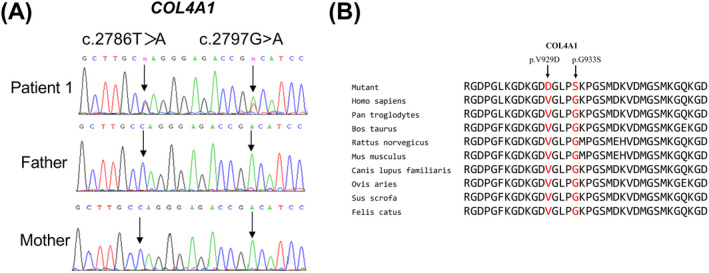
Results: We identified five novel de novo mutations from four known ID-causing genes in the four included patients, namely COL4A1 (c.2786T>A, p.V929D and c.2797G>A, p.G933S), TBR1 (c.1639_1640insCCCGCAGTCC, p.Y553Sfs*124), CHD7 (c.7013A>T, p.Q2338L), and TUBA1A (c.1350del, p.E450Dfs*34). These mutations were all predicted to be deleterious and were located at highly conserved domains that might affect the structure and function of these proteins.
Conclusion: Our findings contribute to expanding the mutational spectrum of ID-related genes and help to deepen the understanding of the genetic causes and heterogeneity of ID.
Keywords: de novo; heterogeneity; intellectual disability; variant; whole-exome sequencing.
© 2022 Guizhou Provincial People's Hospital. Journal of Clinical Laboratory Analysis published by Wiley Periodicals LLC.
Conflict of interest statement
The authors declare that they have no conflict of interest.
Figures


References
-
- Vissers LE, Gilissen C, Veltman JA. Genetic studies in intellectual disability and related disorders. Nat Rev Genet. 2016;17:9‐18. - PubMed
MeSH terms
Grants and funding
- 20161001/Guiyang Science and Technology Innovation Project
- 20165670/Guizhou Science and Technology Projects
- 20192808/Guizhou Science and Technology Projects
- 20205011/Guizhou Science and Technology Projects
- gzwjkj2020-1-250/Science and Technology Foundation Project of Guizhou Provincial Health Commission
LinkOut - more resources
Full Text Sources
