


Microbially derived polyunsaturated fatty acid as a modulator of gastrointestinal motility
- PMID: 35838050
- PMCID: PMC9282928
- DOI: 10.1172/JCI161572
Microbially derived polyunsaturated fatty acid as a modulator of gastrointestinal motility
Abstract
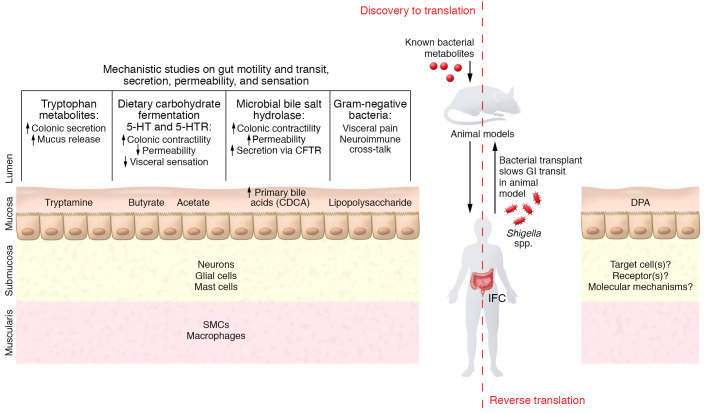
Gastrointestinal (GI) motility requires coordination among several cell types in the intestinal epithelium and the neuromuscular apparatus. A disruption in GI motility was primarily attributed to disruption of this coordinated effort among different host cells, but recent studies have begun to uncover how the products of gut microbiota can alter GI motility by modulating the function of different host cells and the interactions among them. In this issue of the JCI, Chen, Qiu, et al. used a reverse translation approach, isolating a Shigella sp. - peristaltic contraction-inhibiting bacterium (PIB) - from a cohort of patients with intractable constipation. They identified an ω-3 polyunsaturated fatty acid (PUFA), docosapentaenoic acid (DPA), produced by this Shigella variant, as an important driver of constipation using a series of microbiologic, biochemical, and genetic manipulations combined with in vitro and in vivo studies. This finding advances the field, given that production of DPA is rare in the human gut and appears to have a distinct effect on GI physiology.
Conflict of interest statement
Figures
Comment on
-
A Shigella species variant is causally linked to intractable functional constipation.J Clin Invest. 2022 Jul 15;132(14):e150097. doi: 10.1172/JCI150097. J Clin Invest. 2022. PMID: 35617029 Free PMC article.
References
Publication types
MeSH terms
Substances
Grants and funding
LinkOut - more resources
Full Text Sources
Other Literature Sources
