Changes in Traffic Crash Rates After Legalization of Marijuana: Results by Crash Severity
- PMID: 35838426
- PMCID: PMC9318699
- DOI: 10.15288/jsad.2022.83.494
Changes in Traffic Crash Rates After Legalization of Marijuana: Results by Crash Severity
Abstract
Objective: The objective of this study was to estimate the effects of marijuana legalization and the subsequent onset of retail sales on injury and fatal traffic crash rates in the United States during the period 2009-2019.
Method: State-by-state quarterly crash rates per mile of travel were modeled as a function of time, unemployment rate, maximum posted speed limit, seat belt use rate, alcohol use rate, percent of miles driven on rural roads, and indicators of legalized recreational marijuana use and sales.
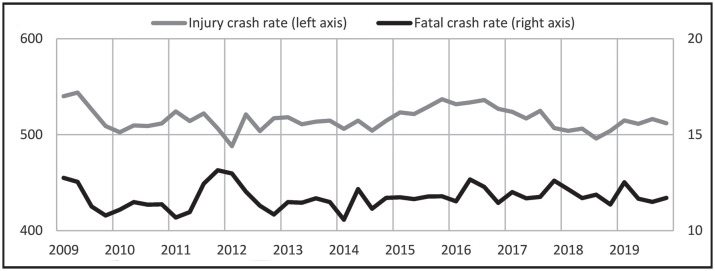
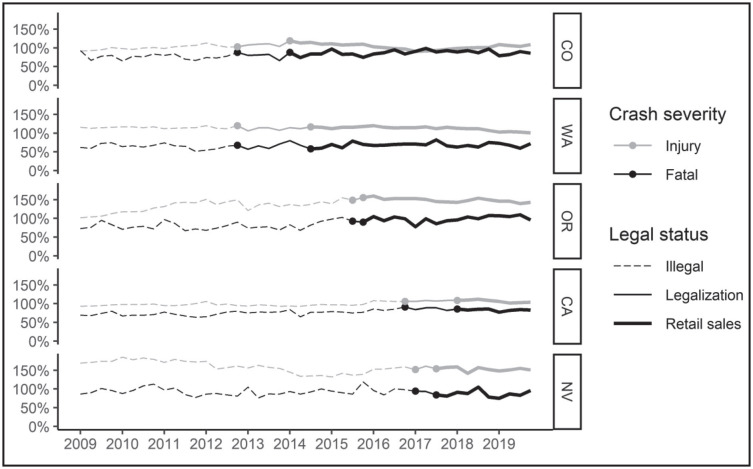
Results: Legalization of the recreational use of marijuana was associated with a 6.5% increase in injury crash rates and a 2.3% increase in fatal crash rates, but the subsequent onset of retail marijuana sales did not elicit additional substantial changes. Thus, the combined effect of legalization and retail sales was a 5.8% increase in injury crash rates and a 4.1% increase in fatal crash rates. Across states, the effects on injury crash rates ranged from a 7% decrease to an 18% increase. The effects on fatal crash rates ranged from a 10% decrease to a 4% increase.
Conclusions: The estimated increases in injury and fatal crash rates after recreational marijuana legalization are consistent with earlier studies, but the effects varied across states. Because this is an early look at the time trends, researchers and policymakers need to continue monitoring the data.
Figures
References
-
- Anderson D. M., Hansen B.&Rees D. I. Medical marijuana laws, traffic fatalities, and alcohol consumption. Journal of Law & Economics. 2013;56:333–369. doi:10.1086/668812.
-
- Aydelotte J. D., Mardock A. L., Mancheski C. A., Quamar S. M., Teixeira P. G., Brown C. V. R.&Brown L. H. Fatal crashes in the 5 years after recreational marijuana legalization in Colorado and Washington. Accident Analysis and Prevention. 2019;132:105284. doi:10.1016/j.aap.2019.105284. - PubMed
-
- Brooks-Russell A., Brown T., Rapp-Olsson A. M., Friedman K.&Kosnett M. Driving after cannabis use and compensatory driving behaviors among current cannabis users in Colorado. Traffic Injury Prevention. 2019;20:S199–S201. doi:10.1080/15389588.2019.1665424.
-
- Chen C., Subramanian R., Choi E.&Liu C. Washington, DC: National Highway Traffic Safety Administration; 2010. Statistical methodology to make early estimates of motor vehicle traffic fatalities. Report No. DOT HS 811 123.
Publication types
MeSH terms
LinkOut - more resources
Full Text Sources
Medical