Occasions of Alcohol and Cannabis Use and Associated Risk for Sexual Assault Among College Women With Higher Sexual Risk Alcohol Expectancies
- PMID: 35838433
- PMCID: PMC9318703
- DOI: 10.15288/jsad.2022.83.556
Occasions of Alcohol and Cannabis Use and Associated Risk for Sexual Assault Among College Women With Higher Sexual Risk Alcohol Expectancies
Abstract
Objective: College women report high rates of sexual assault. Research focused on women's risk factors for sexual assault remains necessary to assist women in reducing their risk. Previous work has shown alcohol use and cannabis use to be associated with sexual assault. The current study examined whether individual difference variables moderated women's risk for sexual assault during occasions of alcohol use and cannabis use using ecological momentary assessment (EMA).
Method: Participants were 18- to 24-year-old first-year undergraduate women (N = 101) who were unmarried and interested in dating men, consumed three or more alcoholic drinks on one occasion in the month before baseline, and engaged in sexual intercourse at least once. Baseline individual difference variables included sex-related alcohol expectancies, alcohol problems, decision skills, and sexual attitudes. EMA reports, collected three times per day over 42 days, included items regarding alcohol and cannabis use and sexual assault experiences.
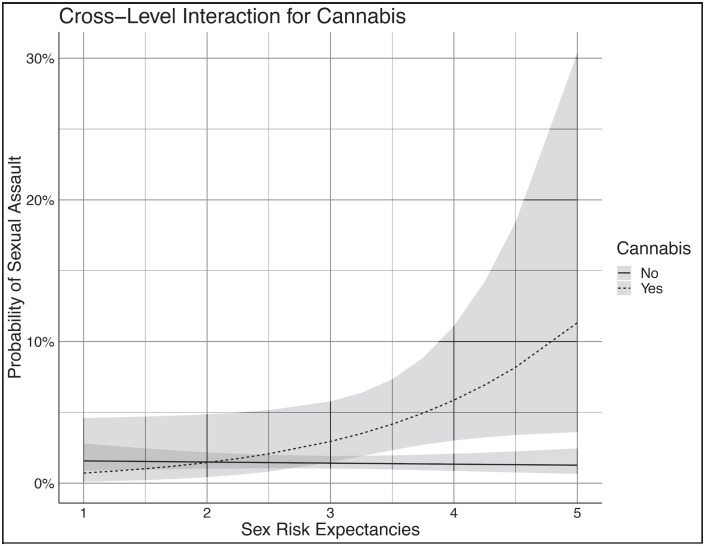
Results: Among women who experienced sexual assault during the EMA period (n = 40), those with higher sexual risk expectancies had a higher probability of sexual assault during occasions when they were using alcohol or cannabis.
Conclusions: Several modifiable risk factors for sexual assault and individual differences factors may exacerbate risk. Ecological momentary interventions may be useful to reduce sexual assault risk for women with high sexual risk expectancies who use alcohol or cannabis.
Conflict of interest statement
The authors thank the college women who participated in the study.
Figures

References
-
- Bae H., Kerr D. C. R. Marijuana use trends among college students in states with and without legalization of recreational use: Initial and longer-term changes from 2008 to 2018. Addiction. 2020;115:1115–1124. doi:10.1111/add.14939. - PubMed
-
- Benson B. J., Gohm C. L., Gross A. M. College women and sexual assault: The role of sex-related alcohol expectancies. Journal of Family Violence. 2007;22:341–351. doi:10.1007/s10896-007-9085-z.
-
- Bryan A. E., Norris J., Abdallah D. A., Stappenbeck C. A., Morrison D. M., Davis K. C., Zawacki T. Longitudinal change in women's sexual victimization experiences as a function of alcohol consumption and sexual victimization history: A latent transition analysis. Psychology of Violence. 2016;6:271–279. doi:10.1037/a0039411. - PMC - PubMed
-
- Bureau of Justice Statistics. Washington, DC: Department U.S. of Justice; 2013. Female victims of sexual violence, 1994–2010 (Publication No. NCJ-240655.
-
- Cantor D., Fisher B., Chibnall S., Townsend R., Lee H., Bruce C., Thomas G. Washington, DC: Association of American Universities; 2015. Report on the AAU Campus Climate Survey on Sexual Assault and Sexual Misconduct.
Publication types
MeSH terms
Substances
Grants and funding
LinkOut - more resources
Full Text Sources
Medical
Research Materials