. 2022 Jul;4(4):e210076.
doi: 10.1148/rycan.210076.

Imaging Glioblastoma Metabolism by Using Hyperpolarized [1-13C]Pyruvate Demonstrates Heterogeneity in Lactate Labeling: A Proof of Principle Study

Affiliations

Imaging Glioblastoma Metabolism by Using Hyperpolarized [1-13C]Pyruvate Demonstrates Heterogeneity in Lactate Labeling: A Proof of Principle Study

Fulvio Zaccagna et al. Radiol Imaging Cancer. 2022 Jul.

Abstract

Purpose To evaluate glioblastoma (GBM) metabolism by using hyperpolarized carbon 13 (13C) MRI to monitor the exchange of the hyperpolarized 13C label between injected [1-13C]pyruvate and tumor lactate and bicarbonate. Materials and Methods In this prospective study, seven treatment-naive patients (age [mean ± SD], 60 years ± 11; five men) with GBM were imaged at 3 T by using a dual-tuned 13C-hydrogen 1 head coil. Hyperpolarized [1-13C]pyruvate was injected, and signal was acquired by using a dynamic MRI spiral sequence. Metabolism was assessed within the tumor, in the normal-appearing brain parenchyma (NABP), and in healthy volunteers by using paired or unpaired t tests and a Wilcoxon signed rank test. The Spearman ρ correlation coefficient was used to correlate metabolite labeling with lactate dehydrogenase A (LDH-A) expression and some immunohistochemical markers. The Benjamini-Hochberg procedure was used to correct for multiple comparisons. Results The bicarbonate-to-pyruvate (BP) ratio was lower in the tumor than in the contralateral NABP (P < .01). The tumor lactate-to-pyruvate (LP) ratio was not different from that in the NABP (P = .38). The LP and BP ratios in the NABP were higher than those observed previously in healthy volunteers (P < .05). Tumor lactate and bicarbonate signal intensities were strongly correlated with the pyruvate signal intensity (ρ = 0.92, P < .001, and ρ = 0.66, P < .001, respectively), and the LP ratio was weakly correlated with LDH-A expression in biopsy samples (ρ = 0.43, P = .04). Conclusion Hyperpolarized 13C MRI demonstrated variation in lactate labeling in GBM, both within and between tumors. In contrast, bicarbonate labeling was consistently lower in tumors than in the surrounding NABP. Keywords: Hyperpolarized 13C MRI, Glioblastoma, Metabolism, Cancer, MRI, Neuro-oncology Supplemental material is available for this article. Published under a CC BY 4.0 license.

Keywords: Cancer; Glioblastoma; Hyperpolarized 13C MRI; MRI; Metabolism; Neuro-oncology.


Conflict of interest statement

Disclosures of conflicts of interest: F.Z. No relevant relationships. M.A.M. No relevant relationships. J.T.G. No relevant relationships. J.K. Institution received grant from NIHR Cambridge Biomedical Research Centre; institution received grants from GlaxoSmithKline and EU Horizon 2020. R.M. No relevant relationships. F.R. No relevant relationships. R.W. Grants from CRUK Cambridge Centre (CCCIT10) and Austrian Science Fund (J-4025). A.B.G. No relevant relationships. S.D. Trainee editorial board member for Radiology: Imaging Cancer. C.J.D. No relevant relationships. S.U. Cambridge Trust, Cambridge International Scholarship (PhD funding, payments made to the researcher); trainee editorial board member for Radiology: Artificial Intelligence. R.F.S. Employed by GE Healthcare. K.A. No relevant relationships. A.C. No relevant relationships. M.C.L. Wellcome Trust grant. M.L. No relevant relationships. A.F. No relevant relationships. S.H. No relevant relationships. I.P. No relevant relationships. B.D.C. No relevant relationships. R.S. No relevant relationships. I.W. No relevant relationships. B.B. Advisory boards of GenMad, Eisai, and Roche (author has undertaken advisory board work through the consultancy arm of the University of Cambridge [Cambridge Enterprise], with the pharmaceutical company contracting Cambridge Enterprise for services, and all fees donated to a University of Cambridge Discretionary account); speakers bureau for Eisai Europe; support from Roche to register for virtual conference; work on data monitoring committees for GenMab, through the consultancy arm of the University of Cambridge (Cambridge Enterprise), with the pharmaceutical company contracting Cambridge Enterprise for services, and all fees donated to a University of Cambridge Discretionary account. J.W. No relevant relationships. J.H.G. No relevant relationships. T.M. No relevant relationships. C.W. No relevant relationships. S.J.P. No relevant relationships. T.S. No relevant relationships. M.J.G. No relevant relationships. S.J. Consulting fees for private practice, sees patients for treatment of CNS tumors and thyroid cancer in the following private hospitals: Nuffield Hospital Cambridge, Genesis Cancer Centre Newmarket, England; expert witness; member of a data monitoring committee for an international trial for the treatment of medulloblastoma (SIOP-HRMB), unpaid; chair of NICE Guideline committee evaluating maternal weight gain during pregnancy; lead of training committee for the Tessa Jowell Brain Cancer Mission; stock shares in Genesis Cancer Care Newmarket as part of Saunders and Jefferies Ltd (Robert D. Saunders, spouse). K.M.B. Cancer Research UK grant to institution; consultancies with NVision Imaging Technologies and New Path Molecular Research; patent application. “Uric acid as adjuvant”. Inventors: Kevin Michael Brindle, Alistair Mcfarlane Moore, Lindy Louise Thomsen. Applicants: Kevin Michael Brindle, Cambridge University Technical Services Limited, Glaxo Group Limited, Alistair Mcfarlane Moore, Lindy Louise Thomsen Glaxo Group Ltd. (Publication number WO2005102394 A1; publication date, 3rd November 2005; filing date 23rd March 2005; priority date, 25th March 2004); patent application. “Imaging medium comprising lactate and hyperpolarised 13C-pyruvate”. Inventors: Kevin M. Brindle, Samuel Evan Day. Applicants: Kevin M. Brindle, Samuel Evan Day, GE Healthcare AS. (Publication number WO2008020765 A2; publication date, 21st February 2008; filing date, 17th August 2007; priority date, 18th August 2006); patent application. “13C-MR imaging or spectroscopy of cell death”. Inventors: Kevin M. Brindle, Samuel Evan Day, Mikko Iivari Kettunen. Applicants: Kevin M. Brindle, Samuel Evan Day, Mikko Iivari Kettunen and GE Healthcare AS. (Publication number WO2008020764 A1; publication date 21st February 2008; filing date, 17th August 2007; priority date, 18th August 2006; patent application. “Agents for detecting and imaging cell death. Inventors: Kevin Brindle, Andre Neves, Maaike De Backer, Israt Alam Applicants: Cambridge Technical Services Ltd. (Publication no. WO2009133362 A3; publication date 25th March 2010; filing date 29th April 2009, priority date 29th April 2008); patent application. “Hyperpolarized lactate contrast agent for determination of LDH activity”. Inventors: Kevin M. Brindle, Mikko Ivari Kettunen, Brett W. C. Kennedy. Applicants: GE Healthcare (Publication no. WO2011138269 A1; publication date 10th November 2011; filing date 2nd May 2011; priority date 3rd May 2010); patent application. “Imaging of ethanol metabolism”. Inventors: Kevin M. Brindle, Piotr Dzien, Mikko Ivari Kettunen. Applicants: Cambridge Enterprise Ltd (EP14150267.4). Filing date 7th January 2014; NCITA Prostate Cancer GlobalTrial Steering Committee (Chair). F.A.G. Research support from GE Healthcare, grant from GlaxoSmithKline; consulting for AstraZeneca (consulting for the University); scientific advisory board of European Institute for Biomedical Imaging; board of trustees for World Molecular Imaging Society.

Figures

None
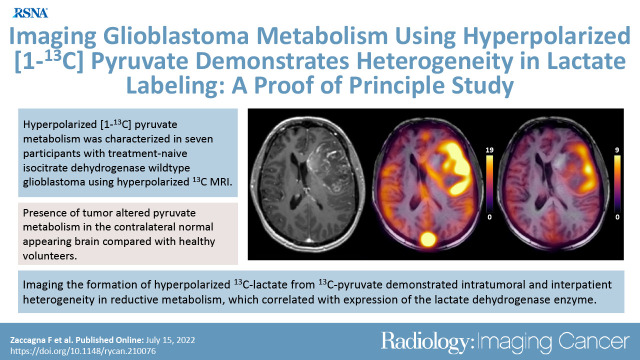
Graphical abstract
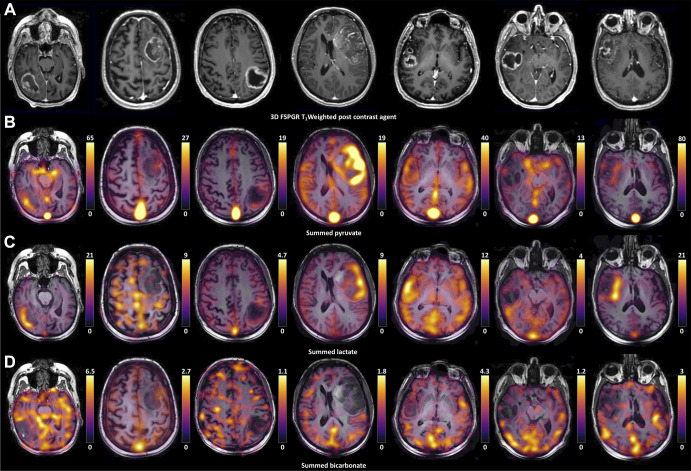
Hyperpolarized 13C MR images from all seven patients. (A) Grayscale
axial contrast-enhanced 1H three-dimensional (3D) T1-weighted fast spoiled
gradient-echo (FSPGR) images through the center of the lesion for each
patient and the corresponding unenhanced images overlaid with the (B)
pyruvate, (C) lactate, and (D) bicarbonate color maps summed over the time
course.
Figure 1:
Hyperpolarized 13C MR images from all seven patients. (A) Grayscale axial contrast-enhanced 1H three-dimensional (3D) T1-weighted fast spoiled gradient-echo (FSPGR) images through the center of the lesion for each patient and the corresponding unenhanced images overlaid with the (B) pyruvate, (C) lactate, and (D) bicarbonate color maps summed over the time course.
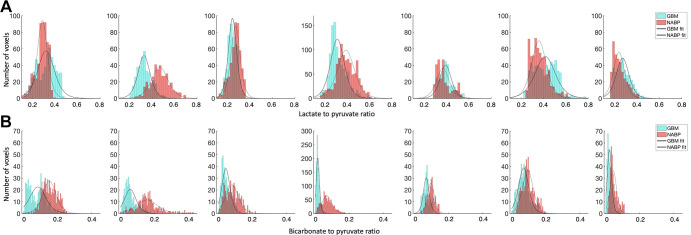
Histograms of the (A) lactate-to-pyruvate and (B)
bicarbonate-to-pyruvate ratios in each voxel from the section through the
center of the lesion for each patient (n = 7) with an overlying polynomial
fit; glioblastoma (GBM) data are shown in blue, and the normal-appearing
brain parenchyma (NABP) data are shown in red.
Figure 2:
Histograms of the (A) lactate-to-pyruvate and (B) bicarbonate-to-pyruvate ratios in each voxel from the section through the center of the lesion for each patient (n = 7) with an overlying polynomial fit; glioblastoma (GBM) data are shown in blue, and the normal-appearing brain parenchyma (NABP) data are shown in red.
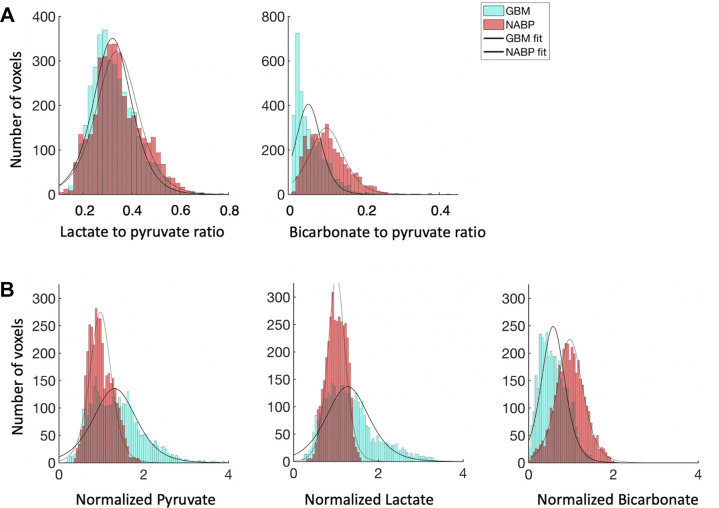
Average labeled metabolite distribution for the entire patient cohort
(n = 7). Histograms show the (A) average lactate-to-pyruvate and
bicarbonate-to-pyruvate ratios and (B) normalized signal intensities for
pyruvate, lactate, and bicarbonate with an overlying polynomial fit.
Normalization was performed relative to the normal-appearing brain
parenchyma (NABP). Ratios for glioblastoma (GBM) are shown in blue, and
ratios for NABP are shown in red.
Figure 3:
Average labeled metabolite distribution for the entire patient cohort (n = 7). Histograms show the (A) average lactate-to-pyruvate and bicarbonate-to-pyruvate ratios and (B) normalized signal intensities for pyruvate, lactate, and bicarbonate with an overlying polynomial fit. Normalization was performed relative to the normal-appearing brain parenchyma (NABP). Ratios for glioblastoma (GBM) are shown in blue, and ratios for NABP are shown in red.
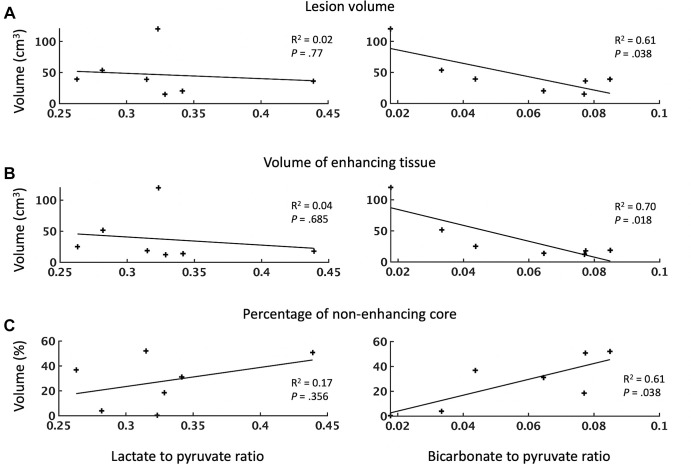
Dependence of metabolite signal ratios (lactate-to-pyruvate and
bicarbonate-to-pyruvate ratios) on (A) tumor volume, (B) volume of enhancing
tissue, and (C) percentage of nonenhancing tumor core. Each point represents
an individual participant. The lesion volume and the volume of enhancing
tissue are expressed in centimeters cubed; the nonenhancing core is
expressed as a percentage of the entire lesion volume. The R2 values,
representing the goodness of each fit, and the corresponding P values for
each regression are given. The level of significance was set at
.05.
Figure 4:
Dependence of metabolite signal ratios (lactate-to-pyruvate and bicarbonate-to-pyruvate ratios) on (A) tumor volume, (B) volume of enhancing tissue, and (C) percentage of nonenhancing tumor core. Each point represents an individual participant. The lesion volume and the volume of enhancing tissue are expressed in centimeters cubed; the nonenhancing core is expressed as a percentage of the entire lesion volume. The R2 values, representing the goodness of each fit, and the corresponding P values for each regression are given. The level of significance was set at .05.
Relationship between lactate dehydrogenase A (LDH-A) expression and
labeling of lactate and pyruvate following injection of hyperpolarized
[1-13C]pyruvate. Scatterplots show the relationship between LDH-A expression
and the lactate-to-pyruvate and bicarbonate-to-pyruvate ratios. Each point
represents a tissue sample. The R2 values, representing the goodness of fit,
and P values for each regression are shown.
Figure 5:
Relationship between lactate dehydrogenase A (LDH-A) expression and labeling of lactate and pyruvate following injection of hyperpolarized [1-13C]pyruvate. Scatterplots show the relationship between LDH-A expression and the lactate-to-pyruvate and bicarbonate-to-pyruvate ratios. Each point represents a tissue sample. The R2 values, representing the goodness of fit, and P values for each regression are shown.
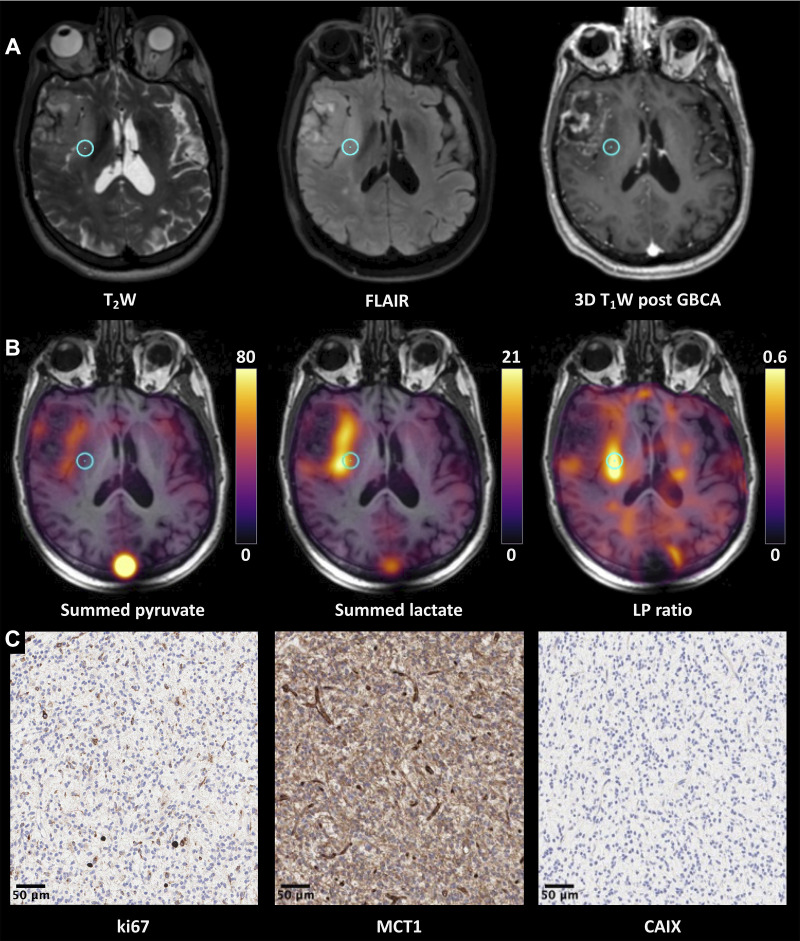
(A–C) Proton images, hyperpolarized 13C MR images, and
immunohistochemical (IHC) data from participant 7 (74-year-old man with
glioblastoma). (A) Grayscale axial three-dimensional (3D) T2-weighted (T2W),
fluid-attenuated inversion recovery (FLAIR), and gadolinium-based contrast
agent (GBCA)–enhanced 3D T1-weighted (T1W) fast spoiled gradient-echo
images through the center of the lesion. There is a lesion within the right
anterior temporal lobe demonstrating T2-weighted and FLAIR hyperintensity
involving the right insula and external capsule and reaching the lentiform
nucleus. (B) The corresponding pyruvate and lactate maps summed over the
entire time course and the lactate-to-pyruvate (LP) ratio map are shown in
color superimposed on the T1-weighted images before contrast enhancement.
The metabolic maps reveal heterogeneity, with higher pyruvate and lactate
being shown in the medial aspect of the lesion; the LP ratio was
particularly higher in the posterior part of insula. (C) Representative IHC
imaging, shown with a 20× magnification, from the target region of
interest highlighted on the 1H and 13C MR images (blue circle) stained for
ki-67, monocarboxylate transporter 1 (MCT1), and carbonic anhydrase IX
(CAIX). Details on IHC analysis are provided in Appendix E1 (supplement); in
brief, the antibodies used for staining were: M7240 for ki-67, HPA003324 for
MCT1, and NCL-L-CAIX for CAIX. Histopathologic findings demonstrated a
homogeneous high-grade tumor with MIB-1 staining of approximately 8%, high
MCT-1 staining, and no significant staining for CAIX.
Figure 6:
(A–C) Proton images, hyperpolarized 13C MR images, and immunohistochemical (IHC) data from participant 7 (74-year-old man with glioblastoma). (A) Grayscale axial three-dimensional (3D) T2-weighted (T2W), fluid-attenuated inversion recovery (FLAIR), and gadolinium-based contrast agent (GBCA)–enhanced 3D T1-weighted (T1W) fast spoiled gradient-echo images through the center of the lesion. There is a lesion within the right anterior temporal lobe demonstrating T2-weighted and FLAIR hyperintensity involving the right insula and external capsule and reaching the lentiform nucleus. (B) The corresponding pyruvate and lactate maps summed over the entire time course and the lactate-to-pyruvate (LP) ratio map are shown in color superimposed on the T1-weighted images before contrast enhancement. The metabolic maps reveal heterogeneity, with higher pyruvate and lactate being shown in the medial aspect of the lesion; the LP ratio was particularly higher in the posterior part of insula. (C) Representative IHC imaging, shown with a 20× magnification, from the target region of interest highlighted on the 1H and 13C MR images (blue circle) stained for ki-67, monocarboxylate transporter 1 (MCT1), and carbonic anhydrase IX (CAIX). Details on IHC analysis are provided in Appendix E1 (supplement); in brief, the antibodies used for staining were: M7240 for ki-67, HPA003324 for MCT1, and NCL-L-CAIX for CAIX. Histopathologic findings demonstrated a homogeneous high-grade tumor with MIB-1 staining of approximately 8%, high MCT-1 staining, and no significant staining for CAIX.

References

    1. Wen PY , Weller M , Lee EQ , et al. . Glioblastoma in adults: a Society for Neuro-Oncology (SNO) and European Society of Neuro-Oncology (EANO) consensus review on current management and future directions . Neuro Oncol 2020. ; 22 ( 8 ): 1073 – 1113 . - PMC - PubMed
    1. Bi J , Chowdhry S , Wu S , Zhang W , Masui K , Mischel PS . Altered cellular metabolism in gliomas—an emerging landscape of actionable co-dependency targets . Nat Rev Cancer 2020. ; 20 ( 1 ): 57 – 70 . - PubMed
    1. Corbin Z , Spielman D , Recht L . A metabolic therapy for malignant glioma requires a clinical measure . Curr Oncol Rep 2017. ; 19 ( 12 ): 84 . - PubMed
    1. Kathagen A , Schulte A , Balcke G , et al. . Hypoxia and oxygenation induce a metabolic switch between pentose phosphate pathway and glycolysis in glioma stem-like cells . Acta Neuropathol (Berl) 2013. ; 126 ( 5 ): 763 – 780 . - PubMed
    1. Kathagen-Buhmann A , Schulte A , Weller J , et al. . Glycolysis and the pentose phosphate pathway are differentially associated with the dichotomous regulation of glioblastoma cell migration versus proliferation . Neuro Oncol 2016. ; 18 ( 9 ): 1219 – 1229 . - PMC - PubMed

Publication types

LinkOut - more resources