. 2022 Aug;12(8):1897-1906.
doi: 10.1007/s13555-022-00771-5. Epub 2022 Jul 15.

Efficacy and Safety of Long-Pulsed 755-nm Alexandrite Laser for Keratosis Pilaris: A Split-Body Randomized Clinical Trial

Affiliations

Efficacy and Safety of Long-Pulsed 755-nm Alexandrite Laser for Keratosis Pilaris: A Split-Body Randomized Clinical Trial

Man Li et al. Dermatol Ther (Heidelb). 2022 Aug.

Abstract

Introduction: Keratosis pilaris (KP) is a disfiguring disease and is resistant to treatment. Several treatment methods are available, but the efficacy is limited. This prospective, rater-blinded, split-body comparative study investigated the efficacy and safety of long-pulsed 755-nm alexandrite laser in the treatment of KP.

Methods: Twenty-two patients with KP of bilateral arms were enrolled in this study. All participants were randomized and treated with a long-pulsed 755-nm alexandrite laser on the left or right arm in four sessions held 3 weeks apart. The unified moisturizing lotion was applied on both left and right arms once a day. Physicians' assessment scores and patients' self-assessment scores were recorded, and skin imaging changes in dermoscopy, high-frequency ultrasound, and skin biopsy were obtained at baseline and 4 weeks after the fourth treatment.

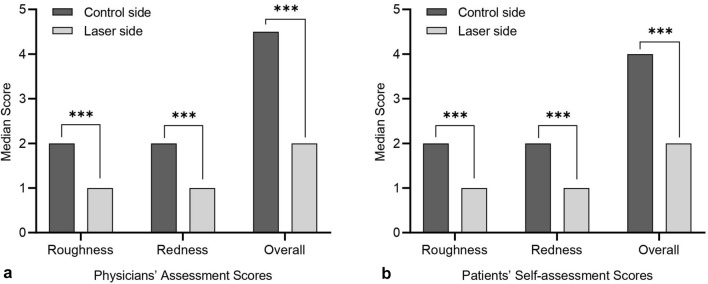
Results: Of the 21 patients who completed the study, 15 were women and 6 were men. At 4 weeks after the fourth treatment, the laser side showed significantly lower total (2.0 versus 4.5), roughness (1.0 versus 2.0), and redness (1.0 versus 2.0) scores according to physicians' assessment (all P < 0.05). Furthermore, the laser side showed significantly lower total (2.0 versus 4.0), roughness (1.0 versus 2.0), and redness scores (1.0 versus 2.0) according to the patients' self-assessment (all P < 0.05). The proportions of patients who achieved dermoscopically and ultrasonographically showed excellent improvements in follicular plugs (57.1% versus 14.3%), perifollicular erythema (52.4% versus 9.5%), perifollicular hyperpigmentation (47.6% versus 14.3%), and the number of epidermal bulges (57.1% versus 19.1%) in the laser side was significantly higher than those who achieved such improvements in the control side (all P < 0.05). Histopathology showed that the follicular plugs and inflammatory cell infiltration were improved at the final visit. Three patients exhibited reversible postinflammatory hyperpigmentation.

Conclusion: Long-pulsed 755-nm alexandrite laser treatment is effective and safe in treating both skin roughness and redness in KP.

Trial registration number: ChiCTR2100054489.

Keywords: 755-nm alexandrite laser; Efficacy; Keratosis pilaris; Safety.


Figures

Fig. 1
Fig. 1
The comparison of the outcome measures for the laser and control sides at the last follow-up visit. a Physicians’ assessment scores. The roughness, redness, and overall scores on the laser side decreased significantly compared with those on the control side at the last follow-up visit (P = 0.000086 for roughness scores, P = 0.000074 for redness scores, P = 0.000081 for overall scores, all P < 0.05). b Patients’ self-assessment scores. The roughness, redness, and overall scores on the laser side decreased significantly more than those on the control side at the last follow-up visit (P = 0.00007 for roughness scores, P = 0.000386 for redness scores, P = 0.000085 for overall scores, all P < 0.05). ***P < 0.001
Fig. 2
Fig. 2
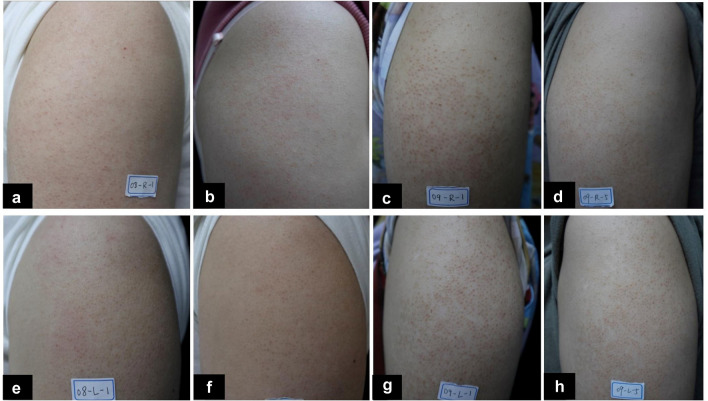
The comparison of clinical photographs at the baseline and at the last follow-up visit. a, b, e, f A mild-moderate KP patient’s photographs at the baseline (a, e) and at the last follow-up visit (b, f) for the laser side (a, b) and the control side (e, f). c, d, g, h A severe KP patient’s photographs at the baseline (c, g) and at the last follow-up visit (d, h) for the laser side (c, d) and for the control side (g, h)
Fig. 3
Fig. 3
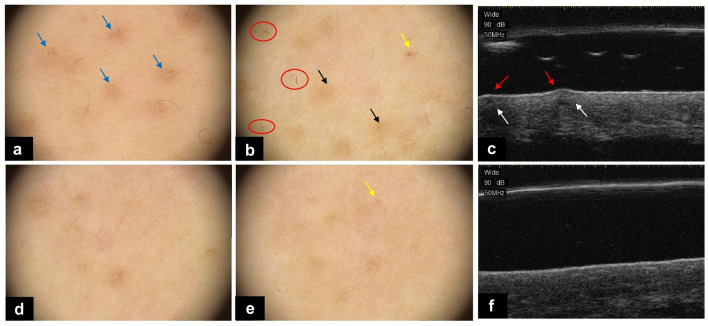
Dermoscopic image (20×) of KP at the baseline (a, b) and at the final visit (d, e). Perifollicular erythema (blue arrows) and hyperpigmentation (black arrows), follicular plugs (blue arrows), and cherry hemangioma (yellow arrows) were all improved at the final visit. The number of vellus twisted hairs (red circles) reduced or disappeared at the final visit (d, e). Ultrasonographic images detected by a 50-MHz HFUS probe at baseline (c) and at the final visit (f). The epidermal bulges (red arrows) were flattened and echo heterogeneity (which means the signal is not uniform, indicated by white arrows) improved at the last follow-up visit
Fig. 4
Fig. 4
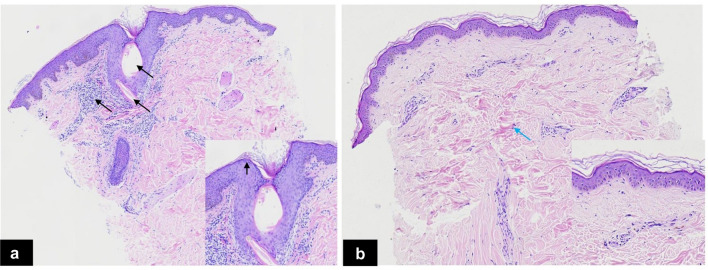
Histopathologic changes. a Before treatment: dilated vellus hair follicle containing keratin and coiled vellus hair with moderate perifollicular mononuclear cell infiltration (black arrows). b The last follow-up visit: All pathological manifestations mentioned above had improved, and the collagen fibers were locally thickened (blue arrows)

References

    1. Maghfour J, Ly S, Haidari W, et al. Treatment of keratosis pilaris and its variants: a systematic review. J Dermatolog Treat. 2020;2020:1–12. - PubMed
    1. Lanigan S. Reduction of pain in the treatment of vascular lesions with a pulsed dye laser and pneumatic skin flattening. Lasers Med Sci. 2009;24(4):617–620. doi: 10.1007/s10103-008-0632-5. - DOI - PubMed
    1. Kechichian E, Jabbour S, el Hachem L, et al. Light and laser treatments for keratosis pilaris: a systematic review. Dermatol Surg. 2020;46(11):1397–1402. doi: 10.1097/DSS.0000000000002441. - DOI - PubMed
    1. Ibrahim O, Khan M, Bolotin D, et al. Treatment of keratosis pilaris with 810-nm diode laser: a randomized clinical trial. JAMA Dermatol. 2015;151(2):187–191. doi: 10.1001/jamadermatol.2014.2211. - DOI - PubMed
    1. Jin WW, Tong Y, Wu JM, et al. Observation on the effects of 595- nm pulsed dye laser and 755- nm long-pulsed alexandrite laser on sequential therapy of infantile hemangioma. J Cosmet Laser Ther. 2020;22(3):159–164. doi: 10.1080/14764172.2020.1783452. - DOI - PubMed

LinkOut - more resources