


Effect of the COVID-19 pandemic on glycemic control in Brazilian patients with type 2 diabetes
- PMID: 35838896
- PMCID: PMC9284486
- DOI: 10.1007/s12020-022-03137-1
Effect of the COVID-19 pandemic on glycemic control in Brazilian patients with type 2 diabetes
Abstract
Purpose: To investigate the effect of restrictive measures the COVID-19 pandemic imposed on glycemic control of patients with type 2 diabetes (T2D) and its associated factors.
Methods: Outpatients with T2D who had an appointment scheduled during the social distancing period were eligible for telemonitoring. Clinical and laboratorial data were collected from medical records in the last consultation before and from the first visit after the COVID-19 pandemic lockdown period.
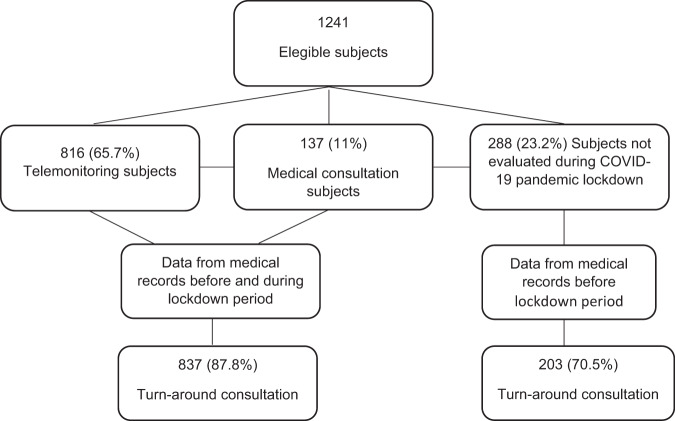
Results: From the 1241 eligible patients, 816 (65.7%) could be contacted by phone, 137 (11%) attended the unit for consultation during the social distancing period, and 1040 (83.8%) returned up to 12 months after the end of the lockdown period. We observed a meaningful reduction of glycated hemoglobin (HbA1c) (7.9 [7-9] vs. 7.7 [6.9-8.8] p = 0.004) and no difference in body mass index (29.5 [26-33.7] vs. 29.6 [26.2-34.1], p = 0.17) before and after the social distancing period. According to insulin use at baseline, the HbA1c variation was +0.6 (-0.7 to +2) and -0.6 (-2.1 to +0.7) in patients without and with insulin, respectively (p < 0.001). In the multivariate model, insulin therapy was the only independent significant predictor of HbA1c reduction.
Conclusion: This study observed an improvement in glycemic control after the lockdown. The only independent predictor found was previous insulin use. Probably, the longer time available to perform frequent blood glucose self-monitoring at home and adjustments in insulin therapy could explain our findings.
Keywords: COVID-19; Glycemic control; Lockdown; Social distancing; Type 2 diabetes.
© 2022. The Author(s), under exclusive licence to Springer Science+Business Media, LLC, part of Springer Nature.
Conflict of interest statement
The authors declare no competing interests.
Figures
References
-
- Alessi J, de Oliveira GB, Franco DW, Brino do Amaral B, Becker AS, Knijnik CP, Kobe GL, de Carvalho TR, Telo GH, Schaan BD, Telo GH. Mental health in the era of COVID-19: prevalence of psychiatric disorders in a cohort of patients with type 1 and type 2 diabetes during the social distancing. Diabetol. Metab. Syndr. 2020;12(1):76. doi: 10.1186/s13098-020-00584-6. - DOI - PMC - PubMed
-
- Davies MJ, D’Alessio DA, Fradkin J, Kernan WN, Mathieu C, Mingrone G, Rossing P, Tsapas A, Wexler DJ, Buse JB. Management of Hyperglycemia in Type 2 Diabetes, 2018. A Consensus Report by the American Diabetes Association (ADA) and the European Association for the Study of Diabetes (EASD) Diabetes Care. 2018;41(12):2669–2701. doi: 10.2337/dci18-0033. - DOI - PMC - PubMed
-
- American Diabetes Association. Improving Care and Promoting Health in Populations: Standards of Medical Care in Diabetes—2021. Diabetes Care. 44 (Supplement_1): S7-S14 (2021). 10.2337/dc21-S001 - PubMed
MeSH terms
Substances
LinkOut - more resources
Full Text Sources
Medical
