


Inconsistencies between Subjective Reports of Cognitive Difficulties and Performance on Cognitive Tests are Associated with Elevated Internalising and Externalising Symptoms in Children with Learning-related Problems
- PMID: 35838930
- PMCID: PMC9653343
- DOI: 10.1007/s10802-022-00930-4
Inconsistencies between Subjective Reports of Cognitive Difficulties and Performance on Cognitive Tests are Associated with Elevated Internalising and Externalising Symptoms in Children with Learning-related Problems
Abstract
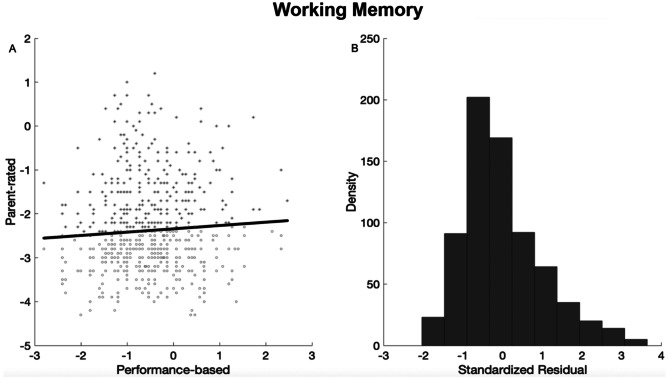
Children with learning difficulties are commonly assumed to have underlying cognitive deficits by health and educational professionals. However, not all children referred for psycho-educational assessment will be found to have deficits when their abilities are measured by performance on cognitive tasks. The primary aim of this study was to estimate the prevalence of this inconsistent cognitive profile (ICP) in a transdiagnostic sample of children referred by health and education service providers for problems related to attention, learning and memory (N = 715). A second aim was to explore whether elevated mental health problems were associated with ICPs. Findings suggest that approximately half of this sample could be characterised as having an ICP. Cognitive difficulties, whether identified by parent ratings or task performance, were associated with elevated internalising and externalising difficulties. Crucially, a larger discrepancy between a parent's actual ratings of a child's cognitive difficulties and the ratings that would be predicted based on the child's performance on cognitive tasks was associated greater internalising and externalising difficulties for measures of working memory, and greater externalising difficulties for measures of attention. These findings suggest that subjective cognitive difficulties occurring in the absence of any task-based performance deficits may be a functional problem arising from mental health problems.
Keywords: Externalising and internalising difficulties; Functional cognitive difficulties; Inattention; Working Memory (WM).
© 2022. The Author(s).
Conflict of interest statement
The authors have no conflicts of interest to declare that are relevant to the content of this article.
Figures


References
-
- Albert MS, DeKosky ST, Dickson D, Dubois B, Feldman HH, Fox NC, Gamst A, Holtzman DM, Jagust WJ, Petersen RC, Snyder PJ, Carrillo MC, Thies B, Phelps CH. The diagnosis of mild cognitive impairment due to Alzheimer’s disease: Recommendations from the National Institute on Aging-Alzheimer’s Association workgroups on diagnostic guidelines for Alzheimer’s disease. Alzheimer’s & Dementia: THe Journal of the Alzheimer’s Association. 2011;7(3):270–279. doi: 10.1016/j.jalz.2011.03.008. - DOI - PMC - PubMed
-
- Alloway TP. Automated working memory assessment. London, UK: Pearson; 2007.
-
- American Psychiatric Association . Diagnostic and statistical manual of mental disorders. 5. Author; 2013.
Publication types
MeSH terms
Grants and funding
LinkOut - more resources
Full Text Sources
Medical