. 2022 Jul 15;8(5):a006221.
doi: 10.1101/mcs.a006221. Online ahead of print.

A biallelic loss-of-function variant in MYZAP is associated with a recessive form of severe dilated cardiomyopathy

Affiliations

A biallelic loss-of-function variant in MYZAP is associated with a recessive form of severe dilated cardiomyopathy

Ales Maver et al. Cold Spring Harb Mol Case Stud. .

Abstract

Purpose: Dilated cardiomyopathy (DCM) is a primary disorder of the cardiac muscle, characterised by dilatation of the left ventricle and contractile dysfunction. About 50% of DCM cases can be attributed to monogenic causes, whereas the aetiology in the remaining patients remains unexplained.

Methods: We report a family with two brothers affected by severe DCM with onset in the adolescent period. Using exome sequencing, we identified a homozygous premature termination variant in the MYZAP gene in both affected sibs. MYZAP encodes for myocardial zonula adherens protein - a conserved cardiac protein in the intercalated disc structure of cardiomyocytes.

Results: The effect of the variant was demonstrated by light and electron microscopy of the heart muscle and immunohistochemical and Western blot analysis of MYZAP protein in the heart tissue of the proband. Functional characterization using patient-derived induced pluripotent stem cell cardiomyocytes revealed significantly lower force and longer time to peak contraction and relaxation consistent with severe contractile dysfunction.

Conclusion: We provide independent support for the role of biallelic loss-of-function MYZAP variants in dilated cardiomyopathy. This report extends the spectrum of cardiac disease associated with dysfunction of cardiac intercalated disc junction and sheds light on the mechanisms leading to DCM.

Keywords: Dilated cardiomyopathy.


Figures

Figure 1.
Figure 1.
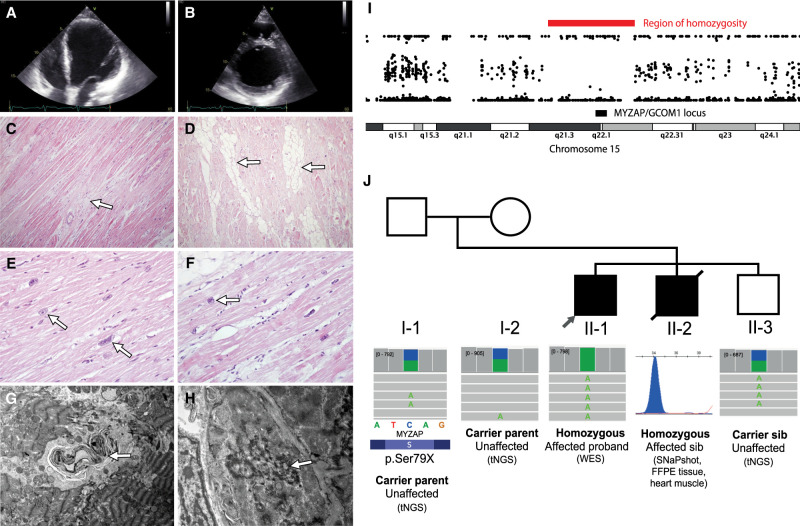
Data from the imaging, microscopy, and genetic studies in the family. Apical four-chamber (A) and parasternal short-axis (B) transthoracic echocardiography video clips of the proband at the age of 21, shortly before transplantation. Note the dilated left ventricle with global hypokinesia and severe reduction of ejection fraction. (C) Light microscopy (original magnification 100×, hematoxylin and eosin [H&E]). The arrow shows the foci of myocardial fibrosis. (D) Light microscopy (original magnification 100×, H&E). Foci of lipocytes in the myocardium (arrows). (E) Light microscopy (original magnification 400×, H&E). Degenerative changes of myocardial nuclei (arrows). (F) Light microscopy (original magnification 400×, H&E). Degenerative changes of myocardial nuclei with perinuclear vacuoles (arrow). (G) Electron microscopy (original magnification, 4400×). Myelin figure in the myocardium (arrow). (H) Electron microscopy (original magnification, 8900×). Focal disorganization of an intercalated disc (arrow). (I) The region of Chromosome 15, indicating the presence of a region of homozygosity detected in exome sequencing data. A region of homozygosity was detected on Chromosome 15, which contains the MYZAP gene locus. (J) The pedigree of the family and segregation results of the premature termination variant detected in the MYZAP gene (NM_001018100.5:c.236C > A, p.Ser79Ter) in the proband (II-1) and the affected sibling (II-2). The unaffected sibling and parents were all heterozygous carriers of the premature termination variant. The variant was initially identified in the proband using exome sequencing and confirmed in the paraffin sample of the deceased affected sibling using SNaPshot methodology and segregation performed using targeted next-generation sequencing (tNGS) in the unaffected sibling and unaffected parents.
Figure 2.
Figure 2.
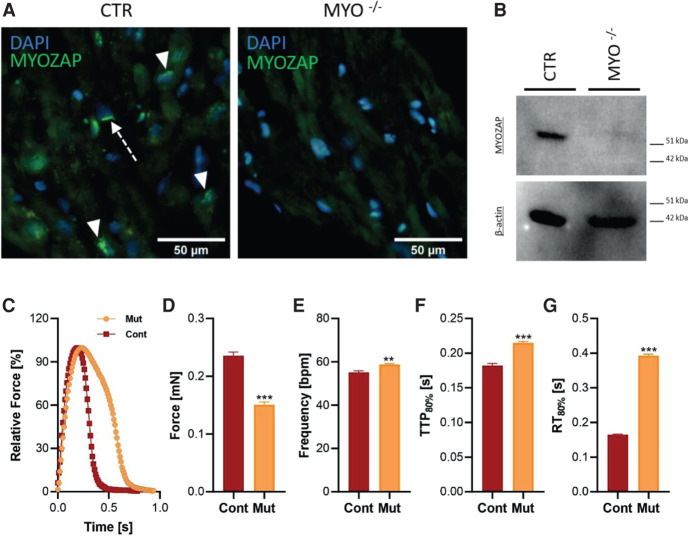
Immunohistochemical and functional studies. The absence of the MYZAP protein in proband tissue was demonstrated by catalyzed fluorescent reporter deposition immunohistochemistry and western blot (WB). (A) In the control sample (CTR), epitopes corresponding to the carboxy-terminal end of the MYZAP protein were distributed in the perinuclear cytoplasm (green signal; arrowhead) and in dense bands perpendicular to myocyte orientation (green signal; arrow). The signal was completely absent in the proband tissue (MYZAP−/−). (B) The absence of the MYZAP signal in the proband tissue was demonstrated by western blot. A β-actin signal on the same membrane was used for internal control (total protein loading control is provided in Supplemental Fig. S1). The bottom panels contain the results of the functional characterization of the engineered heart tissues (EHTs) of patient-derived human induced pluripotent stem cell cardiomyocytes (hiPSC-CMs). (C) The average contraction peaks of EHTs in 1.8 mM Ca2+ Tyrode's solution under 1-Hz pacing at 37°C. (DG) Functional parameters of absolute force (D), frequency (beats per minute, bpm) (E), time to peak 80% (TTP80%, F), and relaxation time (RT80%, G) measured in 1.8 mM Ca2+ Tyrode's solution under 1-Hz pacing at 37 °C. n = 8 patient EHTs and 11 control EHTs. Statistical calculations were carried out by a two-tailed Student's t-test. (**) P < 0.01, (***) P < 0.001.

References

    1. DePristo MA, Banks E, Poplin R, Garimella K V, Maguire JR, Hartl C, Philippakis AA, del Angel G, Rivas MA, Hanna M, et al. 2011. A framework for variation discovery and genotyping using next-generation DNA sequencing data. Nat Genet 43: 491–501. 10.1038/ng.806 - DOI - PMC - PubMed
    1. Elliott P, Andersson B, Arbustini E, Bilinska Z, Cecchi F, Charron P, Dubourg O, Kühl U, Maisch B, McKenna WJ, et al. 2008. Classification of the cardiomyopathies: a position statement from the European Society of Cardiology Working Group on Myocardial and Pericardial Diseases. Eur Heart J 29: 270–276. 10.1093/eurheartj/ehm342 - DOI - PubMed
    1. Heliö K, Mäyränpää MI, Saarinen I, Ahonen S, Junnila H, Tommiska J, Weckström S, Holmström M, Toivonen M, Nikus K, et al. 2021. GRINL1A complex transcription unit containing GCOM1, MYZAP, and POLR2M genes associates with fully penetrant recessive dilated cardiomyopathy. Front Genet 12: 2358. 10.3389/fgene.2021.786705 - DOI - PMC - PubMed
    1. Lonsdale J, Thomas J, Salvatore M, Phillips R, Lo E, Shad S, Hasz R, Walters G, Garcia F, Young N, et al. 2013. The Genotype-Tissue Expression (GTEx) project. Nat Genet 45: 580–585. 10.1038/ng.2653 - DOI - PMC - PubMed
    1. Mak TSH, Lee Y-K, Tang CS, Hai JSH, Ran X, Sham P-C, Tse H-F. 2018. Coverage and diagnostic yield of whole exome sequencing for the evaluation of cases with dilated and hypertrophic cardiomyopathy. Sci Rep 8: 10846. 10.1038/s41598-018-29263-3 - DOI - PMC - PubMed

LinkOut - more resources