


Reliability and validity of the Roche PD Mobile Application for remote monitoring of early Parkinson's disease
- PMID: 35840753
- PMCID: PMC9287320
- DOI: 10.1038/s41598-022-15874-4
Reliability and validity of the Roche PD Mobile Application for remote monitoring of early Parkinson's disease
Abstract
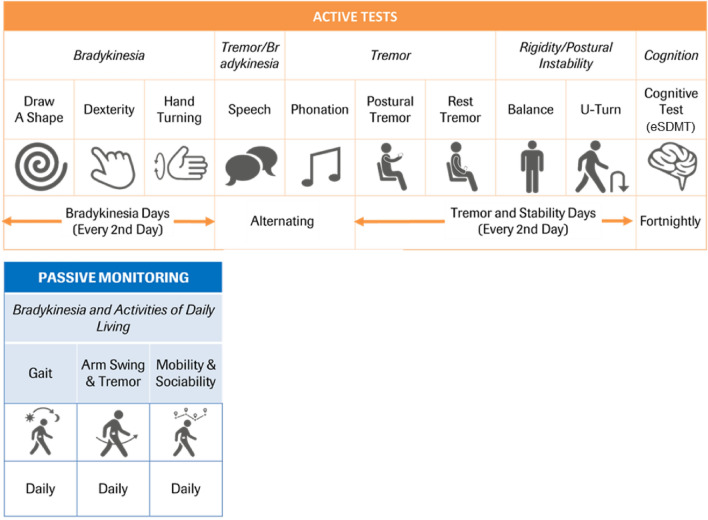
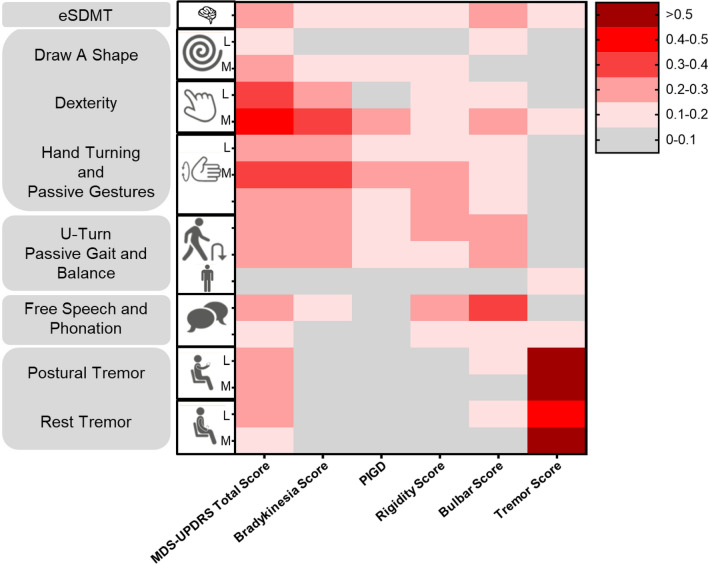
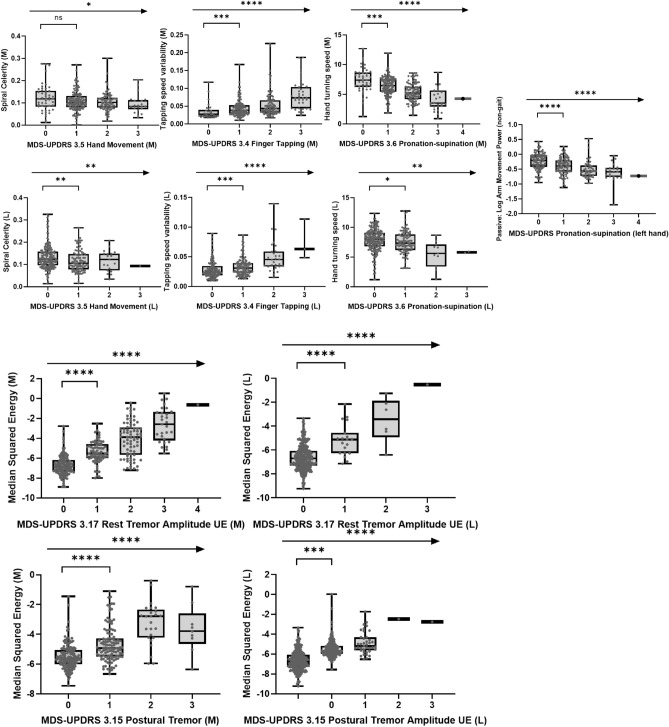
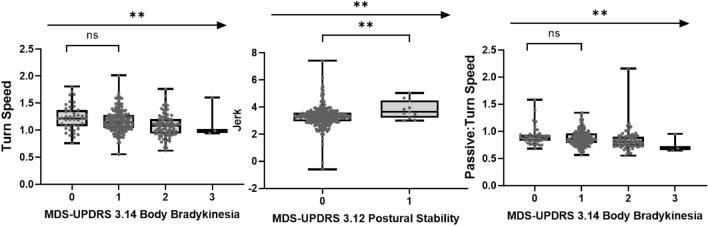
Digital health technologies enable remote and therefore frequent measurement of motor signs, potentially providing reliable and valid estimates of motor sign severity and progression in Parkinson's disease (PD). The Roche PD Mobile Application v2 was developed to measure bradykinesia, bradyphrenia and speech, tremor, gait and balance. It comprises 10 smartphone active tests (with ½ tests administered daily), as well as daily passive monitoring via a smartphone and smartwatch. It was studied in 316 early-stage PD participants who performed daily active tests at home then carried a smartphone and wore a smartwatch throughout the day for passive monitoring (study NCT03100149). Here, we report baseline data. Adherence was excellent (96.29%). All pre-specified sensor features exhibited good-to-excellent test-retest reliability (median intraclass correlation coefficient = 0.9), and correlated with corresponding Movement Disorder Society-Unified Parkinson's Disease Rating Scale items (rho: 0.12-0.71). These findings demonstrate the preliminary reliability and validity of remote at-home quantification of motor sign severity with the Roche PD Mobile Application v2 in individuals with early PD.
© 2022. The Author(s).
Conflict of interest statement
The Authors declare no Competing Non-Financial Interests but the following Competing Financial Interests: FL, KIT, EVV, TK, AB, WLP, WC, YZ, DW, JSE, ABo, HS and GP reports personal fees from F. Hoffmann-La Roche Ltd. BM reports personal fees and other from F. Hoffmann-La Roche Ltd, during the conduct of the study; personal fees from Biogen, personal fees from Servier, non-financial support from Amprion, Grants and personal fees from Michael J. Fox Foundation for Parkinson's Research, Grants from DFG, Grants from EU (Horizon2020), Grants from Parkinson Fonds Deutschland, Grants from Hilde Ulrich Stiftung. WZ reports personal fees from F. Hoffmann-La Roche Ltd and Prothena Ltd. RBP reports Grants and personal fees from Fonds de la Recherche en Sante, Grants from Canadian Institute of Health Research, Grants from The Parkinson Society of Canada, Grants from Weston-Garfield Foundation, Grants from Michael J. Fox Foundation, Grants from Webster Foundation, Grants from National Institute of Health, Grants and personal fees from Roche, personal fees from Takeda, personal fees from Teva Neurosciences, personal fees from Biogen, personal fees from Boehringer Ingelheim, personal fees from Theranexus, personal fees from GE HealthCare, personal fees from Jazz Pharmaceuticals, personal fees from AbbVie, personal fees from Janssen, personal fees from Otsuko, personal fees from Phytopharmica, personal fees from Inception Sciences, other from Parkinson Canada, personal fees from Paladin. ML reports personal fees from F. Hoffmann-La Roche Ltd and has a patent US20190200915A1 pending to Hoffmann-La Roche Inc., a patent EP3701542A2 pending to F. Hoffmann-La Roche AG, a patent WO2019215230A1 pending to F. Hoffmann-La Roche AG, and a patent WO2021055443A1 pending to F. Hoffmann-La Roche AG.
Figures
References
Publication types
MeSH terms
Associated data
LinkOut - more resources
Full Text Sources
Other Literature Sources
Medical
