


Wearable OPM-MEG: A changing landscape for epilepsy
- PMID: 35841260
- PMCID: PMC9805039
- DOI: 10.1111/epi.17368
Wearable OPM-MEG: A changing landscape for epilepsy
Abstract
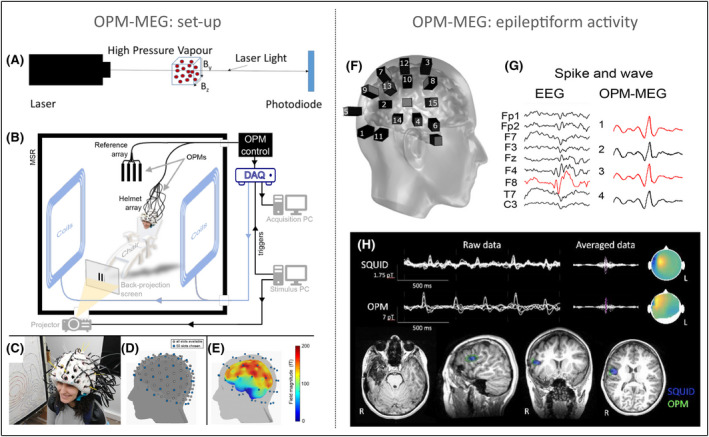
Magnetoencephalography with optically pumped magnometers (OPM-MEG) is an emerging and novel, cost-effective wearable system that can simultaneously record neuronal activity with high temporal resolution ("when" neuronal activity occurs) and spatial resolution ("where" neuronal activity occurs). This paper will first outline recent methodological advances in OPM-MEG compared to conventional superconducting quantum interference device (SQUID)-MEG before discussing how OPM-MEG can become a valuable and noninvasive clinical support tool in epilepsy surgery evaluation. Although OPM-MEG and SQUID-MEG share similar data features, OPM-MEG is a wearable design that fits children and adults, and it is also robust to head motion within a magnetically shielded room. This means that OPM-MEG can potentially extend the application of MEG into the neurobiology of severe childhood epilepsies with intellectual disabilities (e.g., epileptic encephalopathies) without sedation. It is worth noting that most OPM-MEG sensors are heated, which may become an issue with large OPM sensor arrays (OPM-MEG currently has fewer sensors than SQUID-MEG). Future implementation of triaxial sensors may alleviate the need for large OPM sensor arrays. OPM-MEG designs allowing both awake and sleep recording are essential for potential long-term epilepsy monitoring.
Keywords: EEG; MEG; MRI; OPM-MEG; brain surgery; epilepsy.
© 2022 The Authors. Epilepsia published by Wiley Periodicals LLC on behalf of International League Against Epilepsy.
Conflict of interest statement
None of the authors has any conflict of interest to disclose. We confirm that we have read the Journal's position on issues involved in ethical publication and affirm that this report is consistent with those guidelines.
Figures
References
-
- Cohen D, Edelsack EA, Zimmerman JE. Magnetocardiograms taken inside a shielded room with a superconducting point‐contact magnetometer. Appl Phys Lett. 1970;16:278–80.
-
- Tovar‐Spinoza ZS, Ochi A, Rutka JT, Go C, Otsubo H. The role of magnetoencephalography in epilepsy surgery. Neurosurg Focus. 2008;25(3):E16. - PubMed
-
- Jaklevic RC, Lambe J, Silver AH, Mercereau JE. Quantum interference effects in Josephson tunneling. Phys Rev Lett. 1964;12(7):159–60.
-
- Nakasatp N, Levesque MF, Barth DS, Baumgartner C, Rogers RL, Sutherling WW. Comparisons of MEG, EEG, and ECoG source localization in neocortical partial epilepsy in humans. Electroencephalogr Clin Neurophysiol. 1994;91(3):171–8. - PubMed
-
- Barkley GL, Baumgartner C. MEG and EEG in epilepsy. J Clin Neurophysiol. 2003;20(3):163–78. - PubMed
