


The shifting prevalence of asthma and allergic disease in US children
- PMID: 35842086
- PMCID: PMC9901425
- DOI: 10.1016/j.anai.2022.06.030
The shifting prevalence of asthma and allergic disease in US children
Abstract
Background: Asthma is a chronic lung disease that affected 5 million children. Allergy is a common comorbidity of asthma. Having both conditions is associated with unfavorable health outcomes and impaired quality of life.
Objective: Purpose of this study was to assess allergy and its association with asthma by select characteristics among children to determine differences by populations.
Methods: National Health Interview Survey data (2007-2018) were used to assess asthma and allergy status, trends, and the association between allergy and asthma by select characteristics among US children (aged 0-17 years).
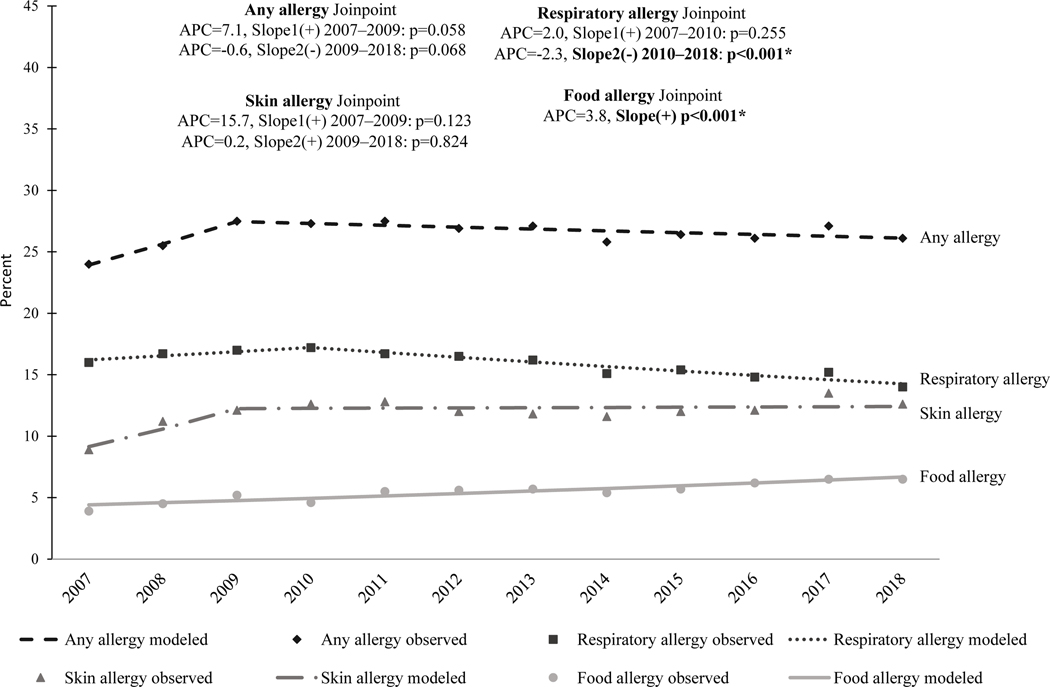
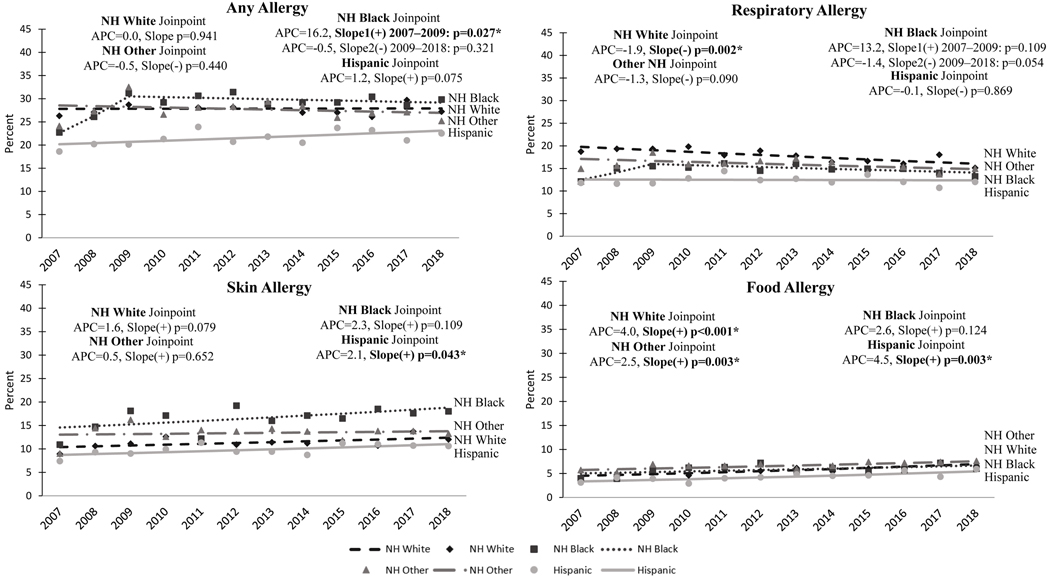
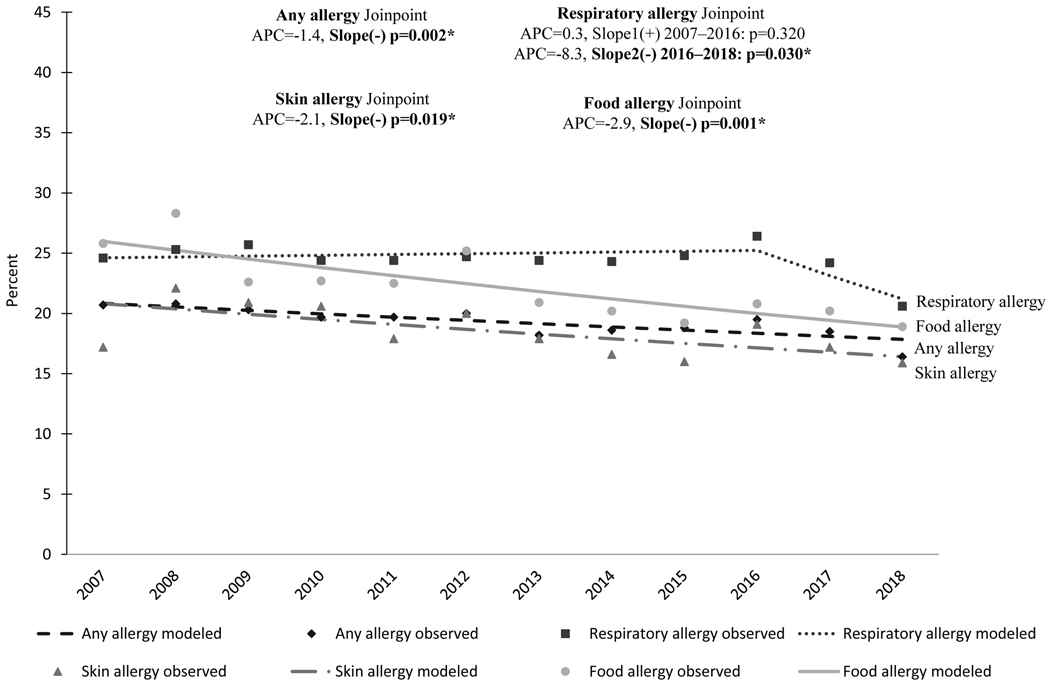
Results: Prevalence of asthma decreased among all children (slope [-] P < .001) and among those with allergy (slope [-] P = .002). More children had respiratory allergy (14.7%), followed by skin allergy (12.7%) and food allergy (6.4%). Prevalence of respiratory allergy significantly decreased among White non-Hispanic children (slope [-] P = .002), food allergy increased among White non-Hispanic (slope [+] P < .001) and Hispanic children (slope [+] P = .003), and skin allergy increased among Hispanic children (slope [+] P = .04). Depending on number and type, children with allergy were 2 to 8 times (skin allergy only and having all 3 allergies, respectively) more likely to have current asthma than were children without allergy. Among children with current asthma, having any allergy was significantly associated with missed school days (adjusted prevalence ratio, 1.33 [1.03-1.72]; P = .02) and taking preventive medication daily (adjusted prevalence ratio, 1.89 [1.32-2.71]; P < .001).
Conclusion: Trends in allergies across years differed by race and ethnicity. Strength of association between asthma and allergy differed by type and number of allergies, being highest among children having all 3 types of allergies. Having both asthma and allergy was associated with unfavorable asthma outcomes.
Copyright © 2022. Published by Elsevier Inc.
Conflict of interest statement
Conflicts of interest: none
Figures
References
-
- Expert Panel Working Group of the National Heart, Lung, and Blood Institute (NHLBI) administered and coordinated National Asthma Education and Prevention Program Coordinating Committee (NAEPPCC), Cloutier MM, Baptist AP, Blake KV, Brooks EG, Bryant-Stephens T, et al. 2020 Focused Updates to the Asthma Management Guidelines: A Report from the National Asthma Education and Prevention Program Coordinating Committee Expert Panel Working Group. J Allergy Clin Immunol. 2020. Dec;146(6):1217–1270. Erratum in: J Allergy Clin Immunol. 2021;147(4):1528–1530. doi: 10.1016/j.jaci.2020.10.003. - DOI - PMC - PubMed
-
- Centers for Disease Control and Prevention. Most recent national asthma data. Atlanta, GA: US Department of Health and Human Services, CDC; 2020. [updated 2021 March 30; cited 2021 July 16]. Available at: https://www.cdc.gov/asthma/most_recent_national_asthma_data.htm.
-
- Global Initiative for Asthma. Global strategy for asthma management and prevention. Fontana, WI: Global Initiative for Asthma; 2020. Available at: https://ginasthma.org/gina-reports.
