. 2022 Jul 16;12(1):12197.
doi: 10.1038/s41598-022-15930-z.

Hepatitis C virus NS3/4A inhibitors and other drug-like compounds as covalent binders of SARS-CoV-2 main protease

Affiliations

Hepatitis C virus NS3/4A inhibitors and other drug-like compounds as covalent binders of SARS-CoV-2 main protease

Babak Andi et al. Sci Rep. .

Abstract

Severe acute respiratory syndrome-coronavirus 2 (SARS-CoV-2), which causes coronavirus disease 2019 (COVID-19), threatens global public health. The world needs rapid development of new antivirals and vaccines to control the current pandemic and to control the spread of the variants. Among the proteins synthesized by the SARS-CoV-2 genome, main protease (Mpro also known as 3CLpro) is a primary drug target, due to its essential role in maturation of the viral polyproteins. In this study, we provide crystallographic evidence, along with some binding assay data, that three clinically approved anti hepatitis C virus drugs and two other drug-like compounds covalently bind to the Mpro Cys145 catalytic residue in the active site. Also, molecular docking studies can provide additional insight for the design of new antiviral inhibitors for SARS-CoV-2 using these drugs as lead compounds. One might consider derivatives of these lead compounds with higher affinity to the Mpro as potential COVID-19 therapeutics for further testing and possibly clinical trials.


Conflict of interest statement

The authors declare no competing interests.

Figures
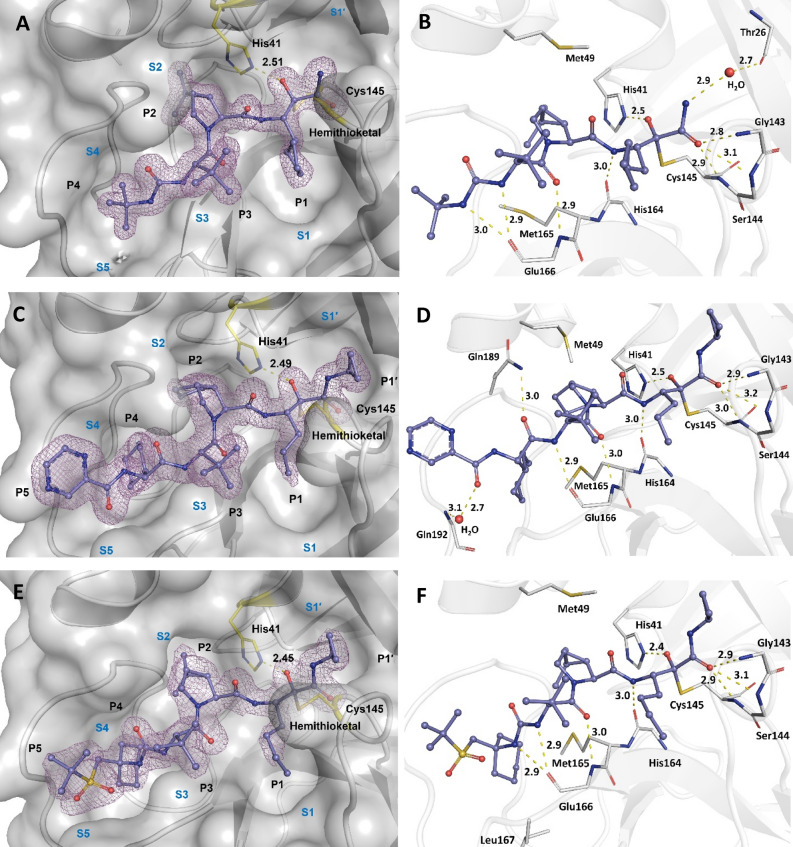
Figure 1
Figure 1
Active subsites of the Mpro binding pocket (S1′–S5), ligand functional groups or positions (P1′–P5), and hydrogen bonding interactions of the HCV NS3/4A inhibitors with Mpro. (A) Electron density of the boceprevir complex at 1.35 Å resolution (PDB entry: 7K40). Boceprevir lacks the P1′ and P5 functional groups and therefore the associated enzyme subsites are not occupied. (B) Hydrogen bonding interactions of boceprevir complex. One structural water molecule facilitates the binding of the amine group of the α-ketoamide moiety. (C) electron density of the telaprevir complex at 1.48 Å resolution (PDB entry: 7K6D). (D) Hydrogen bonding interactions of the telaprevir complex. One structural water molecule facilitates the binding of the pyrazine (P5) moiety. (E) Electron density of the narlaprevir complex at 1.79 Å resolution (PDB entry: 7JYC). (F) Hydrogen bonding interactions of the narlaprevir complex. Ligands are shown as ball-and-stick representation. Electron densities (2Fo–Fc, 1 rmsd) are shown as purple mesh. All distances are in Å. (C) reproduced with permission of the International Union of Crystallography, Acta Cryst. (2021), A77, C194 (https://doi.org/10.1107/S0108767321094885).
Figure 2
Figure 2
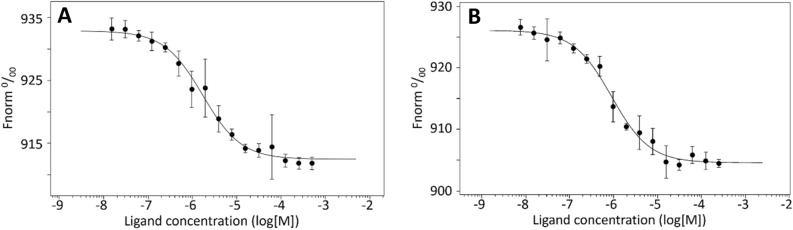
The equilibrium dissociation constants between (A) Mpro-telaprevir (23 ± 4 μM) and (B) Mpro-narlaprevir (12 ± 3 μM) were determined by thermophoretic experiments titrated against fluorescently labeled Mpro. Dissociation curves were fit to the data to calculate the Kds. Data shown are the mean ± SD, n = 3. For boceprevir, the binding experiment was not successful due to the precipitation of the ligand in the assay buffer (30 mM sodium phosphate pH 8.0, 200 mM NaCl, 1 mM DTT). The precipitation led to turbidity and a non-uniform fluorescent signal.
Figure 3
Figure 3
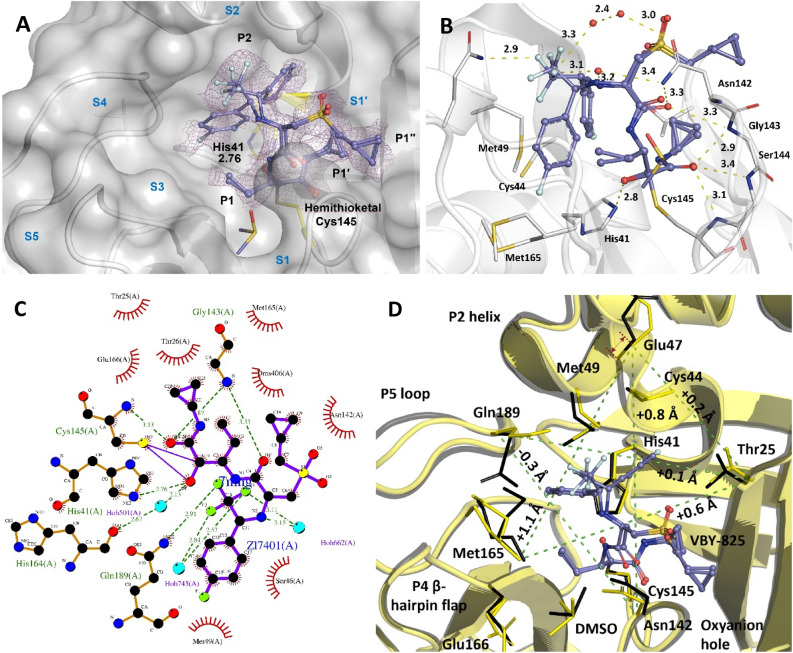
Active subsites of the Mpro binding pocket (S1′–S5), ligand functional groups (P1, P1′, P1′′, & P2), and hydrogen bonding interactions of the novel covalent inhibitor VBY-825 with Mpro. Two different conformations of VBY-825 are shown. (A) Partial electron density of the VBY-825 Mpro complex at 1.70 Å resolution and 0.5 rmsd (PDB entry: 7MNG). VBY-825 lacks the P3–P5 functional groups and therefore the associated enzyme subsites are not occupied. Binding of a DMSO molecule to the S1 site forces the VBY-825 to bind in a tilted conformation to Cys145 (B) Hydrogen bonding interactions of VBY-825 Mpro complex shown for conformer A. Structural water molecules may facilitates the binding of the highly polarized fluorine groups of the trifluoromethyl moiety. A charge-assisted H-bond (CHAB) between H and F is possible, albeit not optimal. (C) A detailed 2D LigPlot+ diagram of all the molecular interactions between conformer A of the VBY-825 and Mpro is shown. Hydrogen bonds are shown as green dotted lines. Spoked arcs represent nonbonded contacts such as hydrophobic interactions. The solid purple line between Cys145 and VBY-825 represents a covalent binding. (D) An overlay (0.28 Å r.m.s.d.) of the apo (black) (PDB: 7K3T) and VBY-825 bound (yellow) (PDB: 7MNG) Mpro. The comparative changes in Cα distances are shown as green dotted lines with values. Binding of the VBY-825 displaces the P2 helix by 1.1 Å (red arrows) and predominantly displaces the side chains of Gln189 and Met165. However, the conformational changes are less significant in comparison with other HCV NS3/4A inhibitor-Mpro complexes.
Figure 4
Figure 4
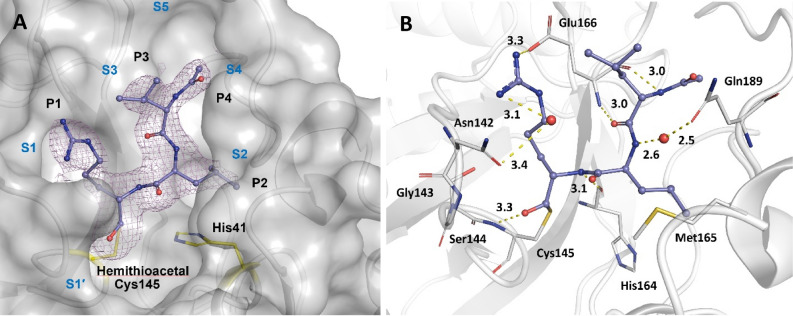
Active subsites of the Mpro binding pocket (S1′–S5), ligand functional groups (P1–P4), and hydrogen bonding interactions of the covalent inhibitor leupeptin with Mpro. (A) electron density of the leupeptin Mpro complex at 2.3 Å resolution and 0.5 rmsd (PDB entry: 7MRR). Leupeptin lacks the P5 functional group and therefore the associated enzyme subsite is not occupied. (B) hydrogen bonding interactions of leupeptin Mpro complex shown. Two structural water molecules shown facilitate the binding of leupeptin.
Figure 5
Figure 5
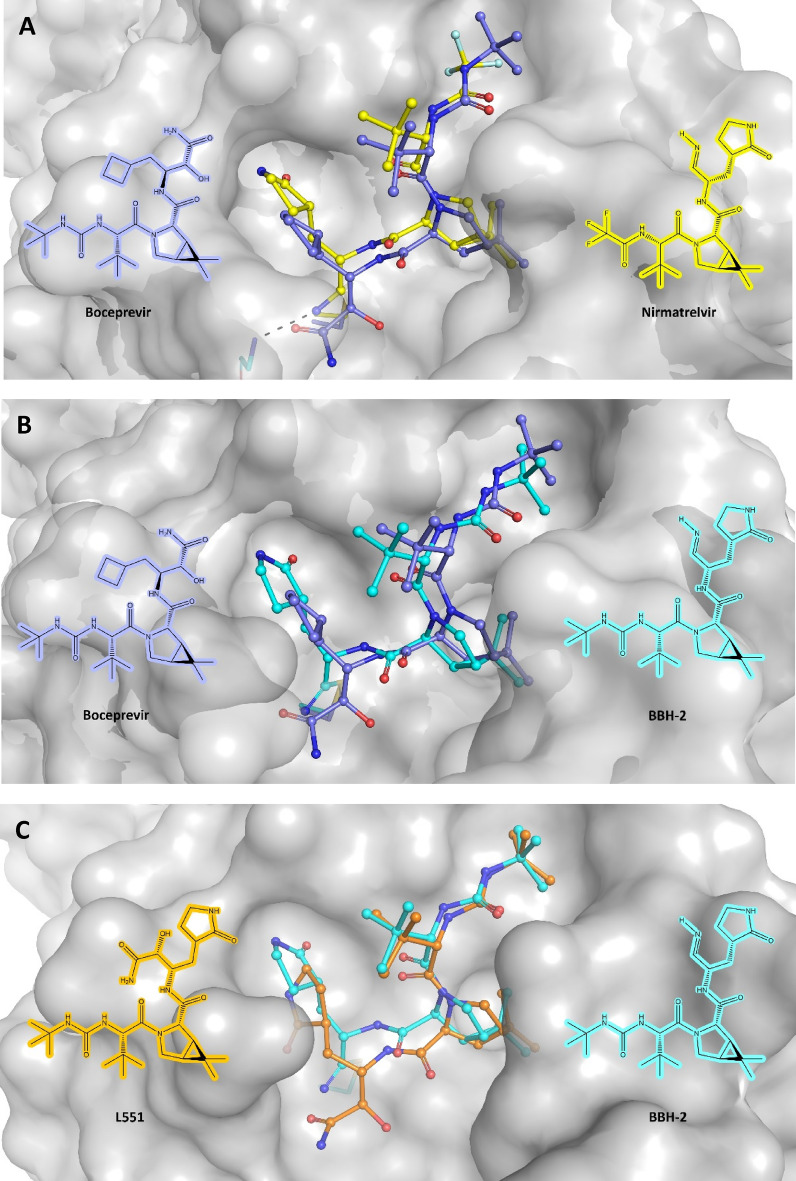
Comparison of the binding modes of four closely related ligands to the Mpro. (A) Comparison of boceprevir (PDB: 7K40—this study) and nirmatrelvir (PDB: 7RFW) binding modes to the Mpro. The nitrile warhead of the nirmatrelvir can make a 3.0 Å hydrogen bond to the Gly143 (shown in black dotted line) (B) comparison of boceprevir (PDB: 7K40) and BBH-2 (PDB: 7TEH) binding modes to the Mpro. (C) comparison of the designed L551 with the molecular docking binding mode as shown (Fig. S2D—this study) and the binding mode of BBH-2 (PDB: 7TEH) to the Mpro. The chemical structures are shown in their binding form. Structures were drawn using ChemDraw 14 Professional from PerkinElmer (https://perkinelmerinformatics.com/products/research/chemdraw).

References

    1. Zhou P, et al. A pneumonia outbreak associated with a new coronavirus of probable bat origin. Nature. 2020;579:270–273. doi: 10.1038/s41586-020-2012-7. - DOI - PMC - PubMed
    1. Wu F, et al. A new coronavirus associated with human respiratory disease in China. Nature. 2020;579:265–269. doi: 10.1038/s41586-020-2008-3. - DOI - PMC - PubMed
    1. Adachi S, et al. Commentary: origin and evolution of pathogenic coronaviruses. Front. Immunol. 2020;11:811. doi: 10.3389/fimmu.2020.00811. - DOI - PMC - PubMed
    1. Gordon DE, et al. A SARS-CoV-2 protein interaction map reveals targets for drug repurposing. Nature. 2020;583:459–468. doi: 10.1038/s41586-020-2286-9. - DOI - PMC - PubMed
    1. Huang Y, et al. Structural and functional properties of SARS-CoV-2 spike protein: potential antivirus drug development for COVID-19. Acta Pharmacol. Sin. 2020;41:1141–1149. doi: 10.1038/s41401-020-0485-4. - DOI - PMC - PubMed

Publication types

MeSH terms