


Sub-national patterns and correlates of depression among adults aged 45 years and older: findings from wave 1 of the Longitudinal Ageing Study in India
- PMID: 35843255
- PMCID: PMC9375859
- DOI: 10.1016/S2215-0366(22)00186-9
Sub-national patterns and correlates of depression among adults aged 45 years and older: findings from wave 1 of the Longitudinal Ageing Study in India
Abstract
Background: Depression is a major public health challenge linked with several poor health outcomes and disabilities among adults aged 45 years and older in India. We aimed to describe the prevalence of depression and its association with a variety of sociodemographic correlates and co-existing health conditions for this age group in India and its states.
Methods: In this prospective cohort study, data from wave 1 (baseline) of the Longitudinal Ageing Study in India were used to estimate the national and subnational state level age-standardised prevalence of depression-major depressive episodes-using the internationally validated Composite International Diagnostic Interview-Short Form (CIDI-SF) scale. Hierarchical mixed effect multivariate logistic regression models were used to study the sociodemographic correlates and co-existing health conditions of major depressive episodes among the nationally representative sample of 72 250 adults aged 45 years and older from 35 states or union territories (except the state of Sikkim). Associations between depression and self-rated health, co-morbid conditions, functional health, and life satisfaction measures were also examined.
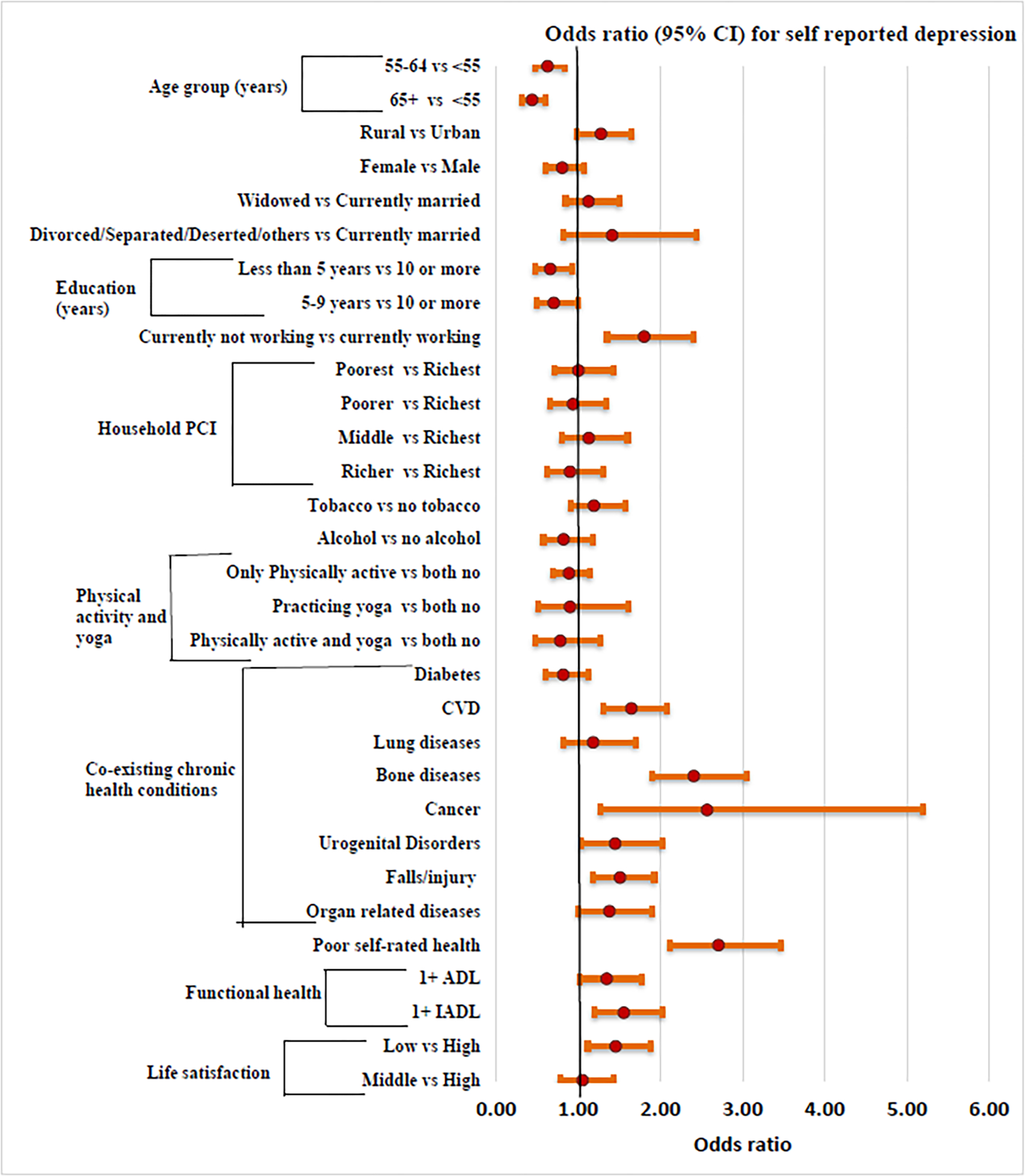
Findings: A total of 40 335 (58·3%) females and 29 407 (41·7%) males aged 45 to 116 years (median age 58 years) participated. The overall age-standardised prevalence of depression based on CIDI-SF scale was 5·7% (95% CI 5·5-5·8) compared with 0·5% (0·5-0·6) self-reported prevalence of depression among adults aged 45 years and older in India. Wide sub-national variations were seen in depression prevalence, ranging from 0·8% (95% CI 0·3-1·3) in Mizoram state to 12·9% (11·6-14·2) in Madhya Pradesh. Prevalence was higher in females (6·3% [95% CI 6·1-6·6] vs 4·3% [4·1-4·6]) for India, and this higher prevalence was more pronounced in some of the northern states. The risk of depression was higher in those residing in rural areas, widowed, with no or low education, and in the poorest quintile. Depression showed a strong positive association with poor self-rated health (OR 2·39 [95% CI 2·21-2·59]; p<0·0001), with one or more limitations in the activities of daily living (ADL; OR 1·60 [1·46-1·75]; p<0·0001), instrumental ADL limitations (OR 1·51 [1·40-1·64]; p<0·0001), and low cognitive judgment of life satisfaction (OR 1·94 [95% CI 1·78-2·10]; p<0·0001).
Interpretation: Despite the substantial burden, depression remains undiagnosed and strongly linked with poor health and wellbeing outcomes in adults aged 45 years and older in India. The ageing population of India and the subnational variations amplify the implications of this new evidence to address the substantial gaps in prevention and treatment of depression.
Funding: LASI was funded by the Ministry of Health and Family Welfare, Government of India, the National Institute of Ageing, USA and the United Nations Population Fund, India.
Copyright © 2022 Elsevier Ltd. All rights reserved.
Conflict of interest statement
Declaration of interests We declare no competing interests.
Figures


Comment in
-
Depression in Indians 45 years and older: a roadblock in healthy ageing.Lancet Psychiatry. 2022 Aug;9(8):605-606. doi: 10.1016/S2215-0366(22)00233-4. Lancet Psychiatry. 2022. PMID: 35843251 No abstract available.
References
-
- Ginn S, Horder J. “One in four” with a mental health problem: the anatomy of a statistic. Bmj. 2012. Feb 22;344: e1302. - PubMed
-
- Vigo D, Thornicroft G, Atun R. Estimating the true global burden of mental illness. The Lancet Psychiatry. 2016. Feb 1;3(2):171–8. - PubMed
-
- GBD 2017 Disease and Injury Incidence and Prevalence Collaborators. Global, regional, and national incidence, prevalence, and years lived with disability for 354 diseases and injuries for 195 countries and territories, 1990–2017: a systematic analysis for the Global Burden of Disease Study 2017. The Lancet. 2018. Nov 10;392(10159):1789–858 - PMC - PubMed
-
- Arokiasamy P, Uttamacharya U, Jain K, Biritwum RB, Yawson AE, Wu F, Guo Y, Maximova T, Espinoza BM, Rodríguez AS, Afshar S. The impact of multimorbidity on adult physical and mental health in low-and middle-income countries: what does the study on global ageing and adult health (SAGE) reveal? BMC medicine. 2015. Dec 1;13(1):178. - PMC - PubMed
-
- Charlson FJ, Baxter AJ, Cheng HG, Shidhaye R, Whiteford HA. The burden of mental, neurological, and substance use disorders in China and India: a systematic analysis of community representative epidemiological studies. The Lancet. 2016. Jul 23;388(10042):376–89. - PubMed
MeSH terms
Grants and funding
LinkOut - more resources
Full Text Sources
Medical
