. 2022 May;29(5):3929-3936.
doi: 10.1016/j.sjbs.2022.03.014. Epub 2022 Mar 10.

Novel molecular classification of colorectal cancer and correlation with survival

Affiliations

Novel molecular classification of colorectal cancer and correlation with survival

Fayaz Hussain Mangi et al. Saudi J Biol Sci. 2022 May.

Abstract

Introduction: Colorectal cancer (CRC) is one of the most common cancers worldwide. This study was designed to evaluate biological patterns, explore molecular classification and correlate with survival outcome in treatment naïve CRC patients.

Methods: Over 11 years consecutive series of 435 CRC patients were operated on as primary surgical therapy. A total of 201 CRC patients were included, whose complete set of clinical information was available, and their good quality tumour blocks were retrieved. Immunohistochemistry was used for tumour analysis, and partitional clustering was performed using R software for cluster analysis.

Results: The median age was 43 (range 10-85) years; adenocarcinoma was the most commonly seen histological type. The great majority had positive CK20, CEA, E-Cadherin, Ki67, CDX2, and p53 expression. There were four distinct molecular classes found, whereas Ki67, CDX2, and p53 play the main role in partitioning. Younger age negatively impacted survival; overall and disease-specific survival was 26 months only with 50 months' longest survival.

Conclusion: Colorectal cancer is a biologically heterogeneous disease with at least four distinct molecular patterns, where cell proliferation and gene repair mechanisms appear to play the key role.


Conflict of interest statement

The authors declare that they have no known competing financial interests or personal relationships that could have appeared to influence the work reported in this paper.

Figures

Fig. 1a
Fig. 1a
Gender specific pattern of age groups of colorectal cancer.
Fig. 1b
Fig. 1b
Age standardized pattern of histological grade in colorectal cancer.
Fig. 1c
Fig. 1c
Association of histological grade and p53 in colorectal cancer.
Fig. 2a
Fig. 2a
Biplots K-means of molecular classification of colorectal cancer. b. Novel molecular classification of colorectal cancer in Pakistani population c. Immunohistochemical pattern of novel molecular classification of colorectal cancer in Pakistani population (Magnification size −10× using Euromax Microscope with camera).
Fig. 2a
Fig. 2a
Biplots K-means of molecular classification of colorectal cancer. b. Novel molecular classification of colorectal cancer in Pakistani population c. Immunohistochemical pattern of novel molecular classification of colorectal cancer in Pakistani population (Magnification size −10× using Euromax Microscope with camera).
Fig. 2a
Fig. 2a
Biplots K-means of molecular classification of colorectal cancer. b. Novel molecular classification of colorectal cancer in Pakistani population c. Immunohistochemical pattern of novel molecular classification of colorectal cancer in Pakistani population (Magnification size −10× using Euromax Microscope with camera).
Fig. 3a
Fig. 3a
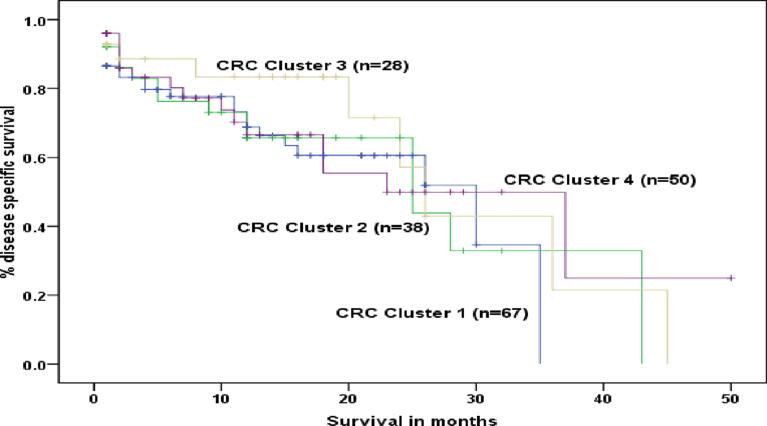
Overall survival in patients with colorectal cancer. b. Disease specific survival in patients with colorectal cancer c. Disease specific survival of patients with colorectal cancer – a comparison of <50 and older then 50 years. d. Disease specific survival of patients with colorectal cancer – Comparison of novel molecular classes.
Fig. 3a
Fig. 3a
Overall survival in patients with colorectal cancer. b. Disease specific survival in patients with colorectal cancer c. Disease specific survival of patients with colorectal cancer – a comparison of <50 and older then 50 years. d. Disease specific survival of patients with colorectal cancer – Comparison of novel molecular classes.
Fig. 3a
Fig. 3a
Overall survival in patients with colorectal cancer. b. Disease specific survival in patients with colorectal cancer c. Disease specific survival of patients with colorectal cancer – a comparison of <50 and older then 50 years. d. Disease specific survival of patients with colorectal cancer – Comparison of novel molecular classes.
Fig. 3a
Fig. 3a
Overall survival in patients with colorectal cancer. b. Disease specific survival in patients with colorectal cancer c. Disease specific survival of patients with colorectal cancer – a comparison of <50 and older then 50 years. d. Disease specific survival of patients with colorectal cancer – Comparison of novel molecular classes.

References

    1. Globocan [Internet], 2020. 2020 is an online, for all cancer sites combined. <https://www.uicc.org/news/globocan-2020-new-global-cancer-data#:∼:text=G....
    1. Álvaro E., Cano J.M., García J.L., Brandáriz L., Olmedillas-López S., Arriba M., et al. Clinical and molecular comparative study of colorectal cancer based on age-of-onset and tumor location: two main criteria for subclassifying colorectal cancer. Int. J. Mol. Sci. 2019;20(4) - PMC - PubMed
    1. Alwers E., Bläker H., Walter V., Jansen L., Kloor M., Arnold A., et al. External validation of molecular subtype classifications of colorectal cancer based on microsatellite instability, CIMP BRAF and KRAS. BMC Cancer. 2019;19(1):1–10. - PMC - PubMed
    1. Belov L., Zhou J., Christopherson R.I. Cell surface markers in colorectal cancer prognosis. Int. J. Mol. Sci. 2011;12:78–113. - PMC - PubMed
    1. Salehi far, S., Soltani, M., Zardast, M., Ghasemian Moghaddam, M.R., 2021. Investigating the factors associated with the level of expression of estrogen and progesterone receptors in patients suffering from colorectal cancer. In: Antwi, S. (Ed.), J Cancer Epidemiol [Internet]. 15, 1–6. <https://www.hindawi.com/journals/jce/2021/4478155/>. - PMC - PubMed