


Individual Factors Associated With COVID-19 Infection: A Machine Learning Study
- PMID: 35844896
- PMCID: PMC9279686
- DOI: 10.3389/fpubh.2022.912099
Individual Factors Associated With COVID-19 Infection: A Machine Learning Study
Abstract
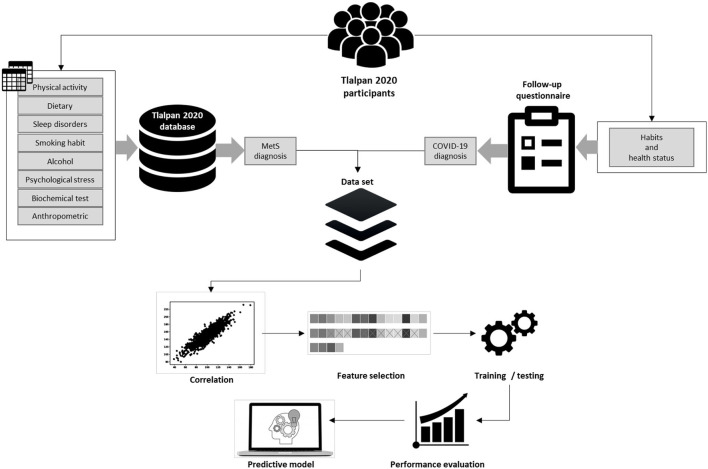
The fast, exponential increase of COVID-19 infections and their catastrophic effects on patients' health have required the development of tools that support health systems in the quick and efficient diagnosis and prognosis of this disease. In this context, the present study aims to identify the potential factors associated with COVID-19 infections, applying machine learning techniques, particularly random forest, chi-squared, xgboost, and rpart for feature selection; ROSE and SMOTE were used as resampling methods due to the existence of class imbalance. Similarly, machine and deep learning algorithms such as support vector machines, C4.5, random forest, rpart, and deep neural networks were explored during the train/test phase to select the best prediction model. The dataset used in this study contains clinical data, anthropometric measurements, and other health parameters related to smoking habits, alcohol consumption, quality of sleep, physical activity, and health status during confinement due to the pandemic associated with COVID-19. The results showed that the XGBoost model got the best features associated with COVID-19 infection, and random forest approximated the best predictive model with a balanced accuracy of 90.41% using SMOTE as a resampling technique. The model with the best performance provides a tool to help prevent contracting SARS-CoV-2 since the variables with the highest risk factor are detected, and some of them are, to a certain extent controllable.
Keywords: COVID-19; feature selection; imbalanced data; machine learning; predictive model.
Copyright © 2022 Ramírez-del Real, Martínez-García, Márquez, López-Trejo, Gutiérrez-Esparza and Hernández-Lemus.
Conflict of interest statement
The authors declare that the research was conducted in the absence of any commercial or financial relationships that could be construed as a potential conflict of interest.
Figures
References
-
- Organization WH . Virtual Press Conference on COVID-19-11 March 2020. Ginebra. (2020).
-
- Shailaja K, Seetharamulu B, Jabbar M. Machine learning in healthcare: a review. In: 2018 Second International Conference on Electronics, Communication and Aerospace Technology (ICECA). Coimbatore: IEEE; (2018). p. 910–4.
Publication types
MeSH terms
LinkOut - more resources
Full Text Sources
Medical
Miscellaneous
