


Impact of Immediacy of Feedback on Continuous Intentions to Use Online Learning From the Student Perspective
- PMID: 35846673
- PMCID: PMC9280469
- DOI: 10.3389/fpsyg.2022.865680
Impact of Immediacy of Feedback on Continuous Intentions to Use Online Learning From the Student Perspective
Abstract
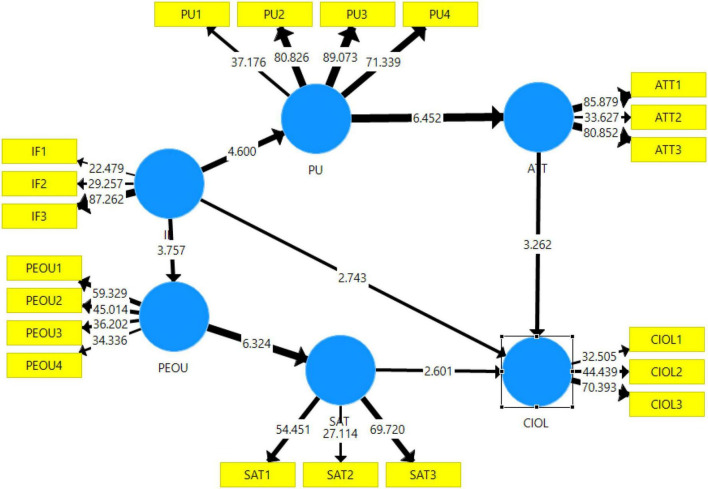
The immediacy of feedback in media is emerging to enhance the interactivity of online experience for users. There is a gap in the study to explore the impacts of the immediacy of feedback on continuous intentions to use online learning from the student perspective. This study aims to fill the gap to investigate the impacts of the immediacy of feedback on students' continuous intentions to use online learning. This study utilizes the technology acceptance model (TAM) and expectation theory model (ETM) to conceptualize the effect of the immediacy of feedback on student continuous intentions to use online learning in terms of the mediation effect of Perceived Ease of Use (PEOU), Perceived Usefulness (PU), satisfaction, and attitude of students for continuous intentions to use online learning. An online survey of higher education students with experience in online learning is conducted to test the proposed hypothesis. The collected data are analyzed by using structural equation modeling (SEM) to establish the proposed hypothesis. The findings reveal that the immediacy of feedback from the media has a strong association with PEOU, PU, students' attitudes, students' satisfaction, and ultimately toward the continuous intentions to use online line learning in future. The study set key theoretical and practical insights to pave the way for future research.
Keywords: COVID-19; immediacy of feedback; information system continuance; online learning environment; technology acceptance model.
Copyright © 2022 Yu and Cai.
Conflict of interest statement
The authors declare that the research was conducted in the absence of any commercial or financial relationships that could be construed as a potential conflict of interest.
Figures


References
-
- Abdul Rahman N. S., Adli N. S., Mat Raffei A. F., Ismail N. S. N. (2020). Factors Determination MOOCs Continuance Intention: a Proposed Conceptual Framework. IOP Conf. Ser. Mater. Sci. Eng. 769:012052. 10.1088/1757-899X/769/1/012052 - DOI
-
- Al-Adwan A. S., Albelbisi N. A., Hujran O., Al-Rahmi W. M., Alkhalifah A. (2021). Developing a Holistic Success Model for Sustainable E-Learning: a Structural Equation Modeling Approach. Sustainability 13:9453.
-
- Alebeisat F., Altarawneh H., Alhalhouli Z. T., Qatawneh A., Almahasne M. (2022). The Impact of Human and Computer Interaction on eLearning Quality. Int. J. Interact. Mob. Technol. 16 58–69. 10.3991/ijim.v16i04.27309 - DOI
-
- Al-Gahtani S. S. (2016). Empirical investigation of e-learning acceptance and assimilation: a structural equation model. Appl. Comput. Inform. 12 27–50. 10.1016/j.aci.2014.09.001 - DOI
-
- Almahamid S., Rub F. (n.d.). Factors that Determine Continuance Intention to use E-learning System: An Empirical Investigation.
LinkOut - more resources
Full Text Sources
Miscellaneous
