Rhinological Status of Patients with Nasolacrimal Duct Obstruction
- PMID: 35846831
- PMCID: PMC9282945
- DOI: 10.1055/s-0041-1730018
Rhinological Status of Patients with Nasolacrimal Duct Obstruction
Abstract
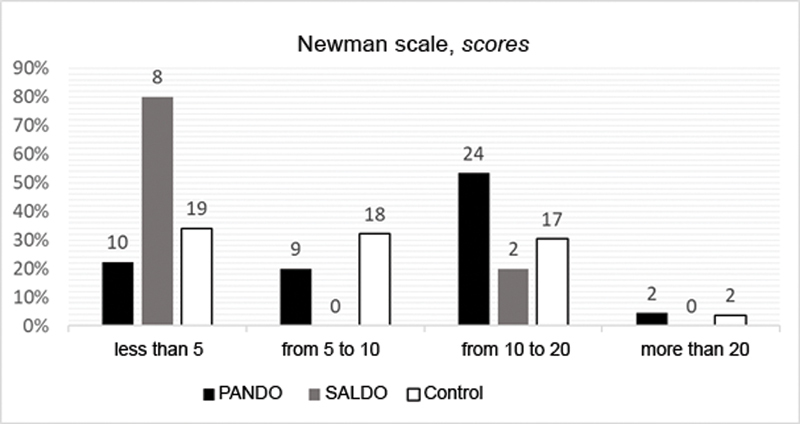
Introduction Studying the state of the nasal cavity and its sinuses and the morphometric parameters of the inferior nasal conchae, as well as a comparative analysis of obtained values in patients with primary (PANDO) and secondary acquired nasolacrimal duct obstruction (SALDO), is relevant. Objective To study the rhinological status of patients with PANDO) and SALDO). Methods The present study was based on the results of computed tomography (CT) dacryocystography in patients with PANDO ( n = 45) and SALDO due to exposure to radioactive iodine ( n = 14). The control group included CT images of paranasal sinuses in patients with no pathology ( n = 49). Rhinological status according to the Newman and Lund-Mackay scales and volume of the inferior nasal conchae were assessed. Statistical processing included nonparametric statistics methods; χ 2 Pearson test; and the Spearman rank correlation method. Results The difference in values of the Newman and Lund-Mackay scales for the tested groups was significant. A significant difference in scores by the Newman scale was revealed when comparing the results of patients with SALDO and PANDO. Comparing the scores by the Lund-Mackay scale, a significant difference was found between the results of patients with SALDO and PANDO and between the results of patients with PANDO and the control group. Conclusion It was demonstrated that the rhinological status of patients with PANDO was worse than that of patients with SALDO and of subjects in the control group. No connection was found between the volume of the inferior nasal conchae and the development of lacrimal duct obstruction.
Keywords: Nasolacrimal Duct; computed tomography; dacryocystography; lund-mackay scale; newman scale; sinus.
Fundação Otorrinolaringologia. This is an open access article published by Thieme under the terms of the Creative Commons Attribution-NonDerivative-NonCommercial License, permitting copying and reproduction so long as the original work is given appropriate credit. Contents may not be used for commecial purposes, or adapted, remixed, transformed or built upon. ( https://creativecommons.org/licenses/by-nc-nd/4.0/ ).
Conflict of interest statement
Conflict of Interests The authors have no conflict of interests to declare.
Figures


References
-
- Ali M J, Paulsen F. Etiopathogenesis of Primary Acquired Nasolacrimal Duct Obstruction: What We Know and What We Need to Know. Ophthal Plast Reconstr Surg. 2019;35(05):426–433. - PubMed
-
- Kwan J YY, Su J, Huang S H. Radiomic Biomarkers to Refine Risk Models for Distant Metastasis in HPV-related Oropharyngeal Carcinoma. Int J Radiat Oncol Biol Phys. 2018;102(04):1107–1116. - PubMed
-
- Lund V J, Mackay I S. Staging in rhinosinusitus. Rhinology. 1993;31(04):183–184. - PubMed
-
- Newman L J, Platts-Mills T A, Phillips C D, Hazen K C, Gross C W. Chronic sinusitis. Relationship of computed tomographic findings to allergy, asthma, and eosinophilia. JAMA. 1994;271(05):363–367. - PubMed
LinkOut - more resources
Full Text Sources