


Odor Enrichment Attenuates the Anesthesia/Surgery-induced Cognitive Impairment
- PMID: 35848747
- PMCID: PMC9845427
- DOI: 10.1097/SLA.0000000000005599
Odor Enrichment Attenuates the Anesthesia/Surgery-induced Cognitive Impairment
Abstract
Objective: To determine the association between olfactory function and cognition in patients and rodents.
Background: Perioperative neurocognitive disorders include delayed neurocognitive recovery (dNCR). The contribution of olfactory function to dNCR remains undetermined. It is unknown whether odor enrichment could mitigate dNCR.
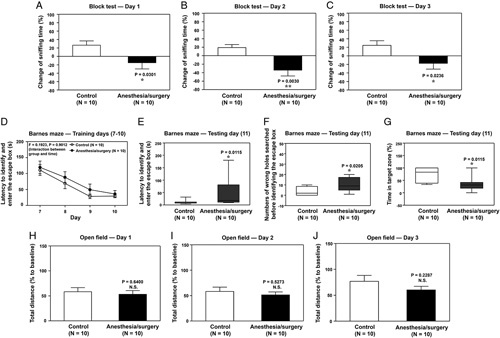
Methods: We performed a prospective observational cohort study to determine potential association between olfactory impairment and dNCR in patients. We assessed the effects of anesthesia/surgery on olfactory and cognitive function in mice using the block test and Barnes maze. We measured interleukin-6 (IL-6), olfactory mature protein, growth-associated protein 43, mature and premature olfactory neurons, postsynaptic density 95, and synaptophysin in blood, nasal epithelium, and hippocampus of mice. Odor enrichment, IL-6 antibody, and knockout of IL-6 were used in the interaction experiments.
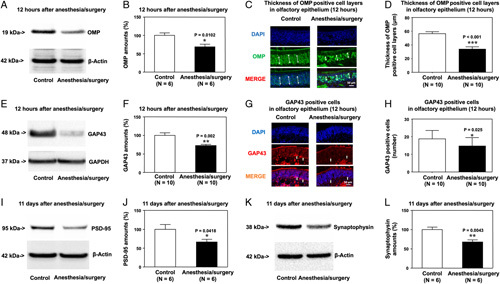
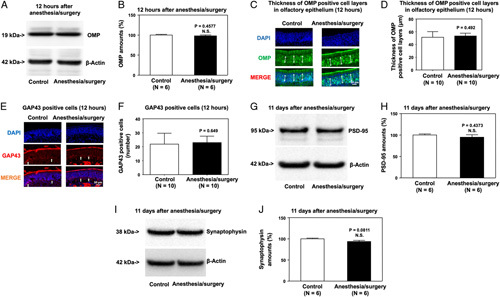
Results: Patients with dNCR had worse odor identification than the patients without dNCR [preoperative: 7 (1.25, 9) vs 10 (8, 11), median (interquartile range), P <0.001; postoperative: 8 (2.25, 10) vs 10 (8, 11), P <0.001]. Olfactory impairment associated with dNCR in patients before and after adjusting age, sex, education, preoperative mini-mental state examination score, and days of the neuropsychological tests. Anesthesia/surgery induced olfactory and cognitive impairment, increased levels of IL-6 in blood and nasal epithelium, decreased amounts of olfactory receptor neurons and their markers in the nasal epithelium, and reduced amounts of synapse markers in the hippocampus of mice. These changes were attenuated by odor enrichment and IL-6 antibody.
Conclusion: The anesthesia/surgery-induced olfactory impairment may contribute to dNCR in patients and postoperative cognitive impairment in mice. Odor enrichment could be a potential intervention.
Copyright © 2022 The Author(s). Published by Wolters Kluwer Health, Inc.
Conflict of interest statement
Z.X. provided consulting services to Shanghai 9th and 10th hospital and Baxter (invited speaker) in the last 36 months. The remaining authors report no conflicts of interest.
Figures
References
-
- Evered L, Silbert B, Knopman DS, et al. Recommendations for the nomenclature of cognitive change associated with anaesthesia and surgery-2018. Anesthesiology. 2018;129:872–879. - PubMed
-
- Vyhnalek M, Magerova H, Andel R, et al. Olfactory identification in amnestic and non-amnestic mild cognitive impairment and its neuropsychological correlates. J Neurol Sci. 2015;349:179–184. - PubMed
-
- Wilson RS, Schneider JA, Arnold SE, et al. Olfactory identification and incidence of mild cognitive impairment in older age. Arch Gen Psychiatry. 2007;64:802–808. - PubMed
-
- Murphy C. Olfactory and other sensory impairments in Alzheimer disease. Nat Rev Neurol. 2019;15:11–24. - PubMed
