


Reassessing the causal role of obesity in breast cancer susceptibility: a comprehensive multivariable Mendelian randomization investigating the distribution and timing of exposure
- PMID: 35848946
- PMCID: PMC7614158
- DOI: 10.1093/ije/dyac143
Reassessing the causal role of obesity in breast cancer susceptibility: a comprehensive multivariable Mendelian randomization investigating the distribution and timing of exposure
Abstract
Background: Previous Mendelian randomization (MR) studies on obesity and risk of breast cancer adopted a small number of instrumental variables and focused mainly on the crude total effect. We aim to investigate the independent causal effect of obesity on breast cancer susceptibility, considering the distribution of fat, covering both early and late life.
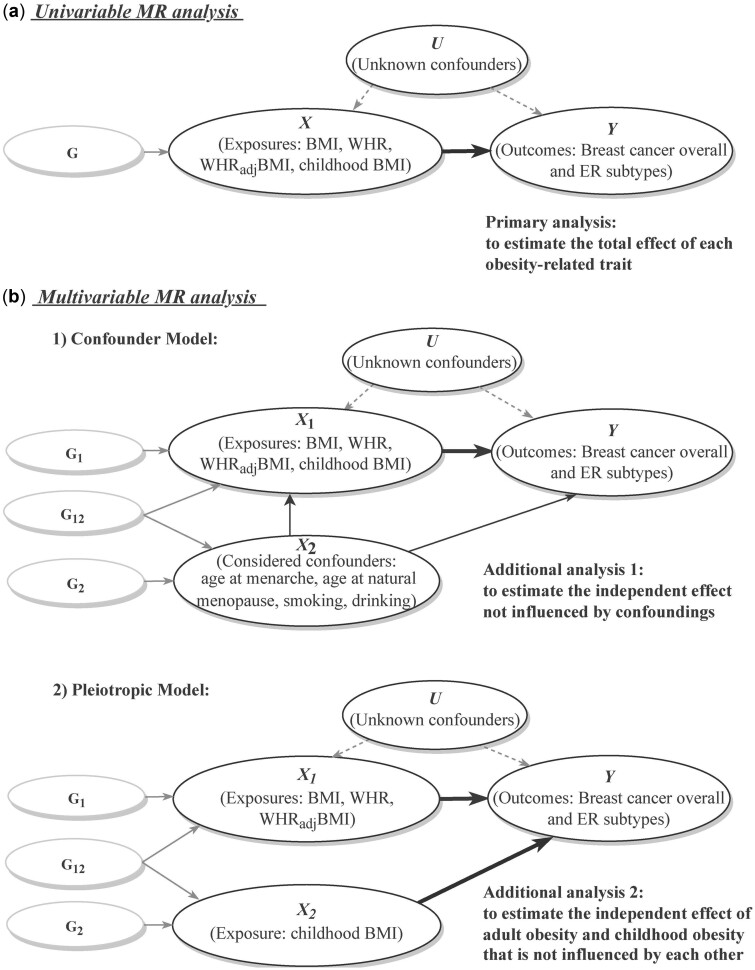
Methods: Using an enlarged set of female-specific genetic variants associated with adult general [body mass index (BMI)] and abdominal obesity [waist-to-hip ratio (WHR) with and without adjustment for BMI, WHR and WHRadjBMI] as well as using sex-combined genetic variants of childhood obesity (childhood BMI), we performed a two-sample univariable MR to re-evaluate the total effect of each obesity-related exposure on overall breast cancer (Ncase = 133 384, Ncontrol = 113 789). We further looked into its oestrogen receptor (ER)-defined subtypes (NER+ = 69 501, NER- = 21 468, Ncontrol = 105 974). Multivariable MR was applied to estimate the independent causal effect of each obesity-related exposure on breast cancer taking into account confounders as well as to investigate the independent effect of adult and childhood obesity considering their inter-correlation.
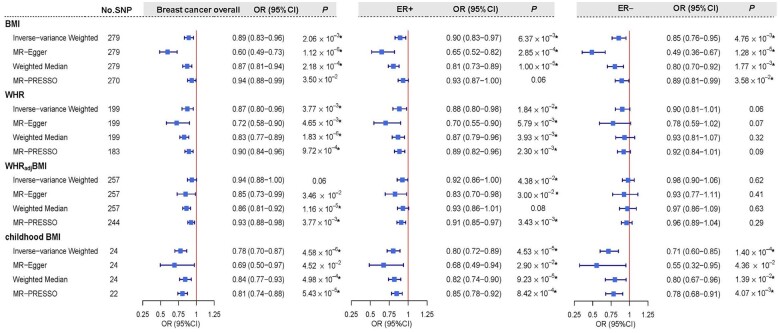
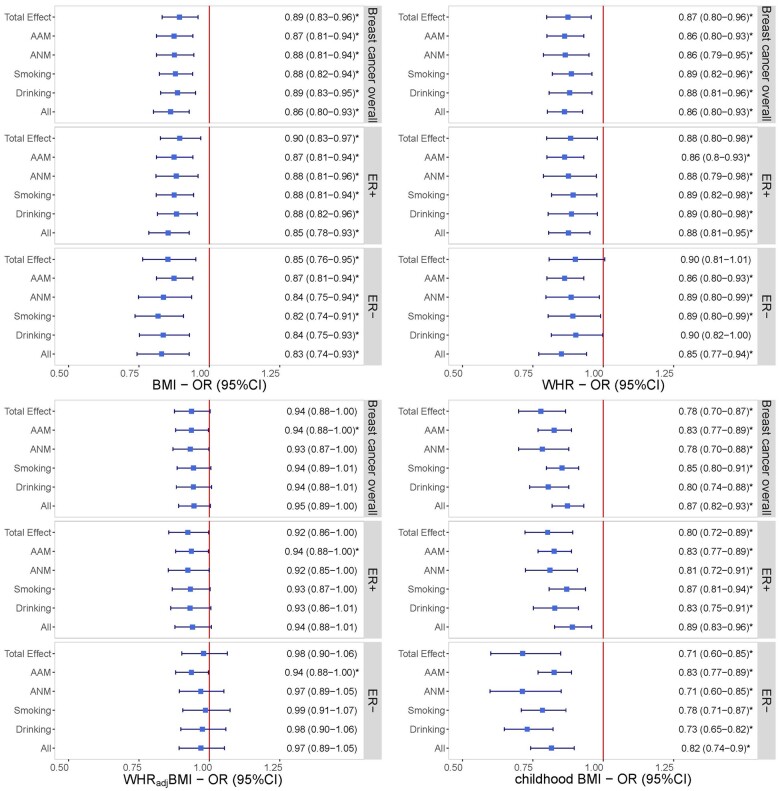
Results: In univariable MR, the protective effects of both adult BMI [odds ratio (OR) = 0.89, 95% CI = 0.83-0.96, P = 2.06 × 10⁻³] and childhood BMI (OR = 0.78, 95% CI = 0.70-0.87, P = 4.58 × 10⁻⁶) were observed for breast cancer overall. Comparable effects were found in ER+ and ER- subtypes. Similarly, genetically predicted adult WHR was also associated with a decreased risk of breast cancer overall (OR = 0.87, 95% CI = 0.80-0.96, P = 3.77 × 10⁻³), restricting to ER+ subtype (OR = 0.88, 95% CI = 0.80-0.98, P = 1.84 × 10⁻²). Conditional on childhood BMI, the effect of adult general obesity on breast cancer overall attenuated to null (BMI: OR = 1.00, 95% CI = 0.90-1.10, P = 0.96), whereas the effect of adult abdominal obesity attenuated to some extent (WHR: OR = 0.90, 95% CI = 0.82-0.98, P = 1.49 × 10⁻²; WHRadjBMI: OR = 0.92, 95% CI = 0.86-0.99, P = 1.98 × 10⁻²). On the contrary, an independent protective effect of childhood BMI was observed in breast cancer overall, irrespective of adult measures (adjusted for adult BMI: OR = 0.84, 95% CI = 0.77-0.93, P = 3.93 × 10⁻⁴; adjusted for adult WHR: OR = 0.84, 95% CI = 0.76-0.91, P = 6.57 × 10⁻⁵; adjusted for adult WHRadjBMI: OR = 0.80, 95% CI = 0.74-0.87, P = 1.24 × 10⁻⁷).
Conclusion: Although successfully replicating the inverse causal relationship between adult obesity-related exposures and risk of breast cancer, our study demonstrated such effects to be largely (adult BMI) or partly (adult WHR or WHRadjBMI) attributed to childhood obesity. Our findings highlighted an independent role of childhood obesity in affecting the risk of breast cancer as well as the importance of taking into account the complex interplay underlying correlated exposures.
Keywords: Childhood adiposity; Mendelian randomization; abdominal obesity; breast cancer; general obesity.
© The Author(s) 2022; all rights reserved. Published by Oxford University Press on behalf of the International Epidemiological Association.
Conflict of interest statement
None declared.
Figures
Comment in
-
Reassessing the causal role of early-life adiposity in breast cancer: could the apparent inverse associations be a manifestation of survival bias?Int J Epidemiol. 2023 Aug 2;52(4):1292-1293. doi: 10.1093/ije/dyad027. Int J Epidemiol. 2023. PMID: 36913517 No abstract available.
-
Response to: Reassessing the causal role of early life adiposity in breast cancer.Int J Epidemiol. 2023 Aug 2;52(4):1294-1295. doi: 10.1093/ije/dyad028. Int J Epidemiol. 2023. PMID: 36913528 Free PMC article. No abstract available.
References
-
- Pischon T, Nimptsch K, eds. Obesity and Cancer, Vol. 208. Cham, Switzerland: Springer International Publishing, 2016.
-
- Norat T, Chan D, Vingeliene S, et al. World Cancer Research Fund International systematic literature review: the associations between food, nutrition and physical activity and the risk of breast cancer. Imperial College London, World Cancer Research Fund International, 2017. https://www.wcrf.org/wp-content/uploads/2021/02/Breast-cancer-report.pdf (7 December 2021, date last accessed).
-
- Davey Smith G, Ebrahim S. ‘Mendelian randomization’: can genetic epidemiology contribute to understanding environmental determinants of disease? Int J Epidemiol 2003;32:1–22. - PubMed
Publication types
MeSH terms
Grants and funding
LinkOut - more resources
Full Text Sources
Medical
