


Medical conditions associated with coffee consumption: Disease-trajectory and comorbidity network analyses of a prospective cohort study in UK Biobank
- PMID: 35849013
- PMCID: PMC9437992
- DOI: 10.1093/ajcn/nqac148
Medical conditions associated with coffee consumption: Disease-trajectory and comorbidity network analyses of a prospective cohort study in UK Biobank
Abstract
Background: Habitual coffee consumption has been associated with multiple health benefits. A comprehensive analysis of disease trajectory and comorbidity networks in relation to coffee consumption is, however, currently lacking.
Objectives: We aimed to comprehensively examine the health outcomes associated with habitual coffee consumption, through clarifying its disease trajectory and comorbidity networks.
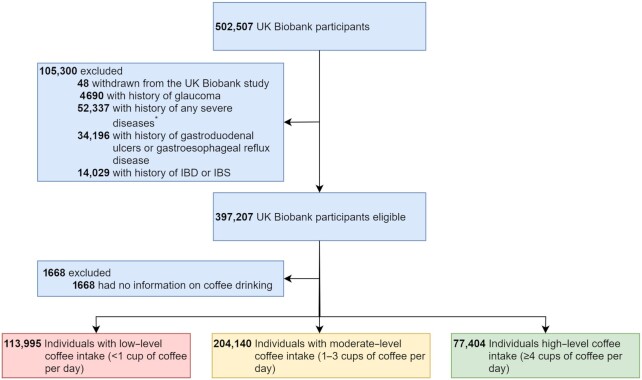
Methods: Based on the UK Biobank cohort, we included 395,539 individuals with available information on coffee intake collected at recruitment between 2006 and 2010. These individuals were categorized as having low (<1 cup per day), moderate (1-3 cups), and high (≥4 cups) levels of coffee intake, and were followed through 2020 to ascertain 496 medical conditions. Cox regression was used to assess the associations between high-level coffee intake and the risk of medical conditions with a prevalence ≥0.5% in the study population, after adjusting for multiple confounders, using low-level coffee intake as the reference. Disease-trajectory and comorbidity network analyses were then applied to visualize the temporal and nontemporal relationships between the medical conditions that had an inverse association with high-level coffee intake.
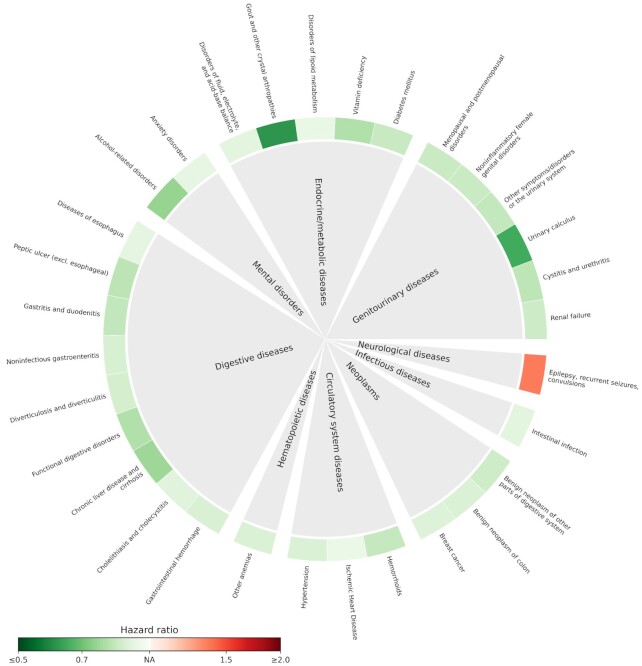
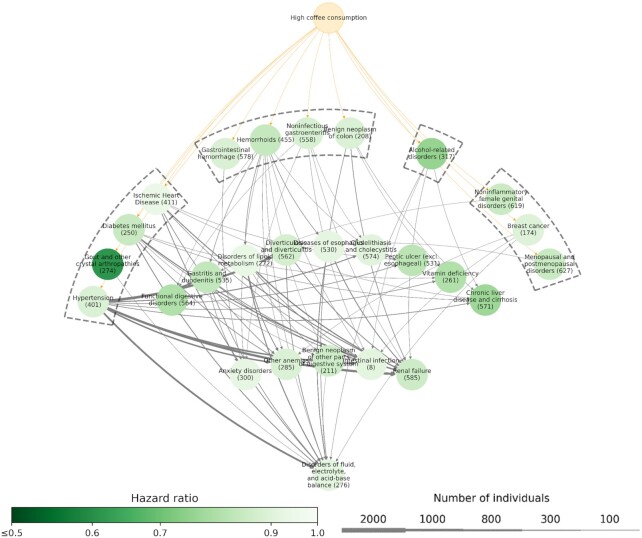
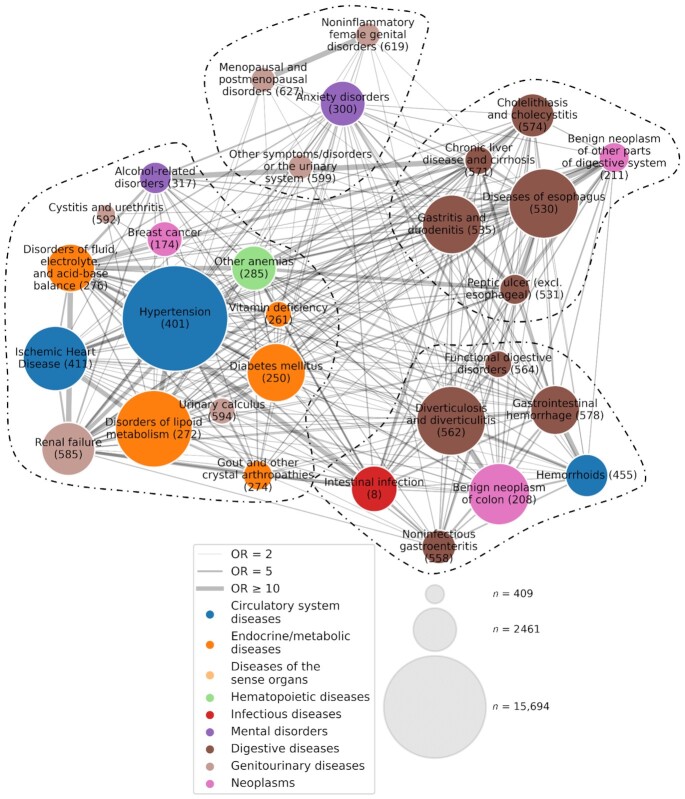
Results: During a median follow-up of 11.8 years, 31 medical conditions were found to be associated with high-level coffee intake, among which 30 showed an inverse association (HRs ranged from 0.61 to 0.94). The inverse associations were more pronounced for women, compared with men. Disease-trajectory and comorbidity network analyses of these 30 conditions identified 4 major clusters of medical conditions, mainly in the cardiometabolic and gastrointestinal systems, among both men and women; 1 cluster of medical conditions following alcohol-related disorders, primarily among men; as well as a cluster of estrogen-related conditions among women.
Conclusions: Habitual coffee consumption was associated with lower risks of many medical conditions, especially those in the cardiometabolic and gastrointestinal systems and those related to alcohol use and estrogen regulation.
Keywords: alcohol-related disorders; caffeine; cardiometabolic diseases; coffee; estrogen-related conditions; gastrointestinal diseases.
© The Author(s) 2022. Published by Oxford University Press on behalf of the American Society for Nutrition.
Figures
Comment in
-
Coffee consumption and disease networks.Am J Clin Nutr. 2022 Sep 2;116(3):625-626. doi: 10.1093/ajcn/nqac165. Am J Clin Nutr. 2022. PMID: 35849012 No abstract available.
References
-
- Heckman MA, Weil J, Gonzalez de Mejia E. Caffeine (1, 3, 7-trimethylxanthine) in foods: A comprehensive review on consumption, functionality, safety, and regulatory matters. J Food Sci. 2010;75(3):R77–87. - PubMed
-
- Kim Y, Je Y, Giovannucci E. Coffee consumption and all-cause and cause-specific mortality: A meta-analysis by potential modifiers. Eur J Epidemiol. 2019;34(8):731–52. - PubMed
-
- Carlstrom M, Larsson SC. Coffee consumption and reduced risk of developing type 2 diabetes: A systematic review with meta-analysis. Nutr Rev. 2018;76(6):395–417. - PubMed
-
- Liu QP, Wu YF, Cheng HY, Xia T, Ding H, Wang Het al. . Habitual coffee consumption and risk of cognitive decline/dementia: A systematic review and meta-analysis of prospective cohort studies. Nutrition. 2016;32(6):628–36. - PubMed
Publication types
MeSH terms
Substances
Grants and funding
LinkOut - more resources
Full Text Sources
