


Impact of post-hepatectomy liver failure on morbidity and short- and long-term survival after major hepatectomy
- PMID: 35849062
- PMCID: PMC9291378
- DOI: 10.1093/bjsopen/zrac097
Impact of post-hepatectomy liver failure on morbidity and short- and long-term survival after major hepatectomy
Abstract
Background: Post-hepatectomy liver failure (PHLF) is one of the most serious postoperative complications after hepatectomy. The aim of this study was to assess the impact of the International Study Group of Liver Surgery (ISGLS) definition of PHLF on morbidity and short- and long-term survival after major hepatectomy.
Methods: This was a retrospective review of all patients who underwent major hepatectomy (three or more liver segments) for various liver tumours between 2010 and 2018 at two Swedish tertiary centres for hepatopancreatobiliary surgery. Descriptive statistics, regression models, and survival analyses were used.
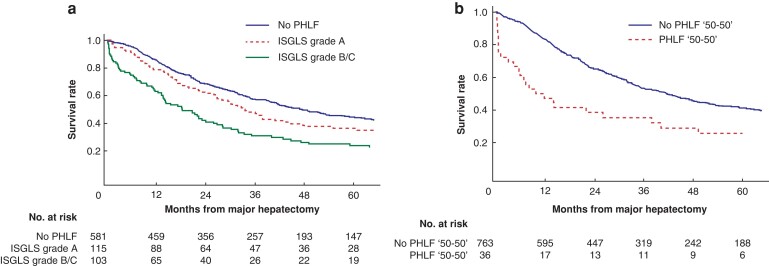
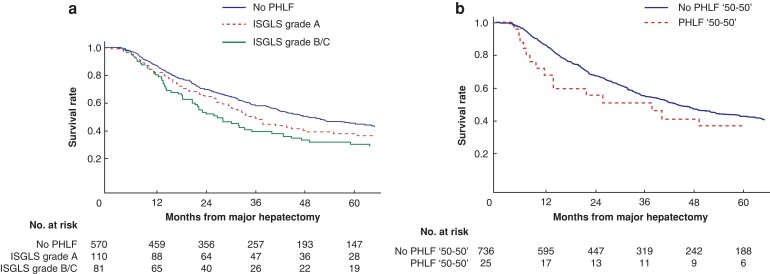
Results: A total of 799 patients underwent major hepatectomy, of which 218 patients (27 per cent) developed ISGLS-defined PHLF, including 115 patients (14 per cent) with ISGLS grade A, 76 patients (10 per cent) with grade B, and 27 patients (3 per cent) with grade C. The presence of cirrhosis, perihilar cholangiocarcinoma, and gallbladder cancer, right-sided hemihepatectomy and trisectionectomy all significantly increased the risk of clinically relevant PHLF (grades B and C). Clinically relevant PHLF increased the risk of 90-day mortality and was associated with impaired long-term survival. ISGLS grade A had more major postoperative complications compared with no PHLF but failed to be an independent predictor of both 90-day mortality and long-term survival. The impact of PHLF grade B/C on long-term survival was no longer present in patients surviving the first 90 days after surgery.
Conclusions: The presently used ISGLS definition for PHLF should be reconsidered regarding mortality as only PHLF grade B/C was associated with a negative impact on short-term survival; however, even ISGLS grade A had clinical implications.
© The Author(s) 2022. Published by Oxford University Press on behalf of BJS Society Ltd.
Figures
References
-
- Gilg S, Sandström P, Rizell M, Lindell G, Ardnor B, Strömberg C et al. The impact of post-hepatectomy liver failure on mortality: a population-based study. Scand J Gastroenterol 2018;53:1335–1339. - PubMed
-
- Truant S, El Amrani M, Skrzypczyk C, Boleslawski E, Sergent G, Hebbar M et al. Factors associated with fatal liver failure after extended hepatectomy. HPB (Oxford) 2017;19:682–687. - PubMed
-
- Mullen JT, Ribero D, Reddy SK, Donadon M, Zorzi D, Gautam S et al. Hepatic insufficiency and mortality in 1,059 noncirrhotic patients undergoing major hepatectomy. J Am Coll Surg 2007;204:854–862; discussion 862–864. - PubMed
-
- Rahbari NN, Garden OJ, Padbury R, Brooke-Smith M, Crawford M, Adam R et al. Posthepatectomy liver failure: a definition and grading by the International Study Group of Liver Surgery (ISGLS). Surgery 2011;149:713–724. - PubMed
