


Mortality among twin individuals exposed to loss of a co-twin
- PMID: 35849345
- PMCID: PMC10114119
- DOI: 10.1093/ije/dyac145
Mortality among twin individuals exposed to loss of a co-twin
Abstract
Background: Although the death of a child, sibling or spouse has been associated with elevated risk of mortality, less is known about the survival of twin siblings exposed to a co-twin loss.
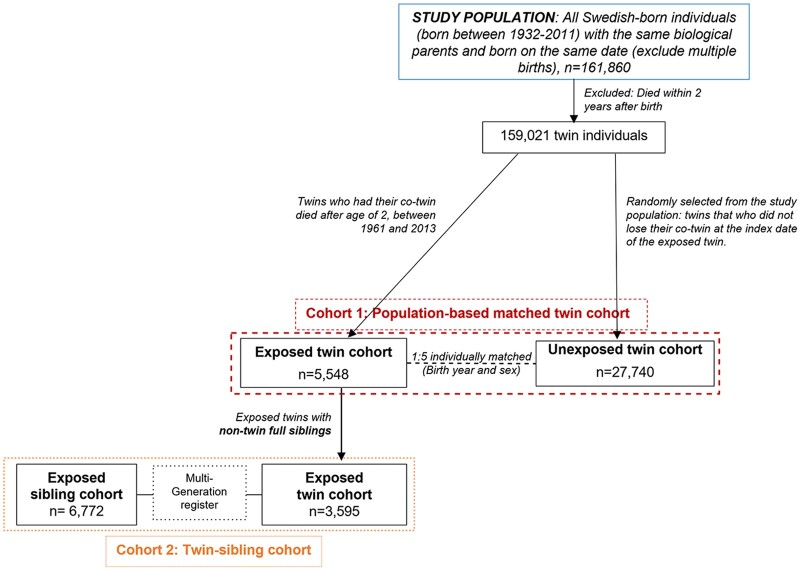
Methods: In a Swedish population-based sibling-matched cohort, we compared the mortality of 5548 twin individuals who lost their co-twin between 1932 and 2011 with that of 27 740 age-matched and sex-matched twin individuals without such a loss and 6772 full siblings of these exposed twin individuals. Cox regression models were used to estimate the hazard ratios (HRs) of all-cause and cause-specific mortality.
Results: We found increased risk of all-cause mortality among twin individuals exposed to a co-twin loss compared with matched unexposed twin individuals (HR = 1.30, 95% CI: 1.18-1.43) and their full siblings (HR = 1.10, 95% CI: 0.96-1.27) after adjusting for multiple covariates. The all-cause mortality risk was greater for loss of a co-twin due to unnatural deaths (HR = 1.54, 95% CI: 1.17-2.03) than natural deaths (HR = 1.26, 95% CI: 1.14-1.40). For cause-specific mortality, co-twin loss was associated with a higher risk of unnatural deaths both among twin individuals who lost their co-twin due to unnatural deaths (HR = 1.98, 95% CI: 1.27-3.10) and those whose loss was due to natural deaths (HR = 1.48, 95% CI: 1.07-2.06). The risk elevations were generally stronger for loss of a monozygotic co-twin than loss of a dizygotic co-twin.
Conclusion: Loss of a co-twin, especially a monozygotic co-twin, was associated with increased mortality, particularly of unnatural causes, among the surviving twin individuals. The excess mortality is likely attributable to both shared disease susceptibility within the twin pair and the adverse health sequelae of bereavement.
Keywords: Co-twin loss; Cox regression model; bereavement; mortality.
© The Author(s) 2022. Published by Oxford University Press on behalf of the International Epidemiological Association.
Conflict of interest statement
H.L. reports receiving grants from Shire Pharmaceuticals; personal fees from and serving as a speaker for Medice, Shire/Takeda Pharmaceuticals and Evolan Pharma AB; and sponsorship for a conference on attention-deficit/hyperactivity disorder from Shire/Takeda Pharmaceuticals and Evolan Pharma AB. Other authors declare no competing interests.
Comment in
-
Comment on 'Mortality among twin individuals exposed to loss of a co-twin'.Int J Epidemiol. 2023 Oct 5;52(5):1665-1666. doi: 10.1093/ije/dyad055. Int J Epidemiol. 2023. PMID: 37141454 Free PMC article. No abstract available.
References
-
- Clayton PJ. Mortality and morbidity in the first year of widowhood. Arch Gen Psychiatry 1974;30:747–50. - PubMed
-
- Brent DA, Perper JA, Moritz G. et al. Psychiatric impact of the loss of an adolescent sibling to suicide. J Affect Disord 1993;28:249–56. - PubMed
-
- Dyregrov A. Parental reactions to the loss of an infant child: a review. Scand J Psychol 1990;31:266–80. - PubMed
Publication types
MeSH terms
Grants and funding
LinkOut - more resources
Full Text Sources
Medical
